

#ClimateDictionary #EcoEducation
Every living thing on this planet needs energy to survive. No matter how big, or how small, organisms need energy to enable them to perform their metabolic activities. Carnivores and herbivores access stored energy through eating plants, however, where does the stored energy originate from? All this energy can be traced back to the source; the photosynthesis carried out by the plants.
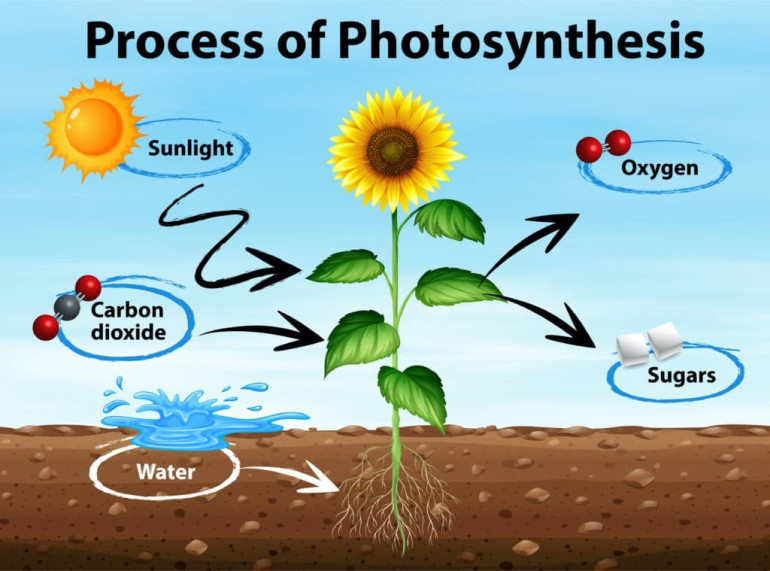
Photosynthesis is a biochemical process whereby light energy is converted into chemical energy. The process itself takes place inside the plant, or more specifically inside the leaves through specialized chloroplast cells.
For this multi-staged chemical reaction to take place, carbon dioxide, water, and light are all required. Light energy is captured and converted into chemical energy, which can then be stored as reduced carbon. It is called reduced carbon as carbon dioxide has been reduced to sugars. This has happened through the chemical reaction known as a reduction; whereby an atom or molecule in a plant species gains electrons and loses oxygen. The byproduct of photosynthesis is thereby oxygen and glucose (sugar).
Organisms capable of performing photosynthesis include plants, algae, and cyanobacteria. These organisms can be defined as ‘photoautotrophic’ as they are using light to manufacture their own energy and sugars. Other animals which rely on the sugars produced through photosynthesis to provide their food are classified as ‘heterotrophs’.
The stages of Photosynthesis
Phase 1: Light Dependent Reaction
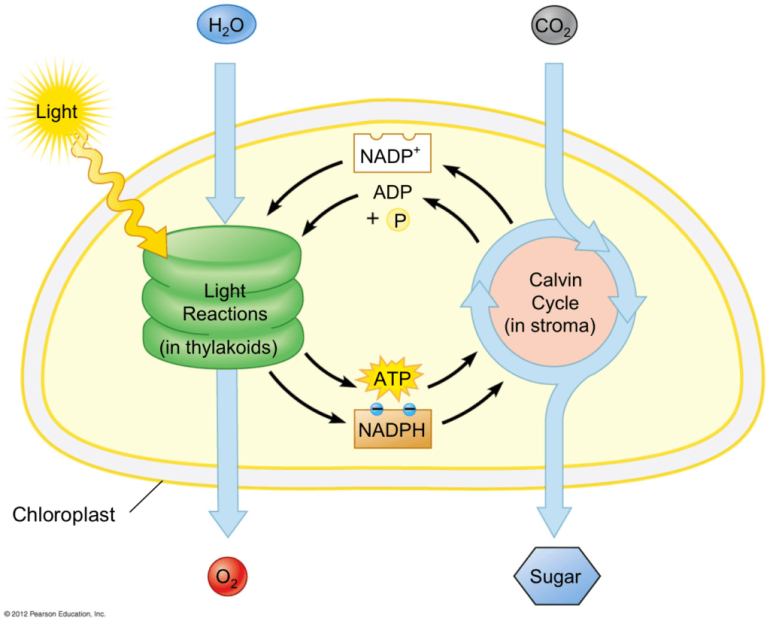
Photosynthesis involves a multitude of steps that occur during two stages. The first stage is known as the light-dependent stage, which as the name suggests, requires light. It occurs in the thylakoid membrane. The thylakoid is the structure found inside the chloroplast which contains chlorophyll (the pigment responsible for absorbing light energy). Light energy is absorbed by the chlorophyll in the grana (stacks of chlorophyll) which generates the coenzyme Nicotinamide adenine dinucleotide phosphate, or NADPH and ATP, which are the energy-carrying molecules. The chemical bonds that are made in this process are then used to fuel the second phase of photosynthesis.
In the light-dependent stage, it is worth mentioning that there are two photosystems responsible for the reactions explained above - photosystem II and photosystem I. These photosystems are not named in sequential order but in the order of when they were discovered by scientists, (which can make it a little more confusing). Photosystem II happens first and is when a water molecule is split to form oxygen gas and protons which are then used to form ATP in an electron transport chain. Then in Photosystem I, light is used to convert NADP+ into NADPH.
Phase 2: Light Independent Reaction
The second stage of photosynthesis, as the name suggests, does not require light, and takes place in the stroma of the chloroplasts. The light-independent reaction can also be referred to as The Calvin Cycle. This is where the ATP and NADPH produced in stage one and CO2 gas are used in conjunction to produce sugar. As a byproduct of ATP and NADPH, the ADP and NADP+ remaining can be reused again in the light-dependent reaction.
Why is it important?
Photosynthesis is a fundamental process for nearly all living plants and animals. Aside from it providing the energy that we need to survive, it is also essential in maintaining our planet; absorbing atmospheric CO2 and converting it into oxygen. Currently, we are in a climate emergency with CO2 emissions higher than they have ever been. Photosynthesis offers us a way to mitigate the effects of climate change, controlling the excess of atmospheric greenhouse gases.
What is the formula of Photosynthesis?
The equation that is commonly written to show the chemical reactions that have taken place in photosynthesis is as follows:
6CO2 + 6H2O → C6H12O6 + 6O2
(Carbon dioxide + water → glucose + oxygen)
What factors can influence the rate of Photosynthesis?
The factors which influence photosynthesis are those that make the process possible. This includes the intensity of light, the concentration of carbon dioxide in the atmosphere, the surrounding temperature, and the availability of water. These are known as the limiting factors, and all play a vital role in photosynthesis.
As the first stage of photosynthesis is a light-dependent reaction, the amount of light available and the rate of photosynthesis increases proportionately until eventually, another factor limits the rate. The optimum wavelength of visible light for photosynthesis stands at between 425-450nm.
An increase in carbon dioxide in the atmosphere generally increases the rate of photosynthesis proportionately - the higher the CO2 concentration in the atmosphere, the more can be incorporated into carbohydrates by plants. However, at a certain point another factor such as water, temperature will limit the rate of photosynthesis hence the term limiting factors.
Due to the dependency on enzymes for photosynthesis, temperature increases the rate of photosynthesis until it has surpassed optimum temperature, after that the rate starts to decrease until it is no longer permitted. This is due to the enzyme’s active site being altered leaving the enzyme denatured and unable to function.
Photosynthesis and its Role in Climate Change
Plants are able to sequester and store large amounts of carbon dioxide over a long period of time. With the world’s climate shifting at an unprecedented rate, it is important that global climate change is mitigated as soon as possible. This is because we need to prevent further tipping points that cause irreversible damage. One reason we are in this position is due to the large amounts of carbon dioxide being emitted into our atmosphere. Photosynthesis provides us with a natural way to ameliorate the carbon dioxide surplus.
Forests provide the world with large ‘carbon sinks’, meaning they absorb more carbon than they release. Research recently showed that between the years 2001 - 2019 the world’s forests sequestered around twice as much CO2 as they emitted, absorbing a net 7.6 billion tonnes of CO2 per year, 1.5 times as much as all US emissions per year. However, forests are only beneficial to us when they exist. When they are cleared or degraded to make room for agriculture or logging, for example, they release more CO2 into our atmosphere. This is because when they are cut down, burned or left to rot, they release their stored carbon into the atmosphere, performing the opposite process to photosynthesis; respiration. In fact, research has shown that as a consequence of deforestation and other disturbances, the world’s forests are emitting 8.1 billion metric tonnes of CO2 yearly and are accountable for 10% of all global warming emissions. We need more forests to help compensate for the carbon dioxide in the air, however not only does deforestation and disturbance prevent the much-needed photosynthesis, but it also releases stored carbon into the atmosphere further adding to the problem.
Forests are essential in stabilizing our atmosphere and so if we want to reduce greenhouse gasses and maintain a balanced environment, large-scale reforesting operations are necessary. They promote photosynthesis and are vital in removing excess carbon dioxide from the air and replenishing our oxygen.
Photosynthesis and its Role in Soil Regeneration
Soil regeneration is the process of promoting microbial life, nutrient availability, carbon levels in the soil, water retention and water movement through the soil. Through persistent farming methods, much of the world's available topsoil has become depleted of nutrients and is eroding. For crops to grow, farmers are relying on harmful nitrate and phosphorus-based synthetic fertilisers and pesticides, which are exhausting the soil further. These unsustainable farming methods have resulted in 40% of topsoil being degraded or eroded away, which further increases floods, eutrophication and droughts.
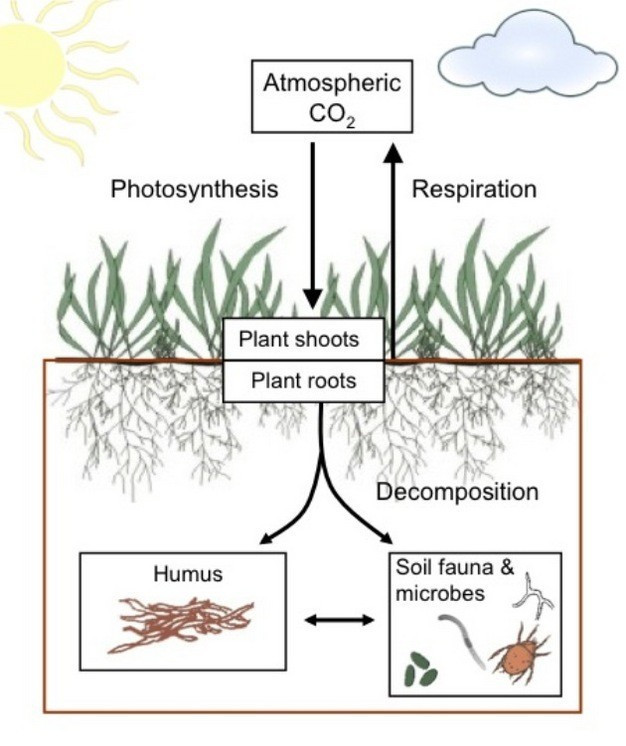
Soil loss is currently at 10-40 times the rate at which it can naturally replenish itself, and it is estimated that in the past century we have lost 150-500 billion tonnes of soil organic matter. If we are to begin soil restoration it needs to start immediately, implementing natural and sustainable practices. One key way to promote soil regeneration is through the establishment of plant communities. Their roots penetrate the soil which binds it together. This binding then promotes microbial action which adds to the soil structure and allows for better water retention and exchange of nutrients and chemicals. Then, when these plants die they help to reintroduce nutrients into the soil through their decomposition, and then photosynthesis helps by further sequestering carbon from the air into the soil. The re-establishment of plant communities is crucial to promote soil health, ensuring healthier ecosystems, promoting decomposition of microorganisms and increasing carbon sequestration.
Climate change, limiting factors and Photosynthesis
As we know photosynthesis is limited by light, temperature, water and carbon dioxide, all of which are impacted through climate change. Since the industrial revolution, the planet's temperature has risen, there is more carbon dioxide in our atmosphere and we are seeing more droughts globally. 2020 was the world's hottest year on record, with average global temperatures 1.2°C warmer than the average during 1951-1980. CO2 has been rising at a rate of 0.17% per year as a direct consequence of the extensive combustion of fossil fuels and large-scale deforestation operations, and since October 2020 more than 50% of the South has been experiencing some level of drought.
The rate of photosynthesis increases with both temperature and carbon dioxide, although both have their limitations. Due to the reliance on enzyme activity, when temperatures exceed the optimum photosynthesis rate for plants, the enzymes needed for these reactions are denatured, and they no longer function for photosynthesis. Additionally, plants will only photosynthesize with the availability of water, however, if droughts and soil degradation continue then the plants’ ability to photosynthesize will be prevented and they will be unable to remove carbon from the air. There may be enough carbon dioxide present for photosynthesis, however, the surrounding environment might inhibit it.
We are still in a position where we can curve the oncoming changes of climate change. Planting trees and promoting photosynthesis is a natural and sustainable way to help mitigate the effects, removing greenhouse gases from our atmosphere, and promoting soil health. These mitigations will allow for a greener future, we just need to implement them before it’s too late.
References
- BBC. “What is photosynthesis?” BBC Bitesize, https://www.bbc.co.uk/bitesize/topics/zvrrd2p/articles/zn4sv9q.
- Craggs, Geoffrey. “Photosynthesis and its Role in Climate Change and Soil Regeneration.” Future Directions, 9 August 2016, https://www.futuredirections.org.au/publication/photosynthesis-role-climate-change-soil-regeneration/.
- Harris, Nancy, and David Gibbs. “Forests Absorb Twice As Much Carbon As They Emit Each Year.” World Resources Institute, 21 January 2021, https://www.wri.org/insights/forests-absorb-twice-much-carbon-they-emit-each-year.
- Lambers, Hans. “photosynthesis.” Britannica, 2021. Britannica, https://www.britannica.com/science/photosynthesis.
- Lumen. “Overview of Photosynthesis.” Lumen, https://courses.lumenlearning.com/boundless-biology/chapter/overview-of-photosynthesis/.
- NASA. “2020 Tied for Warmest Year on Record, NASA Analysis Shows.” NASA, 14 January 2021, https://www.nasa.gov/press-release/2020-tied-for-warmest-year-on-record-nasa-analysis-shows.
- National Geographic. “Photosynthesis.” National Geographic, https://www.nationalgeographic.org/encyclopedia/photosynthesis/.
- RSB. “Photosynthesis.” RSB, https://www.rsb.org.uk/images/15_Photosynthesis.pdf.
- Scitable. “Photosynthetic Cells.” Scitable, https://www.nature.com/scitable/topicpage/photosynthetic-cells-14025371/.
- Sharkey, Thomas D. “Emerging research in plant photosynthesis.” Pub Med, vol. 4, no. 2, 2020, pp. 137-150. https://pubmed.ncbi.nlm.nih.gov/32573736/.
- Vidyasagar, Aparna. “What Is Photosynthesis?” LIVE SCIENCE, 15 October 2018, https://www.livescience.com/51720-photosynthesis.html.
- Warmflash, David. “Two Stages of Photosynthesis.” Sciencing, 26 April 2018, https://sciencing.com/two-stages-photosynthesis-5421327.html.
- Warmflash, David. “What Is the Role of Pigments in Photosynthesis?” Sciencing, 2017, https://sciencing.com/role-pigments-photosynthesis-5518705.html.
Kommentare (1)
Schreibe einen Kommentar