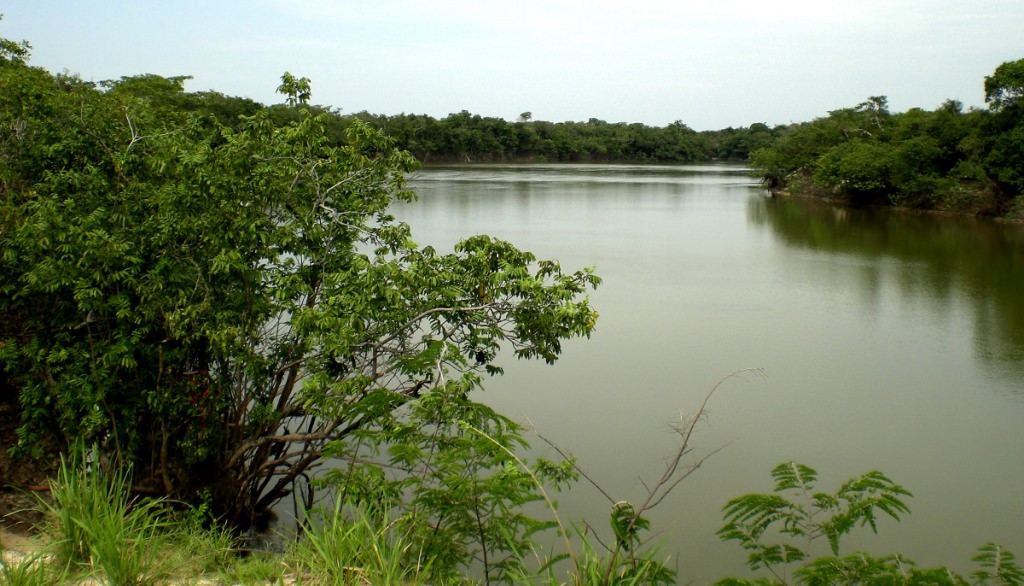

On Saturday, April 26, 2014, the following 10 people signed the agreement declaring the Rio Bita a protected river:
• Sergio Andrés Espinosa Flores, H.E. the governor of Vichada;
• Martha Plazas Roa, the executive director of Corporinoquia, the regional autonomous environmental authority;
• Brigitte Baptiste, the executive director of the renowned Alexander von Humboldt Institute;
• Héctor Alfonso Medina Torres, Rear Admiral in command of Colombia´s eastern naval forces;
• Carlos Arturo Lora Gómez, regional Orinoco territory director for Colombia´s national parks system;
• Fernando Trujillo, executive director of the Omacha Foundation;
• Alejandro Olaya Velasquez, executive director of the Palmarito Foundation;
• Steven Jensen, the executive director of the Orinoquia Foundation;
• A representative of the World Wildlife Fund in Colombia; and
• Dexter B. Dombro, the executive director of the La Pedregoza Environmental Corporation.

L-R: Martha Plazas Roa (Corporinoquia), Brigitte Baptiste (signing, Humboldt), Sergio Andrés Espinosa Flores (Governor), Héctor Alfonso Medina Torres (Navy), Fernando Trujillo (Omacha), Dexter Dombro (La Pedregoza), WWF Representative.

Dexter Dombro signing the Protected River Agreement for the Rio Bita on Saturday, April 26, 2014. In Puerto Carreño, Vichada, Colombia.
The concept of a protected river is not to stop all human activity, but rather to insure that all activities are sustainable and are done with conservation and the protection of biodiversity in mind. This includes efforts to stop illegal hunting and wildlife poaching, to stop illegal commercial fishery, and to stop unsustainable traditional practices, like the collection of giant river turtle eggs, by providing enforcement of the law coupled with #education and alternative solutions to local populations. At the same time, efforts will be made to change the practices of existing forestry and ranching operations, so that they become more sustainable and environmentally friendly. The Rio Bita is approximately 500 km in length, so this is a huge undertaking, but already the various agencies have committed over $2,000 million Colombian Pesos (well over $1 million USD) to the task, together with the navy providing regular river patrols.
Our Amazonia Reforestation project at La Pedregoza, adjacent to the natural reserve area, will play an important leadership role in this process. La Pedregoza is at present the only fully organic tree plantation in the Rio Bita basin, and one of the model partners for sustainable forestry in the region. This is an important partnership, which includes the World Wildlife Fund’s (WWF) Global Forest & Trade Network, The Nature Conservancy (TNC), the Global Environment Facility (GEF), the United Nations Development Program (PNUD), Colombia´s national parks system (PNN), the association of natural reserves (RESNATUR) and the Natura Foundation. The La Pedregoza Environmental Corporation is developing natural silviculture practices that will have global applicability, and has established additional partnerships with Tree-Nation, the International Analog Forestry Network (IAFN) and the International Biochar Initiative (IBI).

Oscar Forero Azabache (middle) of La Pedregoza explaining our Rio Bita turtle rescue program to the Governor of Vichada (right) on April 27, 2014. We are now in our third year of giant Podocnemis river turtle rescue efforts.

Gabriela Huidobro Jauregui (turquoise shirt), La Pedregoza’s forestry engineer, explaining our sustainable forestry practices to members of the Humboldt Institute and the Orinoquia Foundation on April 27, 2014.
The first step the protected river group will take is to do an extensive scientific literature review and to then plug in all the gaps with Rio Bita area studies, so that we have a solid scientific understanding of all aspects of this amazing river system, especially the biodiversity that depends on it and on the surrounding forests and savannahs. The La Pedregoza Environmental Corporation already has a multi-year history of supporting scientific studies in the region, and anticipates that the Reserva Natural La Pedregoza will provide a baseline for many of the scientific investigations being planned for the Rio Bita system. All of the partner organizations are equally experienced, so excellent results can be anticipated.

Scientists of the TNC’s sustainable land use project (SuLU) with members of the La Pedregoza team examining biodiverse savannahs in Vichada.

Ichthyologists cataloging fish species in the inundation Forest inside the Reserva Natural La Pedregoza.
The Rio Bita has no cities, towns or villages along its course, nor are there at present any factories, mines or petroleum installations. This makes the Rio Bita one of the last pure rivers on the planet, one that is home to amazing biodiversity, including aquatic mammals like pink dolphins, manatees and giant river otters. The river and its tributaries are home to an astonishing variety of fish, including many decorative fish normally only seen in aquariums. Monkeys, tapirs, capybaras, deer and many other mammals grace the inundation and gallery forests along the river, while macaws, parrots, falcons and hawks, to name only a few types of birds, control the skies above the river. A plethora of reptiles, like anacondas and turtles, various amphibians and multitudes of interesting insects from praying mantises to stick insects make the region a biologist’s dream. In the Reserva Natural La Pedregoza we have some 370 species of trees and plants and we are still counting. The savannahs bordering the gallery forests are equally biodiverse in plants, animals, birds and insects.
Protecting the Rio Bita for future generations and conserving its biodiversity is a task in which everyone can participate. It is an important part of the planet we all share. The La Pedregoza Environmental Corporation needs your support as it undertakes this huge task together with our partner organizations. Any help you can provide is much appreciated. Become part of the team to lay the foundations for a new and exciting model of conservation – a protected river system from its spring to its confluence with the mighty Orinoco!
Dexter B. Dombro, B.A., LL.B.
Conservationist and Tree Planter
Comentarios (1)
Deja un comentario