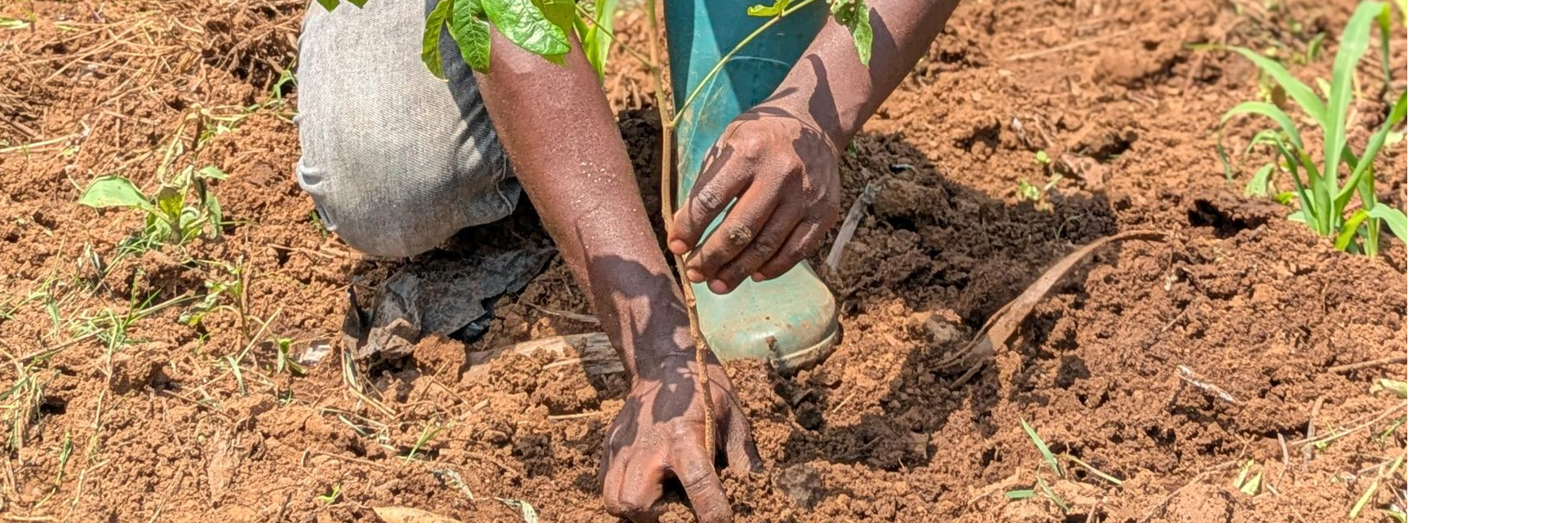

In reforestation projects, planting trees is often seen as the main milestone. However, planting is only the beginning. The first year after planting is one of the most critical stages in determining whether a restoration effort will succeed or fail in the long term.
Why the first year is critical
Once seedlings are planted, they enter a sensitive growth stage. Their root systems are still developing and cannot yet reach deep soil moisture or fully withstand environmental stress. During this period, survival depends heavily on external conditions. Rainfall patterns play a key role, especially in areas with long dry spells. Soil quality also influences how quickly roots establish and how well nutrients are absorbed. Temperature changes and drought conditions can further stress young trees. External pressures also affect survival. In many restoration sites, grazing animals such as goats and cattle can damage or destroy seedlings. Without proper protection, these young trees may not survive their early stage of growth. Because of these combined factors, it is normal for some seedlings not to survive the first year. This is a natural part of ecological restoration, not necessarily a project failure.
The importance of post-planting management
What happens after planting is just as important as planting itself. Post-planting management ensures that seedlings have the best chance of survival and growth. This includes regular monitoring of planted sites to assess survival rates and track tree development. Field teams identify gaps where seedlings have died and carry out replanting (infilling) where needed. Site protection is also reviewed during this stage. Depending on field conditions, measures may be improved to reduce grazing pressure or environmental damage. These actions help strengthen early establishment and improve survival rates. Without consistent monitoring and maintenance, survival rates can drop significantly, reducing the overall impact of restoration efforts.
Learning from the first year
The first year also provides important lessons for future planting. Different sites respond differently depending on soil type, rainfall, and species selection. Some tree species perform better in certain environments, while others require more care in the early stages. Observing these patterns helps improve future species selection and planting strategies. Monitoring data collected during this period also helps refine site preparation and maintenance practices. Over time, this improves the effectiveness of restoration projects.
Building long-term success
Reforestation is a long-term process. Its success cannot be measured immediately after planting but over several years of growth. The first year lays the foundation for this journey. It is a period of adjustment, learning, and observation. Trees that survive this stage are more likely to develop into healthy forest systems that provide long-term environmental and community benefits.
Conclusion
The first-year matters most because it determines the direction of the entire restoration process. It is the stage where nature and human effort interact most closely. Long-term success in reforestation depends not only on how many trees are planted, but on how well they are supported after planting.
Comentarios (1)
Deja un comentario