
Summary of the study for the improvement of Tetraclinis articulata seeds
Daniel Calatayud. Association Semillistas. 10th of May 2022
The seeds came from the 2021 harvest, carried out by ARBA Cartagena. After collection they were cleaned by rubbing, sifting and winding. After the cleaning operations, they were stored in plastic bags in a chamber at 4ºC. Given the lack of academic information on the germination of this species, standard germination (without priming) was studied first. With this data, several treatment proposals were evaluated in order to obtain an optimum in terms of speed and timing of germination, given that the biggest bottleneck for germination in the field is the rapid drying of the soil after a rain. This acceleration of germination opens the doors to broadcast sowing of primed and pelletized seeds. We use this seed biotechnology with the aim of making direct seeding possible, with simple methods that any small organization can replicate. Thus, the impact of each organization dedicated to reforestation could be multiplied.
NOTES:
- The term germination refers to the emission of a radicle with a length between 1 and 2 mm. - The % loss in cotyledon germination has not been studied.
- In each germination test around 30 seeds were used, and no replicas of the tests were carried out.
- The germination tests were carried out on a sand and coconut fiber substrate inside PEbd bags.
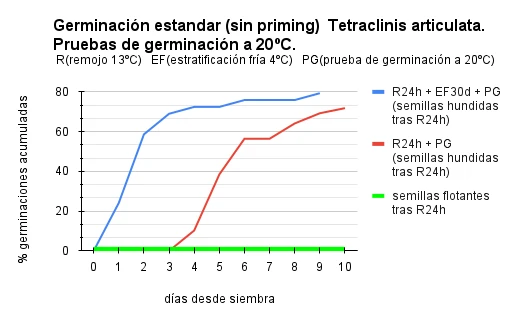
GRAPH: Standard germination (without priming) Tetraclinis articulata
Germination tests at 20C
R(soaked 13C) EF (Stratification in cold 4C) PG (Test for germination at 20C)
% accumulated germinations / days since sowing
OBSERVATIONS
Around 35% of the seeds in the batch floated after 24 hours of soaking. None of these floating seeds managed to germinate. It is possible that a more detailed study can remove seeds that don’t work by adjusting the soaking time needed to remove floating seeds.
Cold stratification could be useful for planting in alveoli (nurseries), to reduce the time of care in maintaining the humidity.
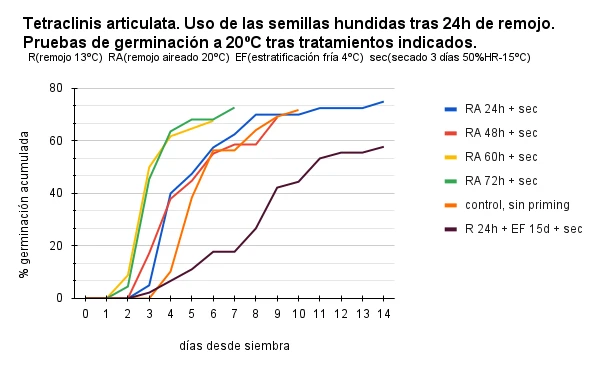
Tetraclinis articulata. Use of sunken seeds after soaking 24h.
Germination tests at 20C after indicated treatments.
R(soaked 13C) RA (aerated soaking 20C) EF (stratification in cold 4C) sec (dried 3 days 50%HR-15C)
OBSERVATIONS:
The aerated soaking treatment consists of a single soaking to which we added an air stone connected to a small fish tank air pump.
To date, we still have to evaluate the germination of two treatments based on cold stratification.
RA treatments between 60 and 72 hours improve the speed of germination.
It takes approximately 6 to 3 days to reach 60% germination accumulated. From other tests with other species we know that at temperatures inferior (not optimal, typical of autumn) the improvement in the speed of germination is even bigger.
The time to reach 50% of the viable germinations in the optimal treatments is approx. 2.5 days at 20ºC. Since it is a relatively short window of time, it is possible to propose an action for broadcast sowing (not buried), designing pelletization for this purpose.
In our methodology, we carry out the sowings as soon as possible (autumn), so that the root system develops as possible in order to face its first summer.
With aerated soaking treatments it is possible to overcome the difficulty of control of germination in the field. To promote establishment after the first summer, it is possible to improve this treatment with the introduction of microorganisms in the water/air solution of the treatment (biopriming) and in the structure of the pelletized seed (to improve the microbiota of the planting microsite).


