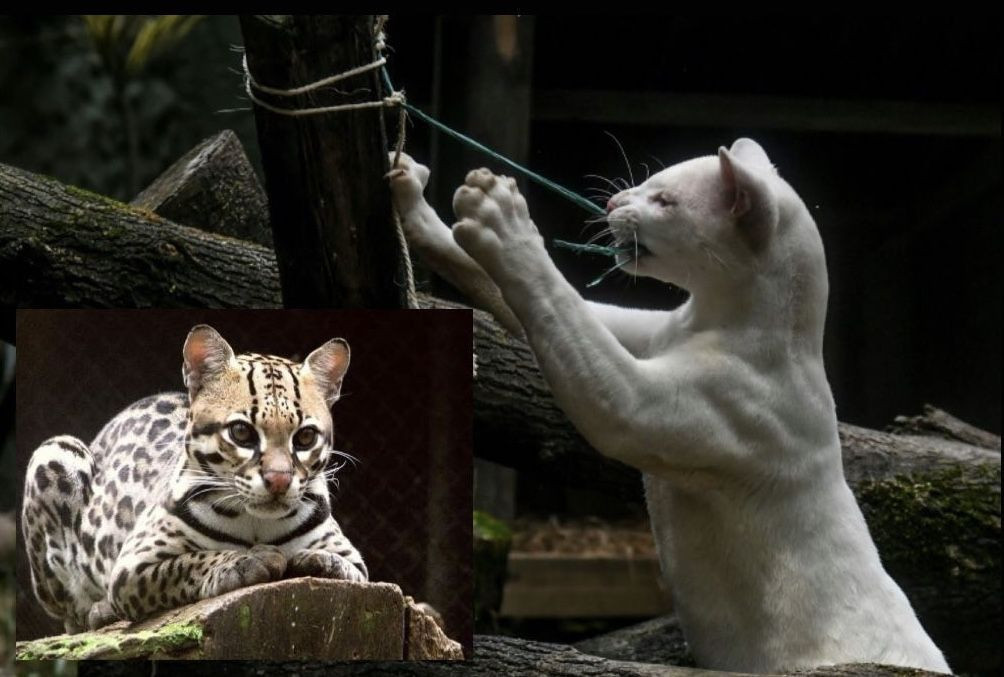

We would like to share some big news with the Tree-Nation community some big news that has brought many mixed feelings inside the scientific community and is a clear example as to why we must protect our native forests.
This news did not happen in our project, but it is about a species that lives inside our project and is categorized as vulnerable in our country.
The Ocelote (Leopardus pardalis) is a feline that lives in different countries and found mainly in jungle environments like ours. It so happens that in November of the year 2021, in Cañon del Mata, Colombia ; a local family found the first example of an albino ocelote. Right now, this individual is under conservation and special care in Parque de la Conservación; Medellín,Colombia.
But what does this mean? Why is this so important?
Though the findings of this unique individual is very intriguing when it comes to the genetic sciences, attracting much interest in deepening its investigation and conservation, WE SHOULD NOT BE HAPPY THAT THIS INDIVIDUAL EXISTS. (Said by many scientists including those who work inside the reserve)
This is because it is a big genetic problem and indicator of an even bigger ecological problem. Their existence is evidence that there are important levels of consanguinity within the local populations of this species. This is because every day there are less individuals in the area due to deforestation and the fragmentation of their territory.
In friendlier words, since this species home is being fragmented and deforested, the Ocelote ends up pairing with its closer family members, lowering their genetic diversity and bringing situations like this.
But you may be wondering, what is the problem that brings this species?
- The Ocelotes original patterns help it camouflage, avoiding predators and benefiting in hunting its prey. By having a white coating, it is impossible to camouflage in the many colors of the jungle.
- The albino species are very sensitive to light, this individual is nearly blind and must be cared for under a specific light in the reserve.
- Loss of its genetic diversity, bringing different problems.
These characteristics (between others) play against its survival skills for the species in the wild. Many investigators in the reserve believe this Ocelote was abandoned by its mother due to its conditions. It is common in nature for animals to abandon their offspring when they show little chances of survival, mainly when they have much offspring at once. Avoiding being a danger to their other siblings, whether its because of an illness or being unfit to survive in the wild.
The biodiversity program understands that this news isn't the happiest of them all, but finds it important to visualize the problems that deforestation and fragmentation brings to our native species.
We leave you these two links you can access to read more about the Albino Ocelote that has the scientific community on its feet:
In the comments, tell us what you think of this article! We would love to hear from you and your thoughts.
Comentarios (0)
Deja un comentario