

#CarbonCatchers series
Climate change is an issue many companies can no longer avoid addressing. As governments are adopting policies and implementing targets for reductions in emissions, some countries are implementing mandatory reports on emissions from companies, for example the UK (Department for the Environment, Food and Rural Affairs, 2019). As a result, many companies are becoming more environmentally conscious these days. And with that, many are seeking to offset the carbon costs of running their businesses. Therefore, it might be useful to know the typical carbon cost per annum of a single employee. This of course will greatly depend on the type of work a business engages in and will vary from employee to employee. For example, an employee that is office based and does not go on many business trips will emit much less CO2 than an employee who travels weekly for work. Furthermore, businesses which have a production element will emit a significantly higher amount of CO2 than those without.
When assessing the greenhouse gas emissions of your company, it is important to consider both direct and indirect sources of emissions (see figure 1 below). Direct GHG emissions are ones which arise from sources controlled and/or owned by the company such as the boiler in an office building, emissions from electricity usage in the office building and emissions from production if a company is responsible for its own production. Indirect emissions include those such as emissions generated in the production of purchased goods, the transportation of goods to the company, commuting by employees and emissions from waste disposal (World Resources Institute, 2015).
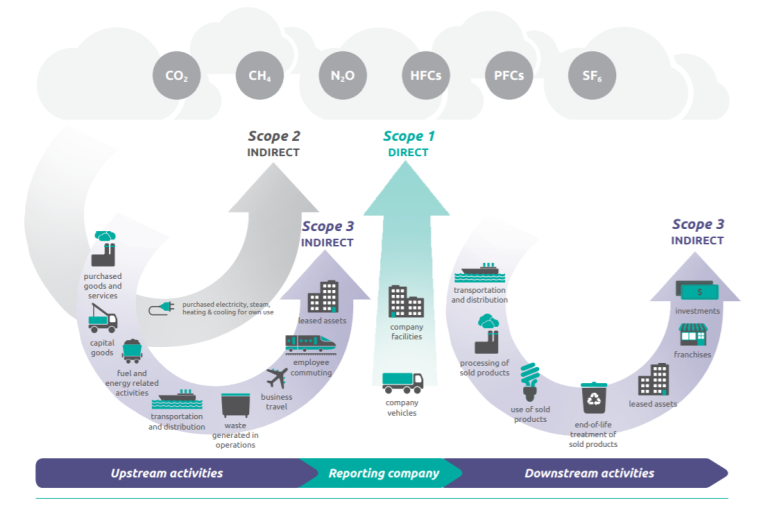
Figure 1. Contributing activities of a company to overall greenhouse gas emissions. Source: World Resources Institute and World Business Council for Sustainable Development, 2011.
1. Office based
Annual emissions of an office-based employee are 3 tonnes #CO2eq as calculated by the French company Sinteo/ARSEG, but assumed to be 3.6 tonnes CO2eq in Europe. This study takes into account energy, water consumption, short business trips as well as fixed assets. It estimates 0.1 tonnes CO2eq per employee go on water and paper, 1.1 tonnes CO2eq per employee is used on energy and 1.8 tonnes CO2eq per employee goes on business trips (Lauer-Stemm et al., 2012). Old equipment can also significantly add to a company’s greenhouse gas emissions. For example, the American EPA calculated that 6.8 million tonnes of CO2eq would be avoided if every office product was Energy Star certified, meaning it is certified as having a minimal impact on the environment. This is roughly equal to taking 158,000 cars off the road (Centre for climate and energy solutions, 2020). There are many small ways to improve the environmental performance of an office-based employee.
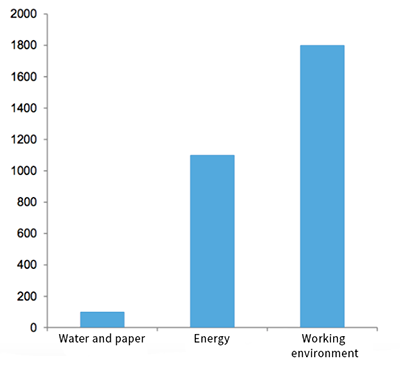
Figure 2: Emissions associated with usage as calculated by Sinteo/ARSEG (Lauer-Stemm et al., 2012).
2. Business Travel
Business travel contributes the most to carbon emissions in a company. In 2016, there were an estimated 457 million one-person business trips made by American employees (U.S. Travel Association, 2020). If you are looking to quickly reduce emissions, the easiest way is to reduce the amount of business trips undertaken each year. This is now easier than ever with the advent of technologies which can allow you to conduct business meetings with clients all across the world from your office building. While some face to face meetings are unavoidable, there is much less of a need to have these on a regular basis when instead you can skype business associates.
What is the carbon cost of short-haul business trips? The emissions of a 2.5 hour short-haul flight is roughly 0.8 tonnes #CO2eq (Kommenda, 2019). The number of stopovers will also affect the CO2 emitted. It is during take-off that the majority of CO2 for a flight is emitted so increasing the number of take-offs by having a stopover will greatly increase the carbon cost of the trip. Where possible, business trips should avoid stopovers as a way to reduce the environmental impact of these trips. Alternative transport is also a way to reduce business trip emissions. The carbon emissions of taking a train journey the same distance are a tenth of that at 0.08 tonnes CO2eq*.
3. Production
The production aspect of a company is also a significant contributor to overall greenhouse gas emissions. Depending on what your company produces, different gases are emitted and in varying quantities. For example, if a company produces lime, their main source of emissions will come from CO2 produced during the calcination process. Alternatively, a company that produces paper will have both CO2, CH4 and N2O emissions associated with the production arising from combustion of fossil fuels and bio-fuels as well as the waste products generated in the manufacturing of stationary equipment (World Resources Institute, 2015). Whatever line of production you are in, there are many different tools on the Greenhouse Gas Protocol Website which allow you to calculate the greenhouse gas emissions of production specific to your sector.
If you are concerned about your company’s environmental impact and are looking to offset your emissions, you can do so on our corporate offset page. If you are unaware of your company's environmental impact, there are many guides online on how to calculate this figure. For example, the “The Greenhouse Gas Protocol: A corporate accounting and reporting standard” gives detailed guidelines not only on how to calculate corporate emissions, but how to set company standards and goals to reduce these emissions (World Resources Institute, 2015).
Keywords
#emissions #co2 #employee #team #company education #EcoEducation
*For calculation purposes, the short haul flight journey used was Paris to Budapest. The CO2eq emissions were calculated using an online calculator < https://calculator.carbonfootprint.com/calculator....>. The same journey by train was then used as a comparison. The CO2eq emissions for this journey were found at < https://www.costtotravel.com/train/from-paris-to-b...>
References:
Centre for Climate and Energy Solutions, 2020. Reducing your carbon footprint at work. Accessed February 2020 < https://www.c2es.org/content/reducing-your-carbon-...>
Department for the Environment, Food and Rural Affairs, 2019. Environmental Reporting Guidelines: Including streamlined energy and carbon reporting guidance. March 2019 (updated Introduction and Chapters 1 and 2). Accessed February 2020 <https://assets.publishing.service.gov.uk/governmen...>
Kommenda, N., 2019. How your flight emits as much CO2 as many people do in a year. The Guardian, Accessed February 2020 < https://www.theguardian.com/environment/ng-interac...>
Lauer-Stemm, J., Rossi, M., Berthelier, N., 2012. Carbone 2012: Étude sur l’impact carbone des espaces tertiaires. Sinteo/ARSEG, Accessed February 2020 <https://immobilierdurable.files.wordpress.com/2012...>
U.S. Travel Association, 2020. U.S. Travel Answer Sheet. Accessed February 2020 < https://www.ustravel.org/answersheet>
World Resources Institute and World Business Council for Sustainable Development, 2011. Corporate Value Chain (Scope 3) Accounting and Reporting Standards. Greenhouse Gas Protocol.
World Resources Institute and World Business Council for Sustainable Development, 2015. The Greenhouse Gas Protocol: A corporate accounting and reporting standard. Accessed February 2020 < https://ghgprotocol.org/sites/default/files/standa...>
Commentaires (3)
Laissez un commentaire