
#EcoEducation #ClimateDictionary
Floods, heatwaves, cold snaps, earthquakes, hurricanes, droughts, thunderstorms, wildfires… All of these are natural disasters that affect not only humans but also all the living beings in the places where they happen. And the bad news is that the frequency of these catastrophes has been on the rise since the 21st century started.
You may be thinking that you are safe where you are living, that these events only occur abroad or in remote locations, but the truth is that despite natural disasters striking more often in some specific areas they can arise worldwide.
As an example, a tsunami hit the coast of several countries in Southeast Asia in 2004 and killed around 300,000 people. The year before, in August 2003, an extreme heatwave shook different European countries killing 35,000 people in just a couple of weeks. Hurricane Katrina swept the South Atlantic coast of the United States in 2005 taking away the lives of almost 2,000 people and causing an economic loss of more than 150 billion dollars. Not to mention the chronic droughts that many southern African countries are suffering from 2018 and are still ongoing, or the major bushfires that constantly raze Australia and have obliterated thousands of acres of bushland and forest and killed billions of animals.
These examples underpin that natural disasters might be ubiquitous whereby prevention, detection, and proper management for these scenarios must be of the highest importance. Besides, the personal and economic losses caused by these catastrophes are countless because they not only kill people and destroy the habitats where they occur but also prompt millions of displaced persons and the complete loss of entire ecosystems for years.
But what can we do as citizens? What are governments doing to protect us from these extremely dangerous and sometimes unpredictable events?
Climate Adaptation:
One of the reasons behind the increase in the number of natural disasters during the past years may be climate change. And most scientists agree that climate change is the direct consequence of global warming due to human activities such as the uncontrolled use of fossil fuels and the overexploitation of natural resources.

Figure 1. Global average near-surface temperatures rise from 1850 to 2020
Therefore, there are two main strategies to tackle this issue:
1.The first strategy aims to diminish the impact of human activities on the environment. It is called climate mitigation.
2.The second strategy aims to prevent or reduce the harm caused by climate change. It is called climate adaptation.
Climate adaptation is described as “the process of adjusting to current or expected climate change and its effects”. The capacity of adaptation to different climate scenarios varies among different species and ecosystems. For example, most mammals, including humans, could not live for long periods above 35ºC, a situation in which the dissipation of the metabolic heat becomes nearly impossible, leading to hyperthermia and death.
Similarly, different countries are able to adapt to climate change in varying degrees. Developing countries usually struggle more than wealthier countries because the economy, technological development, infrastructure, and workforce play a key role in mitigating the detrimental effects of climate change.
Examples of what some countries are already doing:
During the last years, the sea-level rise has threatened many coastal regions around the world. The associated risks are loss of land, life, and livelihood due to inundations and coastal erosion. The United Kingdom already constructed a barrier in 1982 to hold the water of the River Thames back from the city of London. In many islands of Indonesia, mangroves have been restored to improve aquaculture productivity, reduce groundwater extraction and prevent coastal erosion. And the Netherlands has implemented the key concept “Room for the River” to give water more space when floods occur. In this scenario, a dike is moved inwards allowing the river to widen and the increased water flow to be released, reducing economic damage and loss of life.
Higher temperatures lead to heat stress and increased risk of wildfires. Inland big cities are at particular risk because of the extra heat radiated off the roads and the buildings. A possible solution could be to expand green spaces in and around the cities. For example, the Sanjay Gandhi National park in Mumbai (India) includes a vast area of forest that covers more than 10,000 hectares and helps clean the polluted air within the city. Forest management is also critical to prevent wildfires, especially in water-stressed regions with large green areas, such as Australia and Spain.
Droughts are also critical and may affect crop productivity resulting in famine. Protecting and restoring forests, making better use of soil, and re-using evaporated water are successful strategies to prevent water loss. The African Sahel is a region encompassing several countries in mid-Africa that has suffered some of the worst droughts in history during the last years. Serious droughts have also happened in China, India, and Ethiopia, countries with large populations in which limited food supply can be catastrophic. Communities may adapt by switching from irrigated to rainfed crops and using more resistant plant species for food and feed. Governments must support the local population by storing rainwater during the rainy season and launching policies that restrict the use of water for non-vital activities. Overall, sustainable water management is essential for the whole year to overcome droughts when they arise.

Differences between Climate Adaptation and Climate Mitigation:
The United Nations held the “Convention on Climate Change” in Rio de Janeiro in June 1992. The treaty, initially signed by 154 countries, encouraged the governments to promote scientific research, implement policy agreements and accomplish actions to ensure food production, economic development, and environmental protection in a sustainable manner. This treaty was ratified by the Kyoto Protocol in 1997, in which the signing countries committed to reducing greenhouse emissions. The last of these meetings held in Paris in 2015 supported climate adaptation, climate mitigation, and funding to battle climate change.
Whereas climate adaptation seeks to adapt to climate change and its consequences, climate mitigation seeks to reduce greenhouse emissions to tackle climate change directly. Actions to be taken include storing energy more efficiently, using low-carbon technologies (ex. renewable sources), and restoring carbon sinks by fostering reforestation and preventing deforestation.
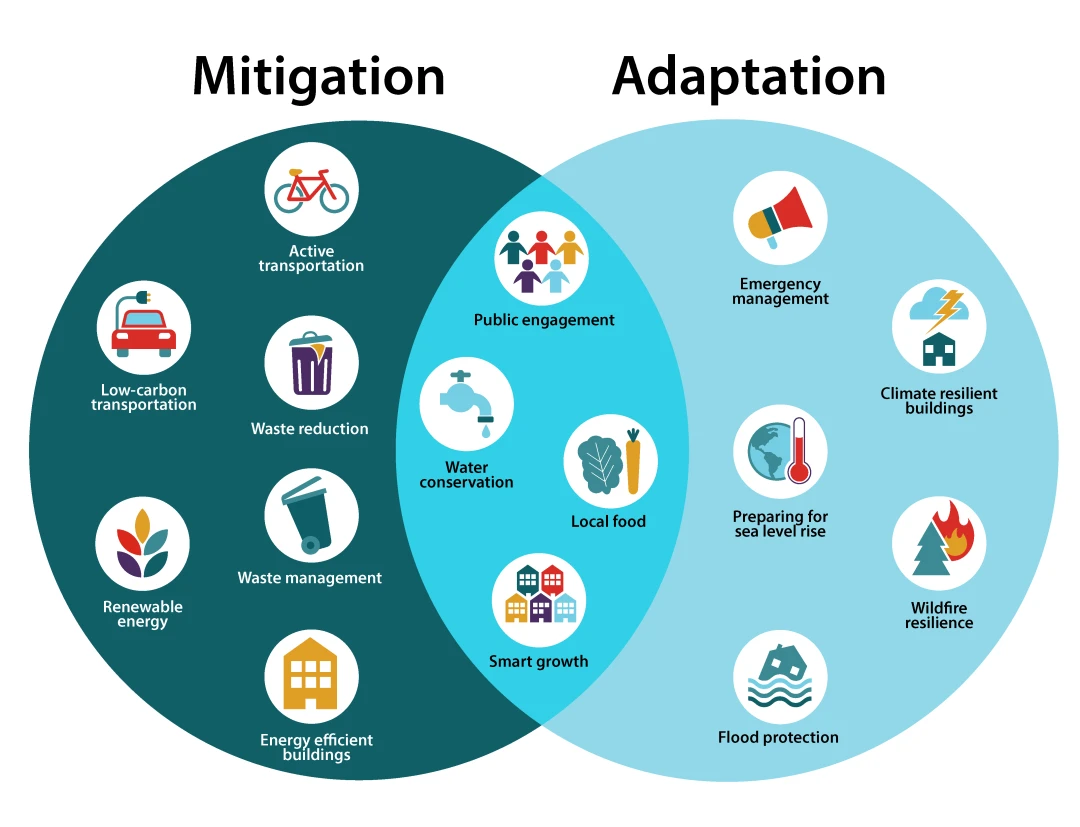
Figure 3. Differences between climate mitigation and climate adaptation. Image retrieved from District of Squamish website (British Columbia, Canada) (https://squamish.ca/climateaction/climate-adaptation/)
How the world prepares to adapt to a more difficult climate and how this generates even more emissions eventually:
Even though the Paris Agreement, signed in 2015 by 193 countries, pursues to keep the rise in mean global temperature below 2ºC, the actions to be taken are still vague. Besides, the rise of the temperatures brings associated adaptation activities that require huge investments, both economic and in resources, and eventually are stop-gap responses to the real problem.
For example, there exists the Africa Disaster Risks Financing (ADRiFi) program, which gives African countries access to payout and market-based solutions in case of a natural disaster. In the Philippines, the government is constructing stronger buildings to avoid uncontrolled flooding of informal settlements, and Canada is committing several billion dollars for green infrastructure to boost resilience against climate change. There are also weather forecast resources that help reduce the impact of extreme events before they hit. All these concepts are good, but the results are short-term solutions that patch the problem rather than tackle it directly.Let's act! Not just adapt:
The solution is neither just waiting for others to do something nor simply adapting to climate change and its consequences. The most straightforward solution is acting directly on the causes underlying climate change such as greenhouse emissions, deforestation, and environmental pollution. Here you can read several daily tips you can follow to help the planet by mitigating climate change:
- Reduce your consumption, reuse things that are still functional and recycle your waste when possible.
- Buy local and ecological food that uses environmentally-friendly fertilizers and requires less transport from the crop to your house.
- Go to study or to work on foot or bike, and if you cannot use the public transport or share the car.
- Be aware of water consumption and try to cut down overuse while washing dishes, brushing teeth, or having a shower.
- Use your cloth bag when shopping and avoid purchasing plastic bags or vegetables wrapped up in plastic.
- Be a sustainable tourist when traveling considering all the aforementioned tips.
- Plant trees to tackle deforestation and greenhouse emissions.
We may not see quick global changes by adapting to a more environmentally friendly lifestyle but each of us has the power to bring on a positive impact that helps fight back climate change. We just have one planet to live on and it is all our responsibility to preserve it for ourselves and for future generations.
Bibliography:
Armstrong AK, Krasny ME, and Schuldt J. 2018. Communicating Climate Change: A Guide for Educators. Cornell University.
Currie-Alder B et al. 2021. Research for Climate Adaptation. Communications Earth & Environment.
European Environment Agency. Climate Adaptation. Accessed February, 2022.
Global Center on Adaptation. 2019. 12 great examples of how countries are adapting to climate change. Accessed February, 2022.
González-Cebrían P. 2018. Los mayores desastres del siglo XXI. Iagua Accessed, February 2022.
IPCC. 2014. The Intergovernmental Panel on Climate Change. Accessed, February 2022.
Khavarian A. and Sharifi A. 2022. Urban Climate Adaptation and Mitigation. Elsevier. Accessed February, 2022.
Our World in Data. Accessed February, 2022.
Park JT. 2015. Climate Change and Capitalism. The Journal of Sustainable Development.
Sherwood SC. and Huber M. 2010. An adaptability limit to climate change due to heat stress. PNAS. Accessed February, 2022.
The Guardian. 2020. 50 simple ways to make your life greener. 2022. Accessed February, 2022.
United Nations Climate Change. 2015. Key aspects of the Paris Agreement. Accessed February, 2022.


