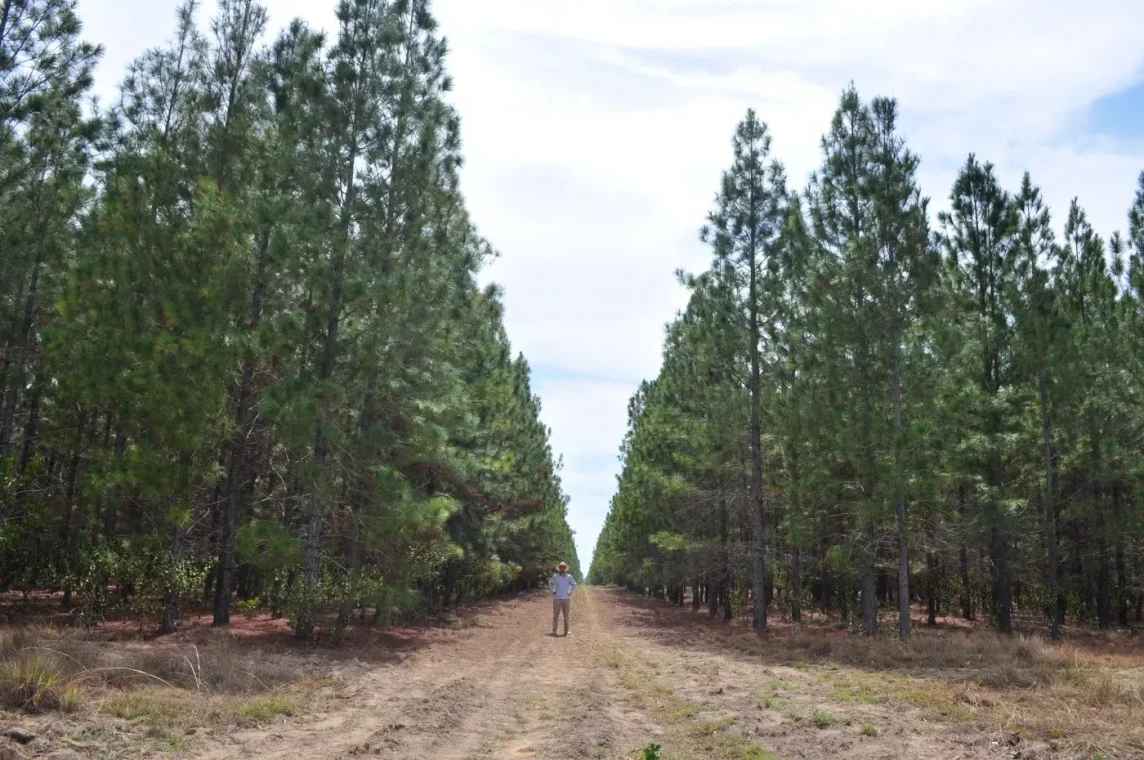

Although here at La Pedregoza we prefer to plant, when possible, with native trees, the growth of our Caribbean Pine plantations has been undeniably phenomenal. These trees produce a rich pine aroma when entering their plots and even a provide a suitable shaded region from the equators harsh sun. Though they are traditionally used for lumber they also produce very valuable side products, such as a very high-quality resin used in the production of industrial soaps, detergents, turpentines, among other products. The tree has adapted itself very well to the harsh Vichadan soils especially those planted with the use of Biochar, which we produce locally on our farm. They have a slower initial growth than some of the other species but experience an undeniable surge of height, strength, and beauty around the fifth to sixth year. The species itself is native to the Americas but not to our region, coming mainly from Central America and the Western Indies [1]. It has been reported previously and evidenced firsthand by us at La Pedregoza, that the species has a high tolerance for lack of water/drought seasons and can even tolerate large amounts of water as long as it is situated in high draining areas. It has also been reported that they are fire resistant once they mature and if the fires are not too severe [2].
It is an excellent species for the acidic soils with high degrees of lixiviation that found here at La Pedregoza. We currently have a total of approximately 65 hectares of high-quality pine planted and hope to continue to plant this beautiful tree. They can reach heights of 20 to 30 meters which is between 65 to 100 feet. They tend to live through average basic life cycles of 20 years [3]. The wood from this species is highly desired for commercial use as it is highly resistant and durable. In the face of global deforestation and climate change, the Pinus Caribaea represents a strong and effective solution in our region of Southern America. The species is also reported as a highly wind resistant species, which works well in our highly windy plains of the Orinoquia.
It has been reported that although small, the Pine nuts from the Pinus Carribea are eaten by both wildlife and humans, mainly native indigenous groups. According to the IUCN redlist of endangered species, the Pinus Caribaea enters the Least concern category, however conservation efforts are still underway to protect it from deforestation and other threats. It is evident to both us and many other foresters that the species Pinus Caribaea are resistant, plentiful, restorative, and efficient carbon sequestering trees.
[1] Farjon, A., & Styles, B. T. (1997). Pinus (Pinaceae). Flora Neotropica, 75, 1–291. http://www.jstor.org/stable/4393881
[2] Vázquez-Yanez, C., Batis Munoz, A. I., Alcocer Silva, M. I., Gual-Díaz, M., & Sánchez-Dirzo, C. (1999). árboles y arbustos potencialmente valiosos para la restauración ecológica y la reforestación. México, D.F.: Reporte técnico del proyecto J084. Comisión Nacional para el Conocimiento y Uso de la Biodiversidad e Instituto de Ecología, UNAM.
[3] INSTITUTO NACIONAL DE BOSQUES. 2017. Pino caribe (Pinus caribaea var. hondurensis (Sénécl.) W. H. Barrett & Golfari). Paquete tecnológico forestal. Guatemala, INAB. 37 p.
Commenti (0)
Lascia un commento