
by Dexter B. Dombro
In a previous article, I mentioned that forests planted for compensation purposes have to do more than just capture CO2 (see: https://tree-nation.com/projects/la-pedregoza/article/4581-the-challenges-of-large-scale-compensation-tree-planting). Biodiversity is fundamental to the establishment of a compensation forest, because without it there is no niche habitat, nor corridors that do more than just hide passing wildlife. This issue is even more complex when one considers the scale and costs required to actually create such a compensation forest.
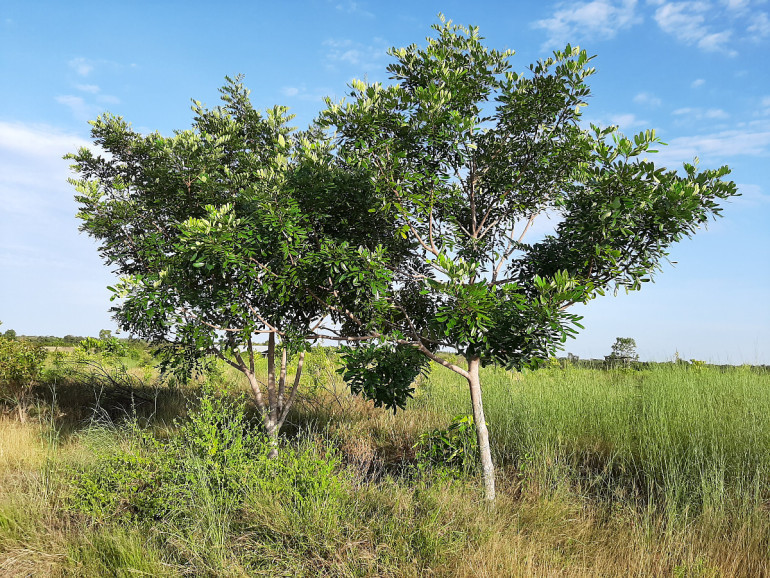
The correct selection of native tree species is important, here a pair of Simarouba amara trees.
We need to plan how to actually plant biodiverse forests in order to counteract the destruction of the Amazon forest, the Indonesian forests, forests in Africa and Australia, and boreal forests in the Arctic regions of the planet. The solution adopted by the Sacred Seeds Botanical Garden is analog forestry. The International Analog Forestry Network’s definition of analog forestry is as follows: Analog Forestry is an approach to ecological restoration which uses natural forests as guides to create ecologically stable and socioeconomically productive landscapes. Analog Forestry is a complex and holistic form of silviculture, which minimizes external inputs, such as agrochemicals and fossil fuels, instead fostering ecological function for resilience and productivity. Analog Forestry values not only ecological sustainability, but recognizes local rural communities’ social and economic needs, which can be met through the production of a diversity of useful and marketable goods and services, ranging from food to pharmaceuticals and fuel to fodder.
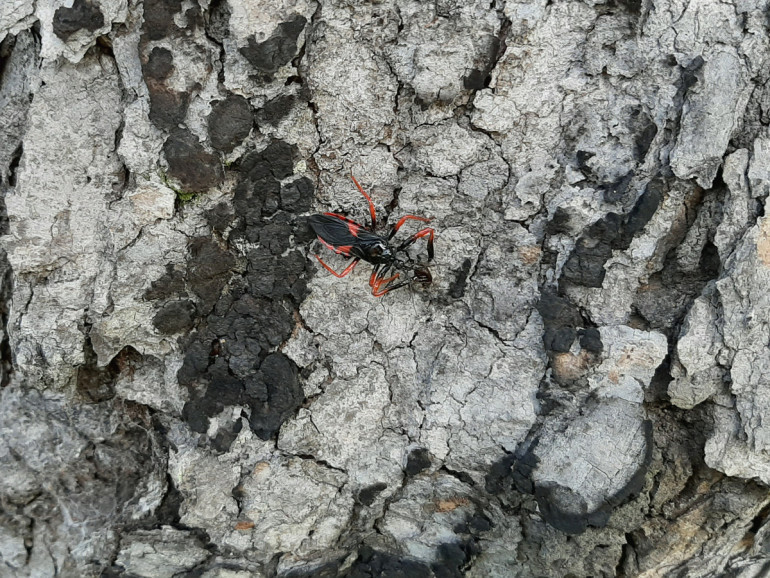
Biodiversity includes not just plants and mammals, but numerous insects and birds that have developed niche habitats in forests composed of native tree species.
In our case, the focus is a bit less social and more on biodiversity and animals, which makes sense given what we consider to be the need for massive compensation tree planting. Working in large landscapes on a large scale, we employ people from local indigenous communities to plant, using organic and mineral based fertilizers, but not agrochemicals. The selected tree species have uses such as traditional medicines, fruits for human food, fodder, wildlife feed, oils, fuel from pruning, fibers and much more. Key to this process is determining the initial dominant or sub-dominant species one wishes to plant, what is the availability of seeds, and how social are the selected trees with other species? The newly planted forest should provide the framework that will encourage other tree species to follow, creating an additional natural regeneration component thanks to contributions from birds and passing mammals.
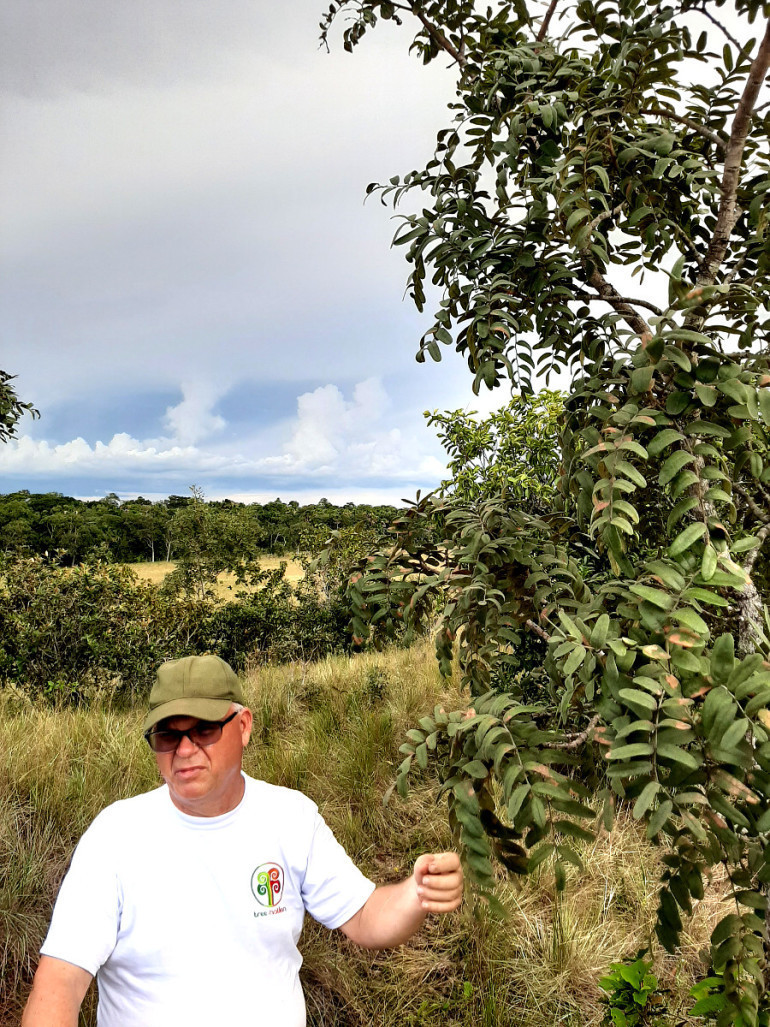
Selecting which trees may be important for the establishment of wildlife corridors can be painful work if a wasp stings you in the process. This is a Bowdichia virgilioides.
In the case of the Orinoco River basin, Sacred Seeds has selected 5 dominant and sub-dominant native tree species for massive compensation planting. Since the newly planted analog forest is also meant to be a carbon sink, 1,225 trees are planted per hectare. They are Vochysia lehmannii, Acosmium nitens, Copaifera pubiflora, Simarouba amara and Vitex orinocensis. Those 5 form the framework for any new compensation forest. Each species will represent 19% of the total trees planted in a hectare. The remaining 5% (70 trees) per hectare is made up of some 32 other species that bring special biodiversity and socioeconomic features to the newly planted forest. They include species that are on the IUCN’s Red List of threatened species.
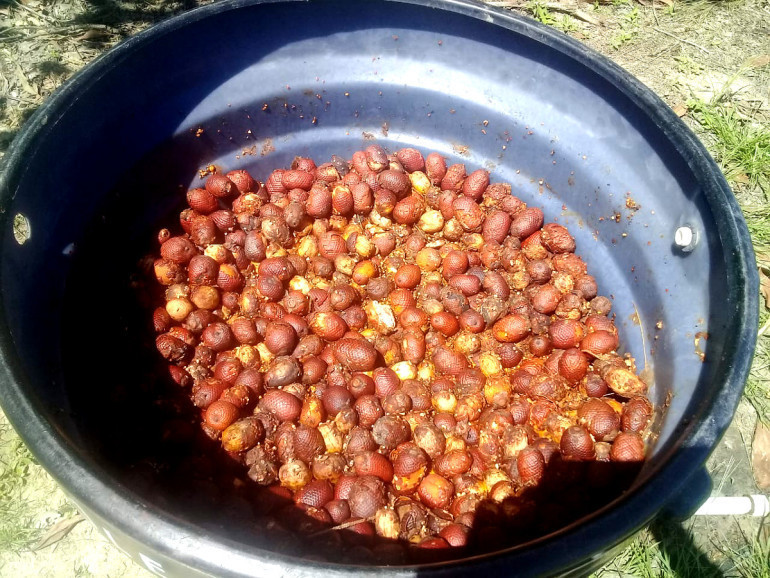 Collecting sufficient seeds for native tree species in complicated on a large scale. These are Mauritia flexuosa seeds.
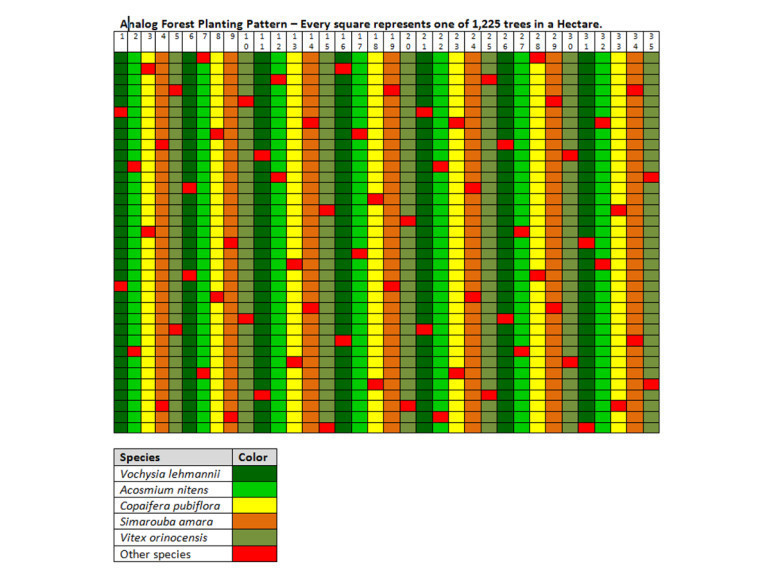
Given the high cost of massive compensation planting (we are talking about 25,000 hectares or more at a time), certain efficiencies have to be built into the planting design. One of those efficiencies is to plant 35 columns with 35 rows per hectare, for a total of 1,225 trees. Each column would be one of the dominant or sub-dominant species. This pattern means that there would be 7 columns of each of the dominant or sub-dominant species evenly distributed in each hectare. Inside each of those columns, on a random basis, 2 trees representing the other species would be planted, for a total of 70 other native tree species. The planting pattern diagram explains this:
Fertilization is an important aspect of this process. Sacred Seeds uses a mix of compost with biochar, as well as a mix of essential minerals, which are applied to each tree planted. This fertilization needs to happen for at least the first 4 years of the newly planted forest, and may be as much as 25% of total costs. Tropical trees are perfect recyclers that get 98% of their nutritional requirements from the atmosphere, and rapidly re-use what falls to the ground, leaving very little to accumulate in the soil. However, the additional 2%, if supplied to the tree in a bio-friendly form, can significantly enhance growth and carbon capture, hence the need for a good fertilization.
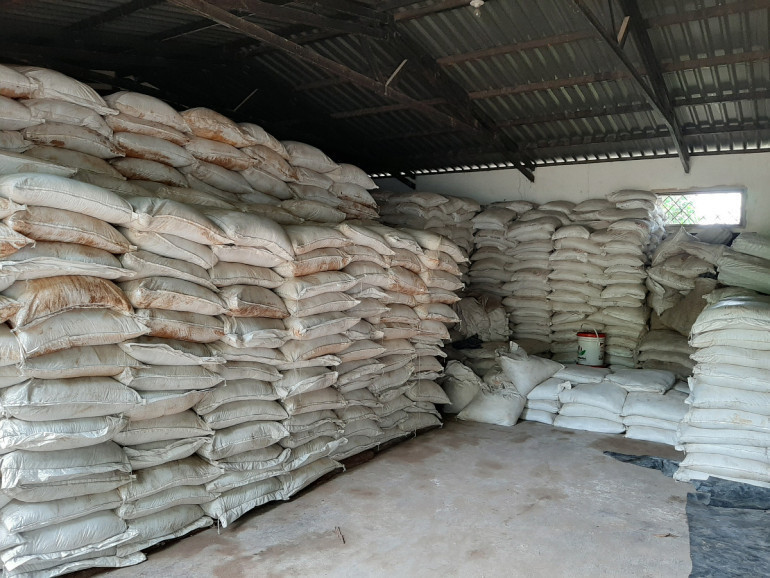 These are all minerals to be added to the soil so that the trees have the essential elements they need, things like phosphoric rocks and dolomite calcium.
Putting organic material, especially #biochar, into tropical soils is important, if one wants the newly planted forest to also store carbon in the soil. Tropical forests tend to have most of their carbon stored in the above ground biomass and the root system, whereas boreal and mid-latitude forests often have large storage of carbon in the forest soil, from deadfall like leaves, fruits and branches. By using biochar to act as a retention agent, one can start to build a carbon rich soil in a tropical forest that enhances tree growth and carbon capture, as well as resilience against diseases.
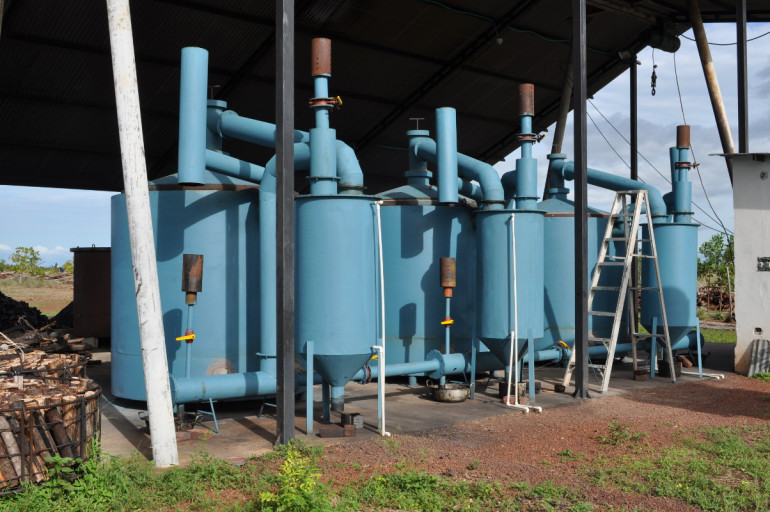
The emissions-free biochar pyrolysis plant at La Pedregoza converts introduced species like Acacia mangium into biochar as a soil amendment for native tree species.
There are numerous challenges to planting and maintaining large carbon sink forests. At the moment, it would appear that planting such forests on private land, using firebreaks and other good forest management practices, is one of the ways to ensure the longevity of this type of biodiverse, analog forest carbon sink. It seems like governments around the world are incapable of protecting natural forests, so this is a viable alternative. Over a 30 year period this type of forest should be able to capture no less than 50 tons of CO2 per hectare per year, so to put that into perspective a 25,000 hectare compensation forest should capture at least 37,500,000 tons of CO2 from the atmosphere over a 30 year period. There is reason to believe that the number could be as high as 75 tons per hectare per year, or 56,250,000 tons over 30 years.
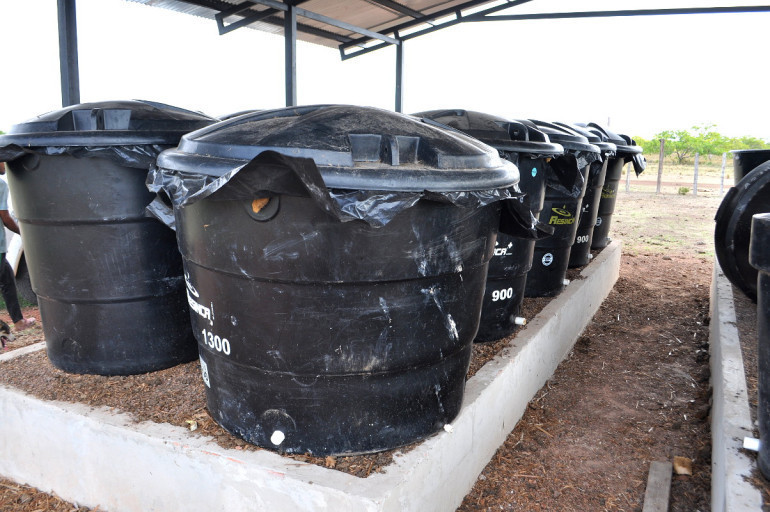
La Pedregoza presently produces about 70 tons of high-quality anaerobic Bokashi compost, together with another 1,200 tons of aerobic compost per year.
Using the above described methodology, the people of the Earth need to plant some 817,000 hectares (8,170 KM2) with 1 billion trees (a thousand million) if we are going to reverse climate change. This is completely doable; Tree-Nation members are demonstrating that it can be done on a daily basis. If large corporate CO2 emitters step up to the plate, we can start to counteract climate change. One third of the planet’s carbon emissions come from just 20 companies, according to the UK’s Guardian newspaper. But we can’t just blame those companies, we use the products they produce and fuel our vehicles with the products they sell. The solution is for everyone to do their share. Tree-Nation plantations and its members are leading the charge.
Commenti (2)
Lascia un commento