

If you installed EcoCart on your Shopify store because sustainability was your brand's actual purpose — not just a checkbox — you may have noticed something has changed.
EcoCart launched in 2020 with a clear promise: help ecommerce merchants make their orders carbon neutral at checkout. For a few years, it was the best-known name in sustainable ecommerce. Merchants who genuinely cared about their environmental impact trusted it.
Then, gradually, it became something else.
Today, EcoCart markets itself as a "Green Protection" platform. The product now bundles shipping insurance, cashback rewards, and claims management alongside a climate impact component. It is a clever business move — bundling increases stickiness and average revenue per merchant. But it also means that climate impact has been demoted from the core value proposition to a feature in a post-purchase optimisation suite.
For merchants whose sustainability commitment is real, this matters. You are not looking for a retention tool with a green badge. You are looking for something that does what it says: makes your business genuinely better for the planet, verifiably, transparently, and at a price that makes sense.
This article compares the leading sustainable checkout apps available to Shopify merchants in 2026 — including EcoCart — so you can make an informed choice.
What Actually Matters When Evaluating a Sustainability App
Before comparing products, it helps to agree on what good looks like. Based on industry guidance and the criteria sustainability leads, ESG teams, and eco-conscious merchants consistently use, five things matter most:
- Price. What does each tree or offset actually cost, and what does that price include? A low headline price that excludes monitoring is not cheaper — it is just less honest.
- Diversity. Can you choose from multiple project types, species, and geographies? A single-project provider limits your ability to align impact with your brand's values and geographic footprint.
- Certification. Is the impact independently certified? Which standards does the provider work with, and how robust are they? Traditional certification relies heavily on documentation and periodic audits; more advanced systems use continuous, data-driven verification.
- Verification. This is different from certification. Certification is a label. Verification is how impact is actually observed over time. The strongest providers use remote sensing, GPS-tagged field evidence, and satellite monitoring — not just reports from in-country partners.
- Transparency. Can your customers, and your ESG team, see exactly where trees were planted, which species, and how they're doing? Real transparency means data that is accessible, traceable, and linked to actual activity — not an aggregate counter and a logo.
With those criteria in mind, here is how the main players stack up.
The Players
EcoCart
EcoCart was a direct competitor in the checkout sustainability space until its recent pivot. As a carbon offset app, it calculated each order's carbon footprint in real time and let customers make their orders carbon-neutral for a small contribution. For several years, it was one of the most recognised names in sustainable e-commerce.
The product has since evolved significantly. EcoCart now positions itself around "Green Shipping Protection" — a bundle that combines shipping insurance with carbon contributions, as well as cashback and claims management. The climate piece is still present, but it is no longer what the product is for.
- Price: Not published. Volume-based, requires a sales demo.
- Diversity: Broad range of offset project types, not limited to trees.
- Certification: Works with VERRA, Gold Standard, and Climate Action Reserve certified projects.
- Verification: Limited transparency on ongoing monitoring methodology.
- Transparency: Impact reporting has become secondary to the post-purchase suite.
Best for: Merchants looking for a combined shipping protection and sustainability bundle who are comfortable with a broader product focus.
The gap it leaves: Merchants who want a focused sustainability tool where climate impact is the entire product, not one feature among several. It is also worth noting that carbon offsets as a category are under increasing regulatory scrutiny — the EU Green Claims Directive and US FTC Green Guides are both tightening the bar on what brands can claim. Abstract credit retirements are harder to defend than a physical, named, tracked tree.
Greenspark
Greenspark is a UK-based sustainability platform for businesses, offering tree planting, plastic rescue, and carbon offsetting in a single subscription model. It covers a broader range of impact types than a pure tree-planting tool and positions itself around customer engagement, loyalty widgets, and B2B ESG reporting.
The product is well-designed, with dynamic widgets and a public impact dashboard. It works with recognised certification standards and vets projects for both environmental and social criteria. For merchants who want a single platform covering multiple impact types, it is a solid option.
- Price: $0.45/tree on a pay-as-you-go basis; drops to $0.40/tree on any paid subscription (from $9/month). No free tier for unlimited use — the subscription is required to unlock the lower rate and full feature set.
- Diversity: Strong — trees, plastic, carbon. Wide project portfolio.
- Certification: Works with recognised standards; projects vetted against UN SDGs.
- Verification: Good reporting infrastructure; monitoring methodology varies by project.
- Transparency: Public dashboards and impact widgets available; data quality depends on the underlying project.
Best for: Brands that want a multi-impact platform covering trees, plastic, and carbon, and are willing to pay a monthly subscription to unlock the full feature set.
Ecologi
Ecologi is one of the most consumer-recognised climate platforms, having funded more than 80 million trees and reported over 3 million tonnes of avoided or removed CO₂. Its Shopify integration lets merchants automate tree planting per order or per sale, with billing added directly to the Shopify invoice.
The model is pay-per-tree with no monthly subscription — straightforward to install and manage. The tradeoff is that Ecologi is primarily a consumer-facing sustainability brand — the product experience is designed around the Ecologi brand's story rather than yours. For merchants who want their own brand to own the sustainability narrative, this can feel limiting.
- Price: $0.80/tree via the Shopify app (free to install, no subscription). The most expensive per-tree price in this comparison.
- Diversity: Multiple project types across Africa, South America, and Southeast Asia.
- Certification: Works with verified reforestation and carbon projects.
- Verification: Relies on in-country partner reporting; independent monitoring less prominent.
- Transparency: Ecologi's own platform is transparent, but white-label reporting for your brand is limited.
Best for: Brands happy to lean on Ecologi's brand credibility for their sustainability story, and who aren't price-sensitive on a per-tree basis.
GoodAPI
GoodAPI is a Shopify-first tree-planting app that connects merchants to Veritree-verified reforestation projects. Its model is straightforward: every order funds a tree, every tree is GPS-tracked and monitored through its critical first years of growth. It has a 5.0-star rating from 200+ Shopify merchants and is designed to go live in under 10 minutes.
At $0.43 per tree with no monthly fee, it is priced competitively. The Veritree partnership is its strongest asset. GoodAPI holds the "Built for Shopify" badge, which signals top-tier performance and API standards and is rare among sustainability apps.
Where GoodAPI falls short is the customer experience beyond the transaction. Trees are tracked and verified, but there is no personalised tree ownership — customers do not get a named tree, an individual forest profile, or an ongoing story about how their specific tree is growing. The experience ends at the confirmation. For merchants who want sustainability to build a lasting emotional connection with customers, not just a receipt, this is a meaningful gap.
- Price: $0.43 per tree, no subscription fee.
- Diversity: Projects in Kenya, Madagascar, and a small number of other sites; project selection is more limited than broader platforms.
- Certification: Veritree-verified with GPS tracking and blockchain records.
- Verification: Strong — multi-layer verification including satellite, drone, and IoT.
- Transparency: Per-tree tracking with geographic and species data, but no personalised customer forest page.
Best for: Shopify merchants who want Veritree-verified planting at a clear price point and minimal setup, and do not need a personalised tree ownership experience for customers.
Tree-Nation
Tree-Nation is a global reforestation platform that has been operating since 2006 — longer than any other provider on this list. Since inception, the platform has facilitated the planting of over 47.6 million trees across all programmes, with around 5.9 million of those planted directly through the Offset Product — the ecommerce checkout integration at the heart of this comparison. 43 active reforestation projects are currently live on the platform, vetted against rigorous environmental, social, and project management criteria.
For Shopify merchants, Tree-Nation's Offset Product integrates directly at checkout: customers plant trees as part of their order, and every tree is linked to a real project with a named species, geolocated planting sites, and a personalised forest page the customer can visit and share. The experience is designed to be the merchant's own — not a third-party brand bolted on.
- Price: From €0.35/tree — the most competitive price in this comparison. No monthly fee, no hidden fees.
- Diversity: This is where Tree-Nation stands apart. The platform has 43 active reforestation projects, covering a wide range of species and geographies. Merchants can choose projects that align with their geography, values, or customer base — or let Tree-Nation allocate across a balanced portfolio. No other provider on this list offers comparable project breadth.
- Certification: Tree-Nation's project approval process is more rigorous than industry standard. Every project is assessed across three dimensions before joining the platform: environmental, social, and project management. Environmental criteria require native species (monocultures are not permitted unless fully justified), measurable biodiversity contribution, and mandatory alignment with SDG 15 — Life on Land. Social criteria include fair labour conditions, Indigenous peoples' rights, and gender equality in employment. On project management, every applicant must provide legal documentation of land ownership or management rights, and demonstrate historical performance verified through remote sensing analysis — before a single tree is funded. Partners are then required to submit monthly field updates throughout the project's life. Tree-Nation also distinguishes between certification (a label) and verification (how impact is actually measured over time) — a distinction most competitors blur.
- Verification: Continuous and multi-layered. Tree-Nation publishes formal Verification Quality Score (VQS) reports for each project — publicly accessible on every project page. Verification inputs can include satellite monitoring, remote sensing (EVI — Enhanced Vegetation Index), geo-tagged field evidence, structured reporting events, and on-site audits. Projects must maintain a minimum VQS threshold to remain active on the platform. Unlike providers that rely on self-reporting by in-country partners alone, outcomes are independently cross-referenced against observable data.
- Transparency: Every tree on Tree-Nation's platform is traceable through the Tree Ledger — a proprietary digital registry that assigns each tree a unique record linked to its project, planting site, species, sponsor, and verification data, preventing double-counting. Customers get a named tree, species information, project updates, and a personal forest page they can share. Merchants get a dashboard with auditable impact data suitable for ESG reporting.
Best for: Merchants who want verified, transparent, species-diverse tree planting that they can own as their brand's sustainability story — with the depth of certification and verification to stand up to scrutiny.
How They Compare
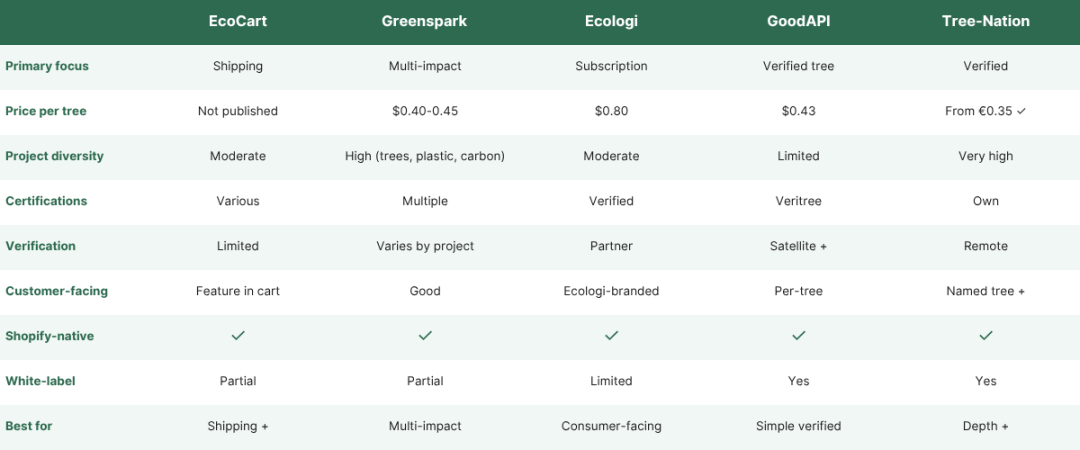
The Bottom Line
If you chose EcoCart in 2020 because you wanted a focused, credible sustainability tool — the kind that actually gives your customers something real — that product no longer exists in the same form. EcoCart made a business decision to become a broader post-purchase platform. That may work for some merchants. It does not work for the ones who chose it specifically for its climate focus.
The good news is that the alternatives have matured considerably. Greenspark is excellent for multi-impact programs. GoodAPI is a clean, well-verified option for Shopify merchants who want a simple setup. Ecologi works well for brands that are happy to lean into someone else's sustainability brand.
For merchants where sustainability is genuinely the point — not an add-on, not a badge — the depth, diversity, and verification approach of Tree-Nation makes it the strongest choice. The platform offers more project choice, more transparent verification methodology, and a customer experience that makes impact feel real and personal rather than generic.
There is also a distinction worth making that most of this market glosses over: the difference between offsetting and planting. Carbon offsets are an abstraction — a financial instrument tied to avoided emissions somewhere in the world. They are increasingly under regulatory scrutiny, with the EU Green Claims Directive and US FTC Green Guides tightening what brands can actually say. A named, GPS-tracked tree in a real forest is not an abstraction. Your customer can see it. It grows. It has a story.
Planting a tree is easy to claim. Making it verifiable, traceable, personally meaningful, and defensible under tightening regulations is harder. Tree-Nation is built to do the harder thing.
Comments (1)
Leave a comment