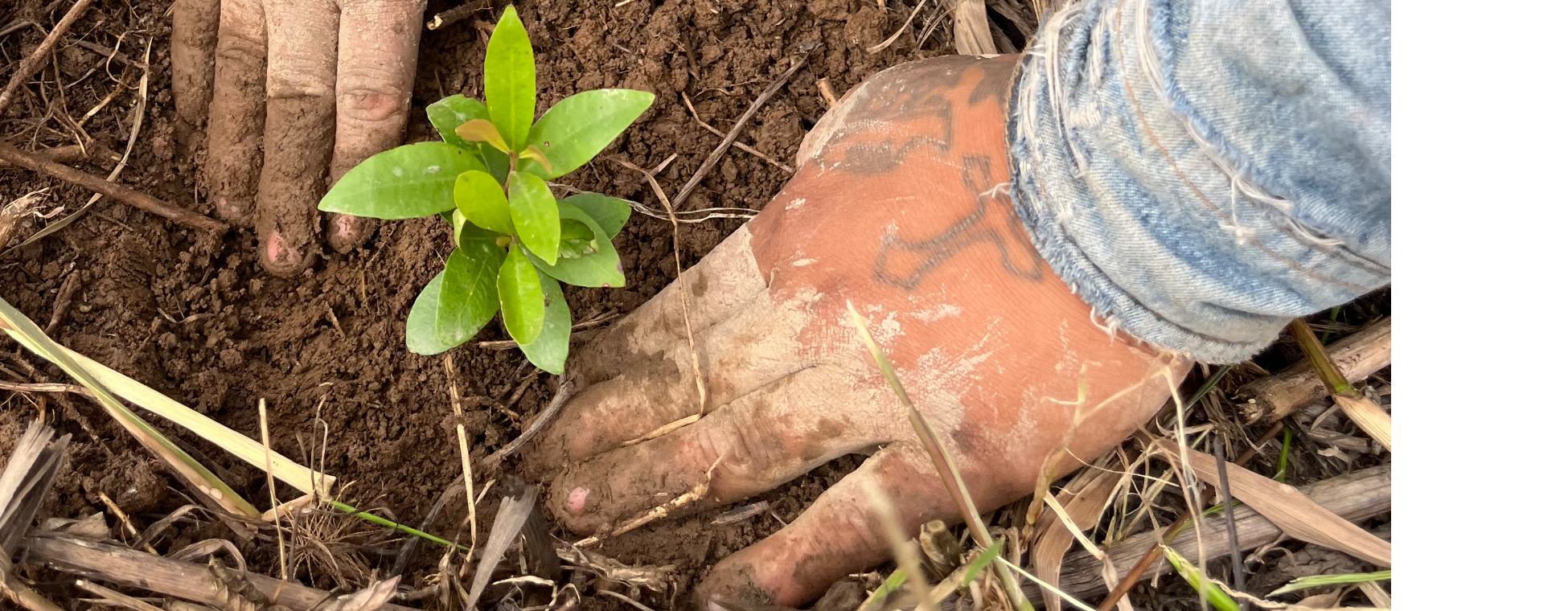

Someone in the community recently asked: 'How do you incorporate technology into your work? Would you describe your approach as low-tech, high-tech, or no-tech—and why?' It's a question with many layers, as our work often blends both high and low-tech solutions. In this instance, we'd like to share a remarkably effective, yet simple, technique we use to significantly improve seedling survival after planting.
Contrary to popular belief, preparing the soil for our seedlings doesn't always require clearing a wide area of all vegetation. Instead, informed by our thorough soil and climate analysis, which is high tec, we clear only a narrow strip of about 20 cm where the seedling will be planted. Importantly, the native vegetation we remove is left on the ground to decompose, enriching the soil with valuable nutrients as it breaks down and improving its structure and water retention.
Furthermore, we actively ensure that the surrounding land remains covered with native weeds, rather than leaving it bare. This blanket of carefully managed vegetation acts as a natural mulch, effectively retaining crucial moisture in the soil and significantly reducing, or even eliminating, the need for costly irrigation systems. This low-tech approach is not only exceptionally cost-effective but also offers a range of crucial benefits:
- Soil Protection: The plant cover acts as a shield, preventing raindrops from directly impacting the soil, which significantly reduces erosion and topsoil loss.
- Moisture Improvement: This natural cover helps to conserve vital soil moisture, a critical factor for the successful growth of trees, especially in dry areas or those with limited rainfall.
- Erosion Reduction: The intricate roots of the plant cover help to bind soil particles together, preventing their displacement by the action of water and wind, thus maintaining the integrity of the land.
- Wildlife Support: The plant cover provides an essential habitat for a variety of native animals, insects, and microorganisms, contributing to the overall biodiversity and health of the local ecosystem.
- Soil Improvement: The gradual decomposition of this plant cover continuously enriches the soil with essential organic nutrients, improving its long-term fertility and structure.
This low-tech approach has proven to be exceptionally cost-effective and consistently yields impressive seedling survival rates, often exceeding 90%.
Comments (0)
Leave a comment