

#EcoEducation #ClimateDictionary
Since the industrial revolution, human activity has directly contributed to the number of greenhouse gases present in our atmosphere with over 34 billion tonnes emitted a year. The primary greenhouse that is emitted by human activity is carbon dioxide (CO2). Carbon dioxide contributes to global warming through its thermal radiating properties which increases the amount of retained heat on the planet's surface.
Activities, such as burning fossil fuels, deforestation, industrial manufacturing, and transportation all play major roles in CO2 emissions. The impact of these activities on the Earth’s geology and ecosystems has resulted in scientists proposing a new geological epoch, the Anthropocene. If levels of carbon dioxide emission continue at the current rate, then it is estimated that they will double in 2060 with temperatures likely increasing by 2.6°C - 3.9°C.
With this in mind, the world is on a global mission to reduce the amount of carbon dioxide present in our atmosphere, with carbon capture and storage (CCS) in the limelight for its CO2 mitigation capabilities.
What is carbon capture and storage?
Our planet's natural systems provide the world with carbon sinks. Carbon sinks are defined by their ability to absorb more carbon from the atmosphere than is released. They essentially capture and store carbon and include plants, the ocean, forests, and soil. With the current levels of CO2 increasing, methods need to be identified which can quickly help deal with our emission crisis. Natural methods include planting trees and restoring our planet's natural systems.
Artificial methods have also been identified by scientists and governments looking toward carbon capture and storage technology to help facilitate our planet's capabilities of carbon sequestration (the process of capturing and storing atmospheric carbon dioxide).
Carbon capture and storage (CCS) is the process whereby CO2 is ‘captured’ at its emission source and is transported to be stored or buried underground in deep geologic formulations. This process allows industries to continue to operate whilst emitting less CO2 into the atmosphere and is thought to play an important role in tackling climate change.
Carbon capture
Carbon capture involves isolating and capturing the carbon emitted from industrial processes or large sources (power plants). It can happen in the open atmosphere and it is removed through either;
- Post-combustion which involves the CO2 being removed after burning fossil fuels.
- Pre-combustion which involves trapping CO2 from fossil fuels before combustion is complete through gasification (for example).
- Oxyfuel combustion which involves burning the fossil fuel in oxygen, not air, resulting in an end product that consists mainly of CO2 and water vapor. The water is then condensed through cooling, resulting in almost pure CO2 which can then be transported and stored.
Carbon storage
Carbon storage is exactly what it sounds like - taking the captured carbon and storing it. There are two types of carbon storage;
- Geologic carbon sequestration which involves storing the carbon underground in geologic formulations.
- Biologic carbon sequestration which involves storing carbon from the atmosphere in vegetation, soils, and aquatic environments.
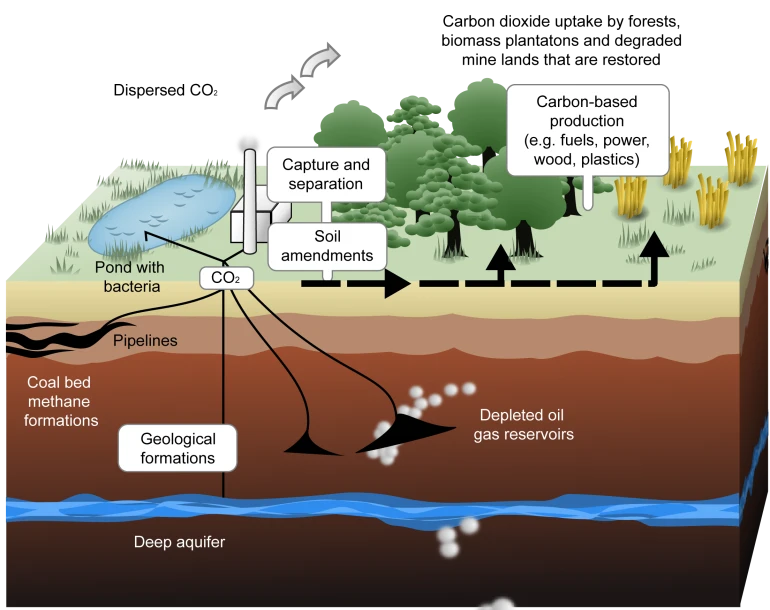
GEOLOGIC CARBON SEQUESTRATION
Storing Carbon in geologic Formulations
Geological storage of carbon involves the CO2 captured from industrial processes being injected into rock formations underground, thereby removing the carbon from the atmosphere. To ensure effective storage, the rock formulations need to exhibit certain characteristics which enable them to store the carbon. For example, they need to be at a certain level (850m) below the ground, as well as having an extensive barrier that blocks the carbon from escaping back into the atmosphere. The rock also needs to be permeable and porous enough so that the carbon can be injected into it.
Types of proposed rock that offer effective storage for carbon include; Deep saline formations (the main contender), unmineable coal seams, depleted oil and gas reservoirs, basalt formulations.
Carbon is injected underground by compressing the gas down into a fluid which can then be pumped down a well to the geological formation. The rocks injected already contain initial fluid of oil, gas or salty water - the CO2 that is injected into the rock is more buoyant than these fluids so a small proportion rises to the top becoming trapped and sealed in. Formulations with the greatest number of barriers, such as a reservoir, make effective carbon storage units.
A benefit of using underground resources for carbon storage is that there is substantial underground storage globally with more storage than is actually required. Currently, 200 million tonnes of CO2 has been successfully injected underground, proving that storing carbon in geological formulations works and is a potential way of removing carbon from the atmosphere.
Storing carbon underground is not without its limitations and although it might seem a feasible option, it is an expensive process that enables fossil fuel companies to keep emitting. CCS technology is funded by the fossil fuel industry, with the industry using these initiatives to reposition themselves and rebrand itself as the “carbon management industry”. The industry’s repositioning is a strategic approach to make the industry appear to be ‘mitigating climate change’ by removing carbon dioxide from the air, however, it is a distraction which allows them to continue burning fossil fuels and emitting carbon.
Furthermore, an integral part of CCS involves water for scrubbing and cooling - this increased demand for water places additional pressure on the sustainability of current water systems, especially in countries where water availability is limited. In addition to water, implementation of CCS technology into power plants requires a significant amount of coal and electrical power, requiring roughly 10–40% more energy than a plant of equivalent output without CCS. The long-term effects of CCS are also unknown and questions should be raised asking whether the funding for CCS technology could be put towards cleaner, more environmentally beneficial methods that support long-term solutions.

Storing Carbon in minerals
Carbon mineralization is the process of transforming carbon dioxide into solid minerals, like carbonate through a chemical reaction. This chemical reaction takes place when certain rocks are exposed to CO2. The benefit of storing carbon this way is that due to its chemical transformation, carbon cannot escape back into the atmosphere.
The difference between carbon mineralisation and storing carbon in rock formations is that carbon mineralisation involves new carbonate minerals being formed within the rock, rather than carbon being dissolved into deep saline groundwaters. The majority of the rocks that facilitate carbon mineralization include those which are igneous or metamorphic, rather than porous sedimentary reservoirs.
The major advantage of carbon storage through mineralization is that due to the chemical reactions that have taken place, carbon cannot escape back into the atmosphere. It also mimics a natural reaction that takes place; CO2 reacting with oxides of alkaline or alkaline-earth metals to form carbonates, with the formula of;
(Ca,Mg)SiO3 (s) + CO2 (g) → (Ca,Mg)CO3 (s) + SiO2 (s)
The reaction itself is spontaneous exothermic and thermodynamically favorable. It is a promising method of CCS due to the wide range of reserves of alkalinity sources available for mineral carbonation.
However, on the downside, this type of storage is expensive and involves large-scale mining. The mining brings with it a combination of local health and environmental concerns, including changing the surrounding ground terrain and adding dust pollution into the atmosphere.
Storing Carbon underwater
The ocean is the world's largest carbon sink, absorbing about one-quarter (25%) of CO2 emitted from human activities such as burning fossil fuels and cement production. When too much carbon is added, the ocean starts to become more acidic, a process known as ocean acidification. Ocean acidification is incredibly detrimental to our aquatic ecosystems - harming coral and plankton by preventing them from forming their shells and skeletons.
It might seem counterintuitive to add more carbon into the ocean, however, there is logic behind storing CO2 in the ocean. CO2 is not just mindlessly pumped into the ocean but is injected deep into the ocean where it can diffuse or be trapped in a specific location depending upon the depth and pressure of where it is injected.
How CO2 is stored is dependent upon the depth of the water. The depth of the water affects the state of the molecule - solid, liquid or gas. If carbon is injected into the water at a deep enough depth, then it becomes denser than seawater and sinks to the bottom of the flow. It can then form an underwater pool and be trapped by its own density. This happens at a depth of around 3,000 meters or lower. Before that, it is still lighter than seawater and would rise in a water column, dissolving into the seawater at a quicker rate. Storing carbon at this depth does not isolate carbon for an indefinite amount of time with models suggesting that 20% of carbon stored at 3,000 meters is expected to reach the atmosphere over 200 years.
The benefits of storing carbon in the ocean are that this method essentially speeds up long-term carbon storage, transporting it into the deep ocean where it will eventually end up. Additionally, pumping it deep underground where it is denser means that it will remain isolated from the atmosphere mitigating potential harm of being absorbed into the surface waters accelerating ocean acidification.
However, storing CO2 in the ocean is not a long-term solution. It is a very expensive way to store carbon with many associated risks. The ocean is very vulnerable to ocean acidification and so subjecting the oceans to even more CO2 with little known about the long-term potential impacts raises concern. It has been suggested that it could be a short-term solution to help drive CO2 down in our atmosphere and stabilize the climate, although, long-term effectiveness is unknown as is the timeframe that it will remain isolated from our atmosphere.

Transportation
Transportation involves the captured CO2 being compressed and transported to where it will be stored. It can be transported via pipelines, road transport or ships. Pipelines offer the cheapest and most common method for transporting CO2 involved in CCS, with millions of kilometres of pipelines already operating around the world. Around 50 CO2 pipelines operate in the US, transporting 68 million tonnes of CO2 per year.
BIOLOGIC CARBON SEQUESTRATION
Storing Carbon in soil
Soil presents itself as a secret weapon when it comes to carbon sequestration. Carbon is taken from the air from plants by photosynthesis and then stored as soil organic carbon (SOC).
The industrial revolution, not only brought with it an increase in carbon from fossil fuel burning, but also the depletion of natural ecosystems due to unsustainable agricultural processes. The disappearance of landscapes has meant that there has been a huge loss of soil carbon released into the atmosphere with an estimated 50-70% of the carbon stock from the world's cultivated soil lost to the atmosphere to become CO2.
When the soil is stripped of its carbon and critical microbes, it becomes dirt, limiting the ability for the soil to provide nutrients for sustainable plant production. This subsequently leads to lower yields impacting food security. Farmers have now turned to pesticides to boost their yields, however, the exhaustive use of pesticides further reduces the SOC implicating the health and available nutrients in the soil. Additionally, the use of pesticides and reduced CO2 means that living organisms present and vital to ecosystems, are unable to survive, impacting soil biodiversity.
There is hope though and regenerative farming agricultural processes are believed to reverse the impacts that farming has had on our land. Regenerative farming techniques not only reduce CO2 from our atmosphere but will also boost soil productivity, increase resilience against floods and droughts, improve the water cycle and promote biodiversity. Overall, soil regeneration is a crucial way that carbon can be permanently sequestered and stored whilst improving soil health and productivity.
Carbon Storage in forests
Forests play a crucial role in our carbon cycle. They help sequester carbon by transforming it into biomass (biological material) through photosynthesis. A substantial amount (48%) of carbon is stored in biomass, litter, roots, trunks, branches and in forest soils. Forests release carbon over a long period of time through natural processes such as respiration, oxidation and decomposition.
Carbon is also released into the atmosphere through human activities, such as harvesting, fires,and deforestation. Human activities are speeding up the release of carbon stored in our forests at an alarming rate, with the world's largest rainforest, the Amazon, struggling to maintain its carbon sequestration capabilities. The giant forest, once a huge carbon sink, is now a major source for CO2, which is mainly due to fires burning huge sections of the forest. Many of these fires are set deliberately to clear land for agricultural purposes, such as beef and soy production, however, with huge environmental implications.
Healthy forests can serve as a great way to sequester carbon. They can act as a carbon reservoir and a tool to sequester excess carbon. Forest management and reforestation are key ways that can help mitigate climate change and reduce CO2 in our atmosphere. Planting trees is an effective way to promote a clean and healthy environment, encourage photosynthesis, improve soil health, and prevent flooding and erosion. It is a simple solution that does not incur the same expense as CCS technology and is a natural way to capture carbon with the long-term effects known.

Carbon Storage in Trees vs Other Plants
Studies have shown that it is through the collaboration of a multitude of plant species that allow for effective forest carbon sequestration. Rather than solely planting one species of tree, it is beneficial to create a diverse ecosystem that mimics natural environments that have been growing for centuries. Research has shown that each tree species added into a plantation will help add 6% to its total carbon stock, therefore, planting a mix of trees could help double forest carbon storage. Forests are home to 75% of our bird species and 68% of the world's mammals, therefore, reforestation efforts must create environments that mimic natural habitats to help sequester carbon and offer habitats that promote biodiversity.
Carbon Storage in Trees vs Oceans
The problem with storing carbon in the ocean is that the long-term implications are unknown. It might seem a suitable option now because effective ways to quickly remove carbon are needed if we are to stabilize our climate. However, problems associated with ocean storage may add to the problem rather than mitigate it - research has suggested that ocean storage will facilitate and promote long-term warming, higher sea levels, acidification and dead zones in the ocean. Planting trees, on the other hand, is a much safer way to store carbon - trees have been sequestering carbon for thousands of years, playing a major role in our carbon cycle. Planting trees and restoring the forests and green spaces that have been destroyed will have huge environmental benefits promoting biodiversity, air quality and the amount of available carbon sinks that naturally sequester the carbon dioxide in our atmosphere
Why plant trees
Planting trees is a crucial way that we can help mitigate the effects of climate change. 420 million hectares of forest have been lost since 1990 and with this loss comes carbon dioxide emission, biodiversity loss, species pushed into extinction and indigenous communities to be evicted from their land. Planting trees is a great way to restore what has been destroyed, encouraging soil health, sequestering carbon dioxide, producing oxygen and creating habitats and ecosystems for our precious biodiversity and communities.
Here at tree-nation, we understand the importance of planting trees, which is why we are asking people around the world to take action. We have a whole variety of trees to choose from and countries to plant in. Reforesting has never been easier so join us in our journey to reforest the world.
References
- Amos, Jonathan, and Martin Stute. “Experiment 'turns waste CO2 to stone.'” BBC, 9 June 2016, https://www.bbc.co.uk/news/science-environment-36494501. Accessed 2021.
- “An assessment of Earth's climate sensitivity using multiple lines of evidence.” ARC Centre of Excellence for Climate Extremes, 15 July 2020, https://climateextremes.org.au/wp-content/uploads/2020/07/WCRP_ECS_Final_manuscript_2019RG000678R_FINAL_200720.pdf.
- “Carbon Removal Fact Sheet: Enhanced Mineralization.” American University, 2018, https://www.american.edu/sis/centers/carbon-removal/upload/icrlp_fact_sheet_enhanced_mineralization_181008.pdf.
- Crootof, Robert, and Yousif Kharaka. “What is carbon sequestration?” U.S. Geological Survey, https://www.usgs.gov/faqs/what-carbon-sequestration.
- “Earth's Biodiversity Depends On The World's Forests.” UNEP-WCMC, 22 May 2020, https://www.unep-wcmc.org/news/earths-biodiversity-depends-on-the-worlds-forests.
- “GEOLOGICAL STORAGE OF CO2: SAFE, PERMANENT, AND ABUNDANT.” Global CCS Institute, 2018, https://www.globalccsinstitute.com/wp-content/uploads/2018/12/Global-CCS-Institute-Fact-Sheet_Geological-Storage-of-CO2.pdf.
- Habib, Emad. “Carbon capture and sequestration in power generation: review of impacts and opportunities for water sustainability - Energy, Sustainability and Society.” Energy, Sustainability and Society, 1 February 2018, https://energsustainsoc.biomedcentral.com/articles/10.1186/s13705-018-0146-3.
- Help Save Nature. “Role of Carbon Sequestration and its Pros and Cons You Never Knew.” Help Save Nature, https://helpsavenature.com/explanation-of-carbon-sequestration-with-pros-cons.
- “How Does Climate Change Affect the Ocean?” NASA Climate Kids, 19 October 2021, https://climatekids.nasa.gov/ocean/.
- Hume, David. “Ocean Storage of CO2.” The Maritime Executive, 29 July 2018, https://www.maritime-executive.com/features/ocean-storage-of-co2.
- Hume, David. “Ocean Storage of CO2.” The Maritime Executive, 29 July 2018, https://www.maritime-executive.com/features/ocean-storage-of-co2.
- Hume, David. “Ocean Storage of CO2.” The Maritime Executive, 29 July 2018, https://www.maritime-executive.com/features/ocean-storage-of-co2.
- Jaramillo, Paulina, et al. “Life Cycle Inventory of CO2 in an Enhanced Oil Recovery System.” ACS Publications, American Chemical Society, 30 September 2009, https://pubs.acs.org/doi/10.1021/es902006h.
- “Long-term consequences of storing captured CO2.” European Commission, 30 September 2010, https://ec.europa.eu/environment/integration/research/newsalert/pdf/211na4_en.pdf.
- “Mauna Loa carbon dioxide forecast for 2021.” Met Office, 4 April 2021, https://www.metoffice.gov.uk/research/climate/seasonal-to-decadal/long-range/forecasts/co2-forecast.
- Mazzotti, Marco. “Mineral carbonation and industrial uses of carbon dioxide.” IPCC, 2010, https://www.ipcc.ch/site/assets/uploads/2018/03/srccs_chapter7-1.pdf.
- Meng, Junlin, et al. “Emerging CO2-Mineralization Technologies for Co-Utilization of Industrial Solid Waste and Carbon Resources in China.” minerals, 2021.
- Neeraj, and Shashikant Yadav. “Carbon storage by mineral carbonation and industrial applications of CO2.” Materials Science for Energy Technologies, vol. 3, 2020, pp. 494-500. Science Direct, https://www.sciencedirect.com/science/article/pii/S2589299120300227.
- NPR. “Parts Of The Amazon Rainforest Are Now Releasing More Carbon Than They Absorb.” npr, 15 July 2021, https://www.npr.org/2021/07/15/1016469317/parts-of-the-amazon-rainforest-are-now-releasing-more-carbon-than-they-absorb?t=1638811361561.
- “Overview of Geological Carbon Storage (GCS).” OSTI.GOV, March 2018, https://www.osti.gov/servlets/purl/1463968.
- “Overview of Geological Carbon Storage (GCS).” OSTI.GOV, February 2018, https://www.osti.gov/servlets/purl/1463968.
- “Regenerative Agriculture: 4 Regenerative Farming Practices - 2021.” MasterClass, 8 November 2020, https://www.masterclass.com/articles/regenerative-farming-practices.
- Schmid, Bernhard. “Planting a mix of tree species 'could double' forest carbon storage.” Carbon Brief, 22 August 2018, https://www.carbonbrief.org/planting-a-mix-of-tree-species-could-double-forest-carbon-storage.
- Sekera, June, and Neva Goodwin. “Why the oil industry's pivot to carbon capture and storage – while it keeps on drilling – isn't a climate change solution.” The Conversation, 23 November 2021, https://theconversation.com/why-the-oil-industrys-pivot-to-carbon-capture-and-storage-while-it-keeps-on-drilling-isnt-a-climate-change-solution-171791.
- “State of the World's Forests 2020.” Food and Agriculture Organization of the United Nations, https://www.fao.org/state-of-forests/en/.
- “Technical Note - How do Trees Store Carbon?– Creating Tomorrow's Forests.” Creating Tomorrow's Forests, 12 October 2020, https://creatingtomorrowsforests.co.uk/blogs/news/technical-note-how-do-trees-store-carbon.
- “TRANSPORTING CO2.” Global CCS Institute, https://www.globalccsinstitute.com/wp-content/uploads/2018/12/Global-CCS-Institute-Fact-Sheet_Transporting-CO2-1.pdf.
- “TREES: Carbon Storage Experts | TreeSpirit Project.” Tree Spirit Project, https://treespiritproject.com/carbon/.
- “UK average footprint.” Carbon Independent, 2021, https://www.carbonindependent.org/23.html.
- “What are igneous rocks?” U.S. Geological Survey, https://www.usgs.gov/faqs/what-are-igneous-rocks?qt-news_science_products=0#qt-news_science_products.
- “What are metamorphic rocks?” U.S. Geological Survey, https://www.usgs.gov/faqs/what-are-metamorphic-rocks-0?qt-news_science_products=0#qt-news_science_products.
- “What is a carbon sink?” ClientEarth, 22 December 2021, https://www.clientearth.org/latest/latest-updates/stories/what-is-a-carbon-sink/.
- “What is carbon capture and storage and what role can it play in tackling climate change? - Grantham Research Institute on climate change and the environment.” London School of Economics, 1 May 2018, https://www.lse.ac.uk/granthaminstitute/explainers/what-is-carbon-capture-and-storage-and-what-role-can-it-play-in-tackling-climate-change/.
- “What is the Anthropocene? And why does it matter?” The World Economic Forum, 31 August 2016, https://www.weforum.org/agenda/2016/08/what-is-the-anthropocene-and-why-does-it-matter/.


