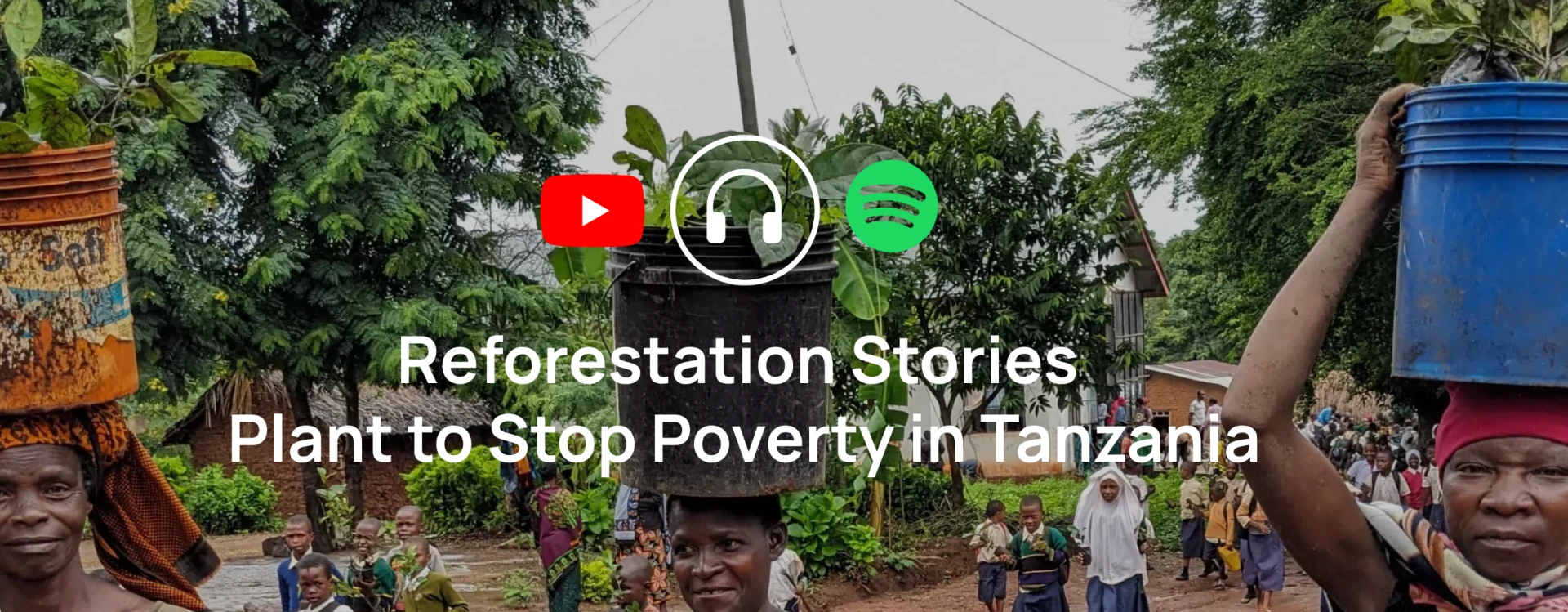

In Tanzania’s Pangani River Basin, where eroded riverbanks and vanished biodiversity signal decades of environmental neglect, the Plant to Stop Poverty project on Tree-Nation has planted over 1.6 million trees since 2021, aiming for 12 million by 2030.
Led by Khalifa Mganga, a Korogwe native whose childhood memories of lush riverine ecosystems contrast sharply with today’s barren reality, this initiative intertwines ecological restoration with economic survival. It addresses the intertwined crises of deforestation and poverty through strategic reforestation and agroforestry.
Oriana Medina from Tree-Nation’s Environment Department recently spoke with Khalifa about the changes, impacts, and future goals that Plant to Stop Poverty aims to implement.
Check out the full video on YouTube or listen to the podcast on Spotify.
Origins in loss, driven by necessity
Khalifa, who witnessed the disappearance of Milicia excelsa trees and golden finches along the Mankane River, founded Forest Focus five years ago with colleagues equally alarmed by the region’s ecological and social decline. The river, once a lifeline for millions across five regions, now suffers from eroded banks and diminished flow, a consequence of unregulated farming and climate-driven rainfall scarcity.
Forest Focus, partnering with Tree-Nation, targets these issues by replanting native species like Ficus sur and Albizia schimperiana to stabilize riverbanks, while introducing fruit-bearing trees such as mango (Mangifera indica) and passion fruit (Passiflora edulis) to provide farmers with viable income sources, reducing dependence on destructive practices like charcoal production.
A dual approach: Ecology and economy
The project’s forest gardening program, an agroforestry model, trains farmers to integrate high-value crops with trees, yielding harvests in as little as six months for passion fruit or 24–36 months for grafted citrus and avocado. These crops, fetching $2–3 per kilogram for passion fruit and commanding export markets for Tanzanian oranges, offer a lifeline to communities where 75% rely on subsistence agriculture.
Simultaneously, 2–5% of funds support vulnerable students, providing bicycles, uniforms, and stationery to keep 100 primary and secondary students, three high schoolers, and two university students in education.
The initiative operates across 12 planting sites, with new additions in 2025: Luangera, a Pangani tributary plagued by commercial sand extraction, and Dimsomera, a two-year-old village of Maasai and Datoga migrants.
In Dimsomera, blooming trees support the Datoga’s traditional beekeeping, enhancing honey production for food and trade, a pragmatic adaptation for pastoralists navigating a new landscape.
Navigating harsh realities
Climate change, manifesting in erratic rainfall and reduced soil moisture, threatens tree survival, forcing the team to prioritize resilient species like Markhamia lutea, a non-native “nursing species” that fosters conditions for other vegetation in degraded areas. Another hurdle is the overwhelming demand for trees, as villages inundate Forest Focus with requests exceeding current supply, a testament to the project’s impact but a logistical strain. Monitoring combines field visits, where officers replace lost saplings and teach compost production from eggshells and coffee grounds, with sample plots and satellite imagery to track large-scale restoration.
Transformation through changed perspectives
Communities once reliant on illegal mining or timber now guard the trees they plant, a shift Khalifa attributes to education about biodiversity’s value. Also, crocodiles, once hunted, are now seen as vital to the ecosystem. Economically, families who before scraped by on one meal a day now afford two or three, using income from fruit sales to buy maize or household goods. These changes, while incremental, signal a profound reorientation toward sustainability.
Looking to 2025
This year, Forest Focus will expand efforts in Luangera and Dimsomera, educating communities to curb sand extraction and supporting beekeeping with targeted planting. Plans also include refining socioeconomic impact metrics with Tree-Nation, introducing KPIs to quantify educational and economic gains. For farmers facing hunger, fast-yielding crops like papaya remain critical, bridging the gap until larger trees bear fruit.
A call to engage
Tree-Nation’s platform details the project’s progress through field updates and videos, offering a window into its tangible impact. Donating to plant a tree supports not just reforestation but a model that binds environmental health to human welfare.
In a region where 400,000 hectares of forest vanish annually, this work, grounded in pragmatism and local knowledge, stands as a bulwark against collapse.


