
Hey,
We wanted to write to you directly about something we've been dealing with.
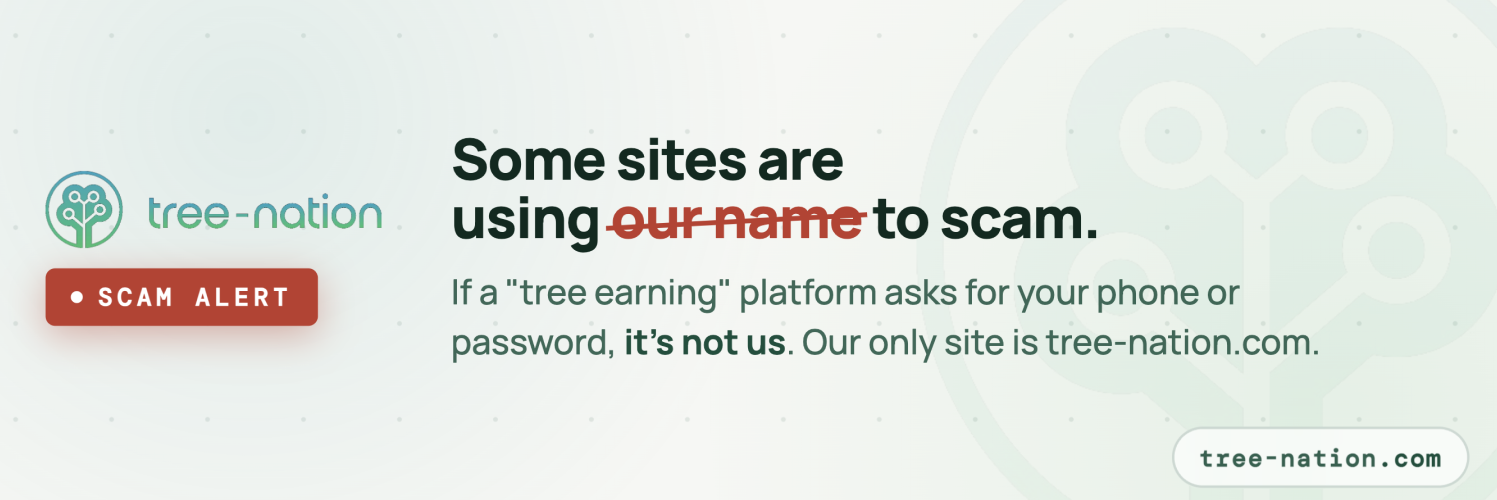
Over the last few months, some fraudulent websites have started using the Tree-Nation logo, our name, and our wordmark on fake login pages. They ask people for a phone number and a password, and pitch what they call a "tree earning" product. Daily payouts for signing up, referral bonuses, withdrawals that eventually stop working. The classic scam, dressed in leaves.
These sites are not us.
There is no Tree-Nation "earning" product, no daily yield, no paid login. Our only website is tree-nation.com. If you're ever unsure, that's the one to check against.
We're intentionally not naming the scam domains. No point sending them traffic they didn't already earn.
Why this keeps happening
When a mission resonates, fraudsters notice. Climate has become one of the most profitable hooks for online scams in the last couple of years. The same people who were running crypto rug-pulls in 2021 have rebranded into "green investment," "carbon yield," and "tree earnings." It's painted with trees and leaves now, but it's the same trick.
We're writing about it openly because we think it's worth knowing the pattern, whether or not you ever planned to plant a tree with us. If a scam ever targets another cause you care about, the tells below work the same way.
How to spot a fake
A few signs we've noticed across the sites impersonating us, and across the ones impersonating other climate brands too:
- They ask for your phone, not your email. Real platforms use email as the primary identifier. It's how receipts, legal notices, and recovery work. Phone-only is almost always a credential-harvesting funnel.
- They promise daily earnings on trees. Trees grow over decades. Nobody credible offers daily returns on a seedling.
- They lean on referrals. "Invite your friends to unlock higher tiers" is a pyramid, not a project.
- There's no map, no photos, no project list. If a platform talks about "our forests" but can't show you where they are, which species were planted, who planted them, or when, they don't really exist. For contrast, every one of our reforestation projects is published with a location, a partner NGO, a species list, field photos, and progress updates you can read through for yourself.
- The domain is new. A quick WHOIS lookup usually shows the site was registered a few weeks ago. Nothing wrong with new domains on their own, but paired with a brand that claims to have been around for years, it's a red flag.
- The pitch came in a DM, not from the brand. Telegram groups, WhatsApp forwards, SMS links, Facebook Reels: these are the distribution vectors. Real climate platforms don't onboard users through messages from strangers.
What we're doing about it
We've reported the sites currently impersonating us through the proper abuse channels. Some will come down quickly; others will drag. And when one disappears, another tends to pop up on a new domain a week later. That's the nature of this kind of fraud. We'll keep filing, because the reports feed into the databases browsers and email providers use to block scam sites at scale.
If you think you landed on one
First: you're not naive for getting this far. These sites are designed by people who are professionally good at this, and they target people who care. Caring is a good thing to be.
A few practical steps:
- If you reused a password anywhere else that you also typed into the fake site, change it on those other accounts. A password manager makes this much less painful.
- Don't send money, crypto, or bank details to anyone claiming to represent Tree-Nation or a "tree earning" product. We don't have a product like that. Anyone asking for a deposit on our behalf is not acting on our behalf.
- Watch out for a follow-up "recovery" contact. A few weeks after the first scam, a second message often shows up offering to help you "get your money back" for a fee. That's the same operator, or one of their peers, running the recovery-scam layer.
- Tell us how you were contacted. If the link reached you through Telegram, WhatsApp, SMS, Facebook, or anywhere else, forward the message to support@tree-nation.com. The distribution channel is usually the most useful thing we can report next.
What a real tree with us actually looks like
Since we're here, it's worth saying what the real version is, if only so the contrast is obvious.
When you plant a tree with us, you get a certificate with the species, the date it was planted, the reforestation project it belongs to, and the country where it's growing. Over time, we send updates: photos from the field, news from the NGOs running the planting on the ground, and progress reports as the forest matures. Every project on our platform has a public page with its own map, partner organisation, planting records, and species list. We don't ask for your phone number. There's no dashboard of daily payouts. There's no login that collects anything it doesn't need.
Individuals can plant a single tree as a gift or grow a personal forest over time. Businesses can offset their emissions, run employee reforestation programmes, or gift trees to customers. Whatever the route, the tree is real, the location is real, and the people planting it are real.
One last thing, plant a real one
If reading this made you want to do the opposite of what the scammers do, the best response is probably the simplest one: plant a tree with us at tree-nation.com. One tree, a forest, a gift, a monthly drop, whatever fits. Everything comes with real coordinates, real photos, and real updates over the years.
The return on a real tree is a real tree. That's the whole promise, and it's the only one worth making.
Thanks for reading, and thanks for being the kind of person who cares enough to be a target. Stay safe out there. If you ever see a link that looks like us but doesn't feel right, write to us at support@tree-nation.com. We'd rather answer a hundred "is this you?" emails than let one person get taken in.
The Tree-Nation team
Comentários (0)
Deixe um comentário