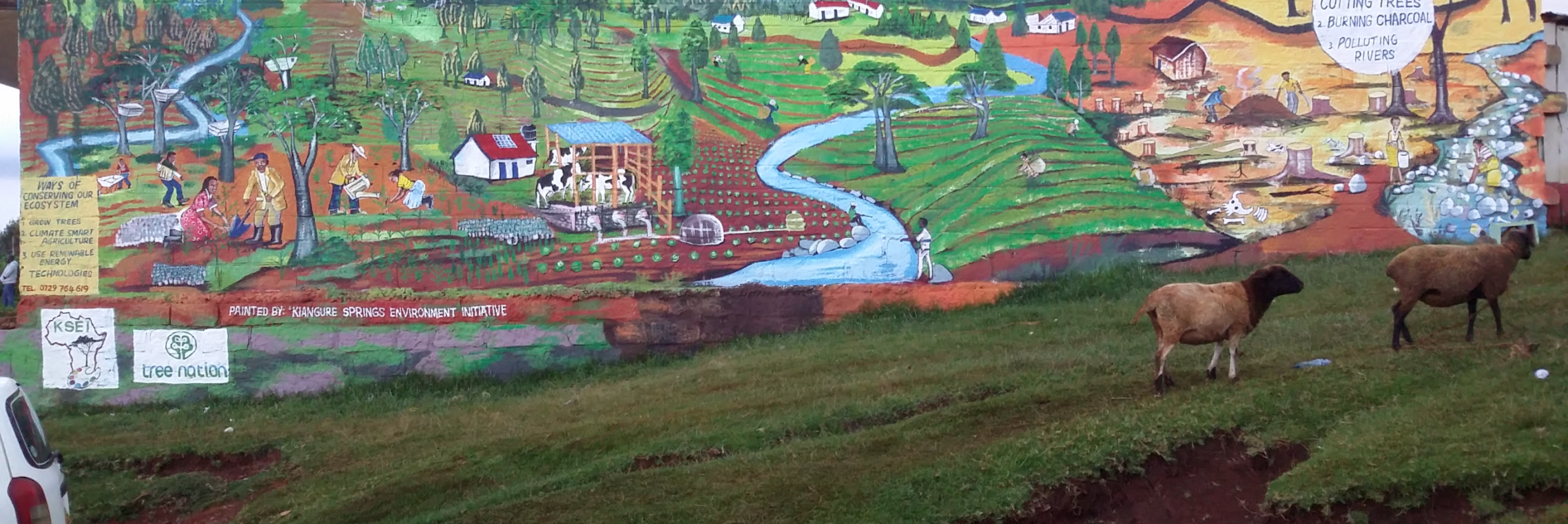

Mural art has emerged as one of the most powerful community-based communication tools for environmental conservation and climate change awareness. Through initiatives such as the Save the Aberdare Forest project, murals transform ordinary public walls into educational platforms that inspire communities to protect forests, water sources, biodiversity, and the environment. In rural and urban communities alike, mural paintings create a lasting visual message that reaches people regardless of age, literacy level, or social background.
One of the major roles of mural art is simplifying complex environmental issues into understandable visual messages. Climate change, deforestation, pollution, soil erosion, and water conservation are often scientific concepts that many community members may not easily understand through written reports or technical presentations. Murals use images, colors, symbols, and local cultural expressions to communicate these issues in a simple and memorable way. A painting showing dried rivers, destroyed forests, or wildlife loss immediately communicates the consequences of environmental destruction, while murals depicting healthy forests, clean rivers, and productive farms inspire positive action.
Murals also serve as permanent public reminders of conservation responsibility. Unlike workshops or seminars that occur once and end, wall murals remain visible every day in schools, markets, shopping centers, churches, bus stages, and community halls. They continuously reinforce conservation messages to residents and visitors. In areas surrounding the Aberdare Forest, murals can constantly remind communities about the importance of protecting water catchment areas, preventing illegal logging, reducing forest fires, and planting trees.
Another important role of mural art is promoting community ownership and participation in environmental conservation. When local youth, artists, women groups, schools, and community organizations participate in painting murals, they become directly involved in spreading environmental messages. This participation creates a sense of responsibility and pride toward protecting natural resources. Community members begin to view conservation not as a government obligation alone, but as a shared community duty.
Murals are also effective in preserving indigenous environmental knowledge and cultural values. Many African communities traditionally respected forests, rivers, and wildlife through cultural beliefs and practices. Environmental murals can incorporate local symbols, traditional stories, indigenous trees, and cultural identity to reconnect people with conservation values that may be disappearing due to modernization. In this way, mural art bridges traditional knowledge and modern climate action.
Additionally, mural art attracts public attention and stimulates dialogue. Large colorful paintings naturally capture people’s curiosity and encourage conversations about environmental problems and solutions. Children ask questions, youth discuss climate change, and adults reflect on environmental practices affecting their livelihoods. This helps create a culture of environmental awareness at the grassroots level.
Murals can also inspire behavioral change. Visual campaigns encouraging tree planting, waste management, river protection, clean energy use, and sustainable farming practices influence how people interact with the environment. For example, murals showing the connection between forests and rainfall can motivate farmers to support reforestation efforts. Paintings illustrating pollution and waste disposal impacts can encourage cleaner community practices.
For projects such as Save the Aberdare Forest, mural art additionally strengthens environmental advocacy and visibility. Murals create a recognizable identity for the project and help attract support from schools, government agencies, NGOs, donors, tourists, and environmental partners. They demonstrate creative and inclusive approaches to climate education that resonate strongly with communities.
In the context of climate change mitigation, mural art helps communities visualize both the dangers of environmental degradation and the hope of sustainable action. Murals can portray themes such as afforestation, renewable energy, water conservation, wildlife protection, and climate resilience. By doing so, they encourage communities to become active participants in protecting ecosystems for future generations.
Ultimately, mural art transforms walls into voices of environmental conservation. It educates, inspires, mobilizes, and unites communities around the common goal of protecting nature and combating climate change. Through creative visual storytelling, initiatives like Save the Aberdare Forest project demonstrate that art is not only a cultural expression but also a powerful tool for environmental transformation and sustainable development.
Comentários (0)
Deixe um comentário