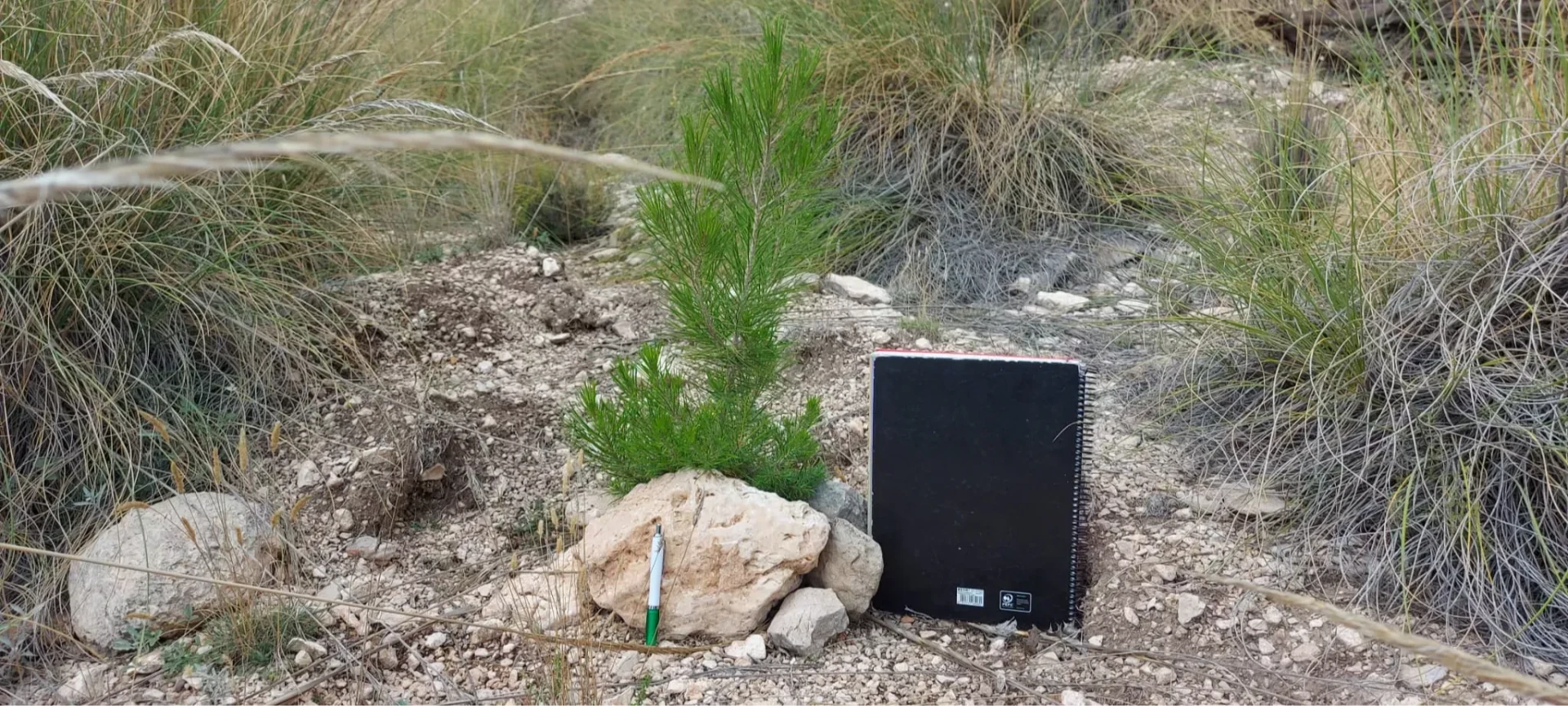

Despite facing difficulties, the plan demonstrates a remarkable survival rate in certain areas, while in others it presents unique challenges.
Since 2016, AlVelAl has been working on an ecosystem restoration plan for the creation of an ecological corridor that links the territory in which it operates.
A plan designed under the criteria set out in the Andalusian Master Plan for ecological connectivity, the presence of people associated with AlVelAl with a natural area, public forests present in the territory, institutional support for the development of the actions and the technical and economic viability of the same.
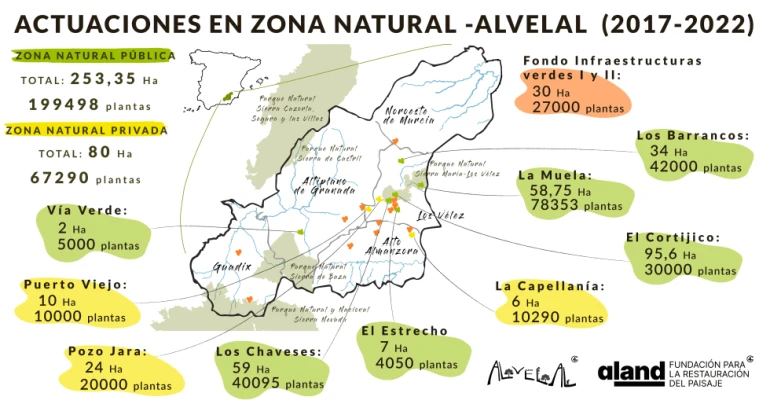
Within the framework of this project, various actions have been carried out in the territory in which a total of 368,000 individuals of autochthonous species have been planted, 733,253 seeds have been sown and 15 biodiversity ponds have been built. All of them thanks to the collaboration of public entities such as the Sierra María - Los Vélez Natural Park and the Department of Sustainability, Environment and Blue Economy of the Andalusian Regional Government; and private entities such as the Aland Foundation, Ecosia, Tree-nation, Trees For All, Life Terra, Jonas Philanthrophies, Retree, Holding Pon, Commonland and the Wates Foundation.
These actions have faced various challenges, especially the environmental conditions that we found in the AlVelAl territory, the orography of certain areas of action, very poor soils in some cases, irregular rainfall in recent years and the massive presence of wild rabbits in some areas at specific times. The latter has been a major difficulty until last year, when we were able to make competitive biodegradable protectors available.
In this scenario, the survival rate between the different projects varies between the 90% we found in the El Cortijico actions and the 11% we found in La Capellanía.
Actions in public land
Ecosystem restoration actions have been carried out in different parts of the AlVelAl territory thanks to the collaboration of public and private entities for the large-scale restoration of the territory.
Thus, in La Solana de La Muela, different phases of work have been carried out, carrying out plantations, tests with coconut trees and thinning of the existing pine forest mass due to the extreme difficulties of colonisation of certain species. To this end, specific nuclei of future seed donors were created, diversifying the monospecific forest mass, thus reducing the risk of forest fires and increasing biodiversity.
In this area, due to the adverse conditions of both the area of action and the weather we have experienced in recent years, the survival rate is 20%.
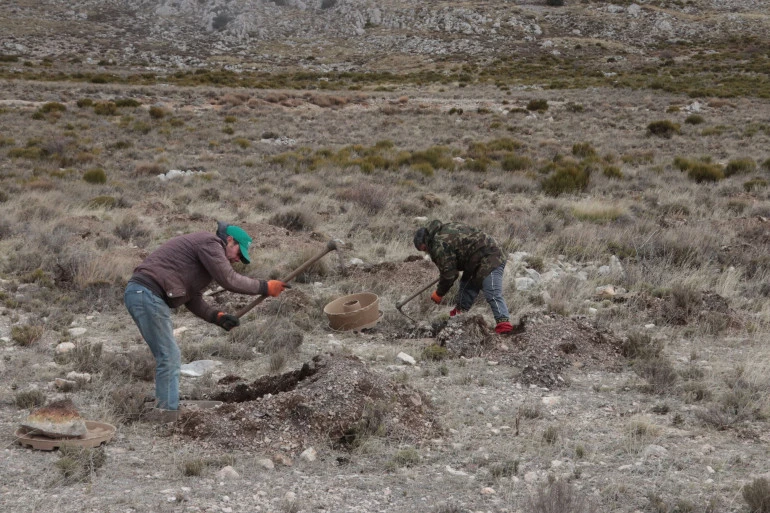
In El Cortijico, El Estrecho and Los Chaveses, various phases have also been developed with plantations of native species, sowing acorns and seeds with drones with the aim of creating a viable population of Sabina albar to help preserve the gene pool of the Sabina Milenaria, increase the presence of Pinus nigra and enrich with shrub species that produce flowers and fruit. Drone planting, an innovative technique in Andalusia, did not give the desired results due to the lack of rainfall in the area in recent years, which has been scarce and torrential.
In Los Barrancos, two phases of planting have also been carried out in order to recover the populations of Sabina albar and other species of Juniperus; in the same way that in La Alfaguara a repopulation action has also been carried out with 5,000 plants.
Actions in private areas
The involvement of the people associated with AlVelAl and their commitment to the restoration of ecosystems in the natural areas of their farms is fundamental for the development of AlVelAl's land restoration plan.
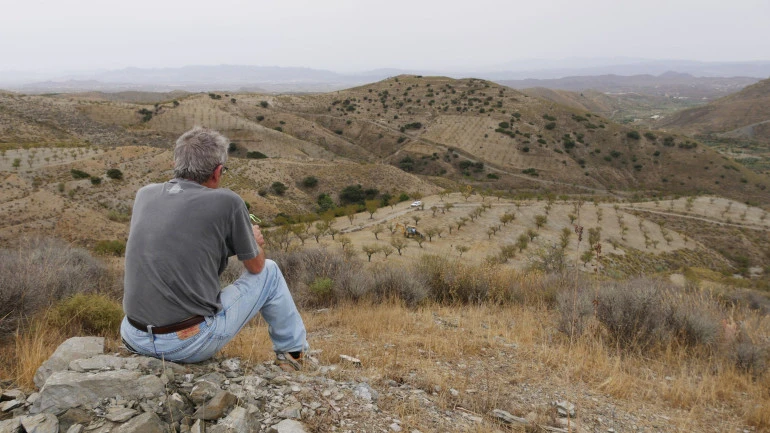
Thus, throughout the years of life of this association, ecosystem restoration actions have been carried out in natural areas in five private estates. La Capellanía, with the aim of reforesting an agricultural estate; Pozo Jara, with the aim of diversifying the forest mass and creating a nucleus of Sabina Albar; Belveles Puerto Viejo, reforesting with different species of Juniperus and Pinus halepensis, as well as shrub species; La Junquera to support the slow serial evolution of a hill by planting Juniperus thurifera, Pinus halepesis and shrub species; and Montilla, with the aim of creating a population of Sabina Albar and assisting the natural recolonisation of Holm oak and Juniper.
Guarantees
Since its inception, the ecosystem restoration plan has been ratified by the different boards of AlVelAl and has been submitted to different certifications that guarantee the work that the organisation is carrying out in this area. It has been certified by Earth Mind's Voluntary Conservation Areas and Preferred by Nature's Forest Ecosystem Restoration Standard, and has been evaluated by the Society for Ecological Restoration Robin Chazdon and published in its newsletter.
These certifications show us the success of our effort that needs continuity and the importance of explaining how the Mediterranean semi-arid ecosystems are and how the constant change of conditions due to climate change are leading to innovate against the theoretical models.


