Canada78.7 Score de qualité
We are restoring Manitoba's Boreal Forests by planting native trees in collaboration with local Indigenous communities. These forests, damaged by pest infestations and wildfires, need proper management to recover and withstand future threats. By planting native species and ensuring forest maintenance, we can guarantee their long-term resilience and restoration.
Forests aren't only restored by experts — they're kept alive by communities.
Across Canada, families and local volunteers are showing up, seedlings in hand, turning restoration into something personal. The work is simple, but the impact grows for decades
When degraded land is replanted with native species, it rebuilds the structure wildlife depends on — from canopy cover to understory shelter.
From forest canopy to syrup production, this iconic Canadian tree connects ecology, economy, and tradition.
Winter in the boreal forest favors trees that can wait. Pines hold onto their needles year-round, making use of brief light and warmth whenever conditions allow.
In parts of Canada’s boreal forest, fog contributes moisture directly to mosses and surface soils. These cool, damp conditions slow decomposition and shape how the forest stores carbon.
Forests are built to withstand change — but not unlimited pressure.
In high-use natural areas, long-term resilience depends on how recreation is managed. Staying on marked trails, respecting closures, and limiting off-trail impact helps forests regenerate naturally and maintain
Conservation at Devil’s Lake is continuous work.
Local teams regularly monitor forest conditions, address early signs of degradation, and carry out maintenance that helps prevent long-term damage. This steady, on-the-ground stewardship is what keeps the area resilient.
Keeping an eye on tree growth isn’t just about measuring height. It’s about noticing how the seedling is settling in—how its color changes, how much new growth appears, and whether it’s handling the local conditions as expected.
Here, a newly planted seedling is getting one of the most important parts of early maintenance: water. In Canada, young trees need regular hydration to adapt to the soil, withstand temperature swings, and grow into healthy forest companions.
Deer are a familiar sight in North American forests—but they’re also an important part of keeping ecosystems balanced.
Healthy forests provide them with food and shelter, and in return, deer help shape plant growth and spread seeds. Protecting these forests means protecting the wildlife
The Kirtland’s Warbler is one of North America’s rarest songbirds.
It relies on very specific forest conditions to survive—young jack pine stands found in parts of Canada and the northern U.S. Protecting and restoring these forests means giving species like this one a real chance
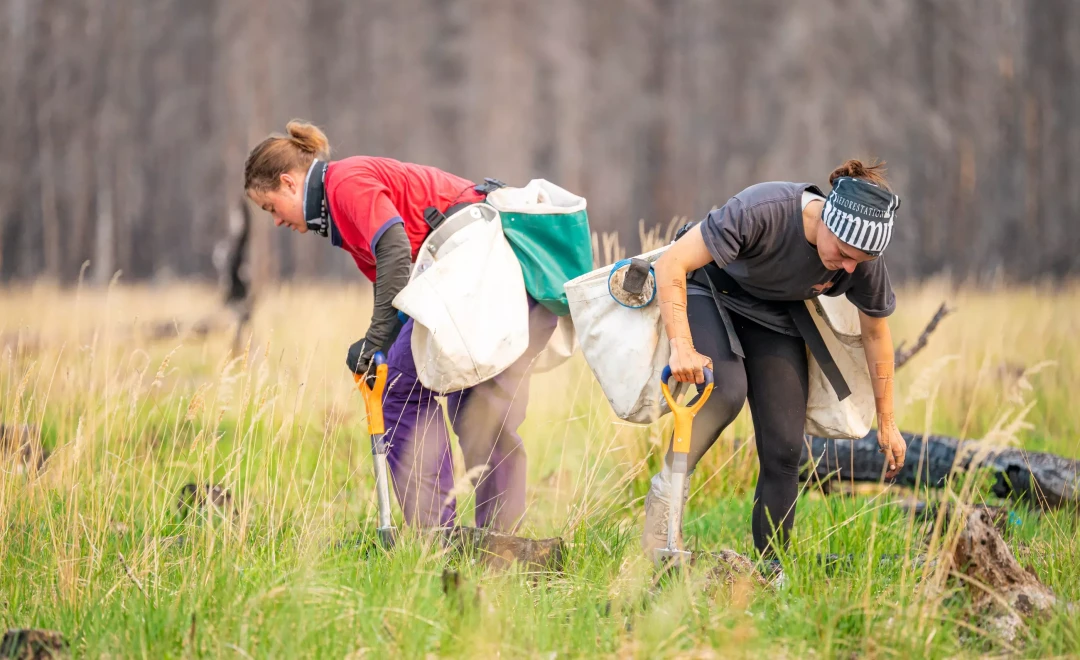
Back at Devil’s Lake, Canada, planting was all about keeping things practical.
With a shovel and bags packed with seedlings, the team planted directly into the soil—one tree after another. Simple tools, steady work, and a big impact for the forest.
Throwback to our planting activities at Devil’s Lake, Canada.
Back then, the team put in a huge effort to get the trees in the ground—hard work that was all about improving the quality of the forests in the area. Looking back, those days set the foundation for the progress we see
Autumn is almost here! 🍂
We can’t wait to see the leaves change colors—and to know that many of those trees, planted through our project, will be part of the beautiful scenery.
Getting to know our forests is the first step to protecting them.
Awareness creates connection—and that’s what drives real conservation and restoration.