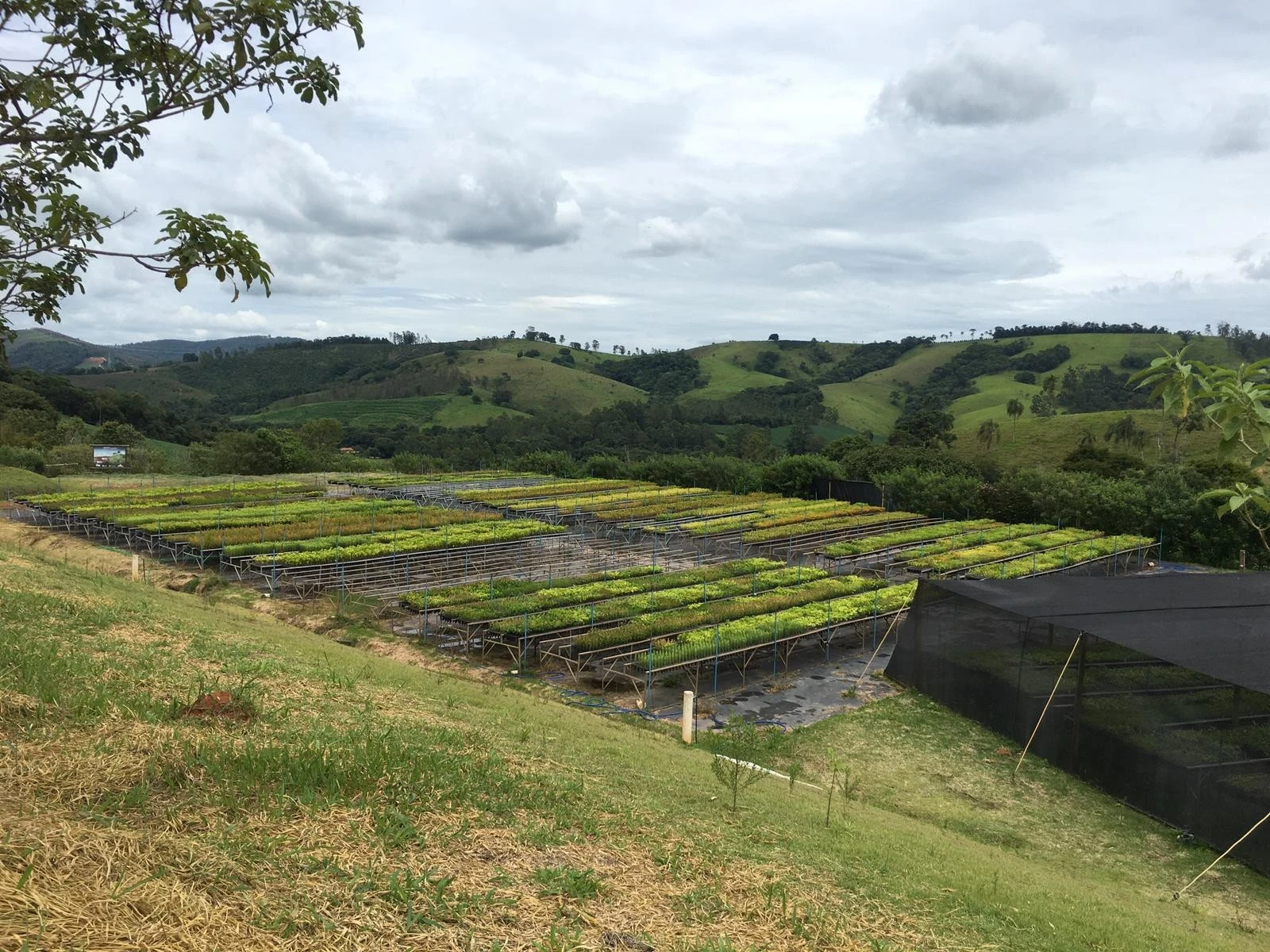

Tree-Nation just came back from visiting the Copaiba project, located in the North of Sao Paulo state in Brazil. Philippa, our Corporate Partnerships Manager went to visit the Copaiba nursery close to the picturesque city of Monte Alegre do Sul to see the great work that is happening on this project. Philippa and Dede, our Brazilian videographer were able to film and take interviews of the team on the project and the Tree-Nation planting site. “It was so great to put faces to names and meet everyone”, says Philippa. The team , mostly female, the project founders Flávia Balderi, Ana Pauloa Balderi, Tiago Sartori and Richieri Antonio Sartori were all there to greet and give a warm welcome.
We began by meeting every team member and getting a tour of the site, learning more about the Copaiba project and its long standing history in the area. Flavia explained to us that the project started just over 20 years ago, celebrating its 20th anniversary of reforestation in the region in January 2020. It has been growing and learning how to reforest the area , building strong relationships with sponsors as well as land owners to continue the work. In 2005 they were given the land in which their Copiaba HQ is based and they recently won an award for their work, the 2019 winners of Premiação das Melhores ONGs do Brasil for their continuous efforts and innovation.
“We’re all very honored and proud of what has been accomplished”, said Flavia.
In total, the Copaiba project has planted over 20 million trees. Their nursery extends on 5000 m² with the capacity to produce 500,000 seedlings per year of 140 different species. Currently the nursery holds 350.000 seedlings of 85 species and has 3 main areas, the first – where the seedlings are first placed in soil. All saplings are grown directly from seed and kept growing until they are big enough to be put into their planting capsules. We went to visit this area of the nursery, which is where all the work starts out. Usually when the seedlings grow to around 2.5cm in height, they are then transferred to an effective tubing and capsule system. These planting tubes then grow the seedlings into saplings and are transferred into another area of the nursery, where they grow to around 17.5 cm in height. They are then ready to be planted in the ground to create a new forest!

Veridana and Myriam preparing the saplings for planting
Before they are sent to be planted, each sapling is carefully removed from its growing tube and set out, species by species, in just the right mix for the planting site and ground conditions. One by one the saplings are laid out side by side, in around a 2m line, where they are then rolled up tightly into a neat bundle ready to be taken out into the field. This multi-species bundling technique makes the planters job a lot easier once on the planting site, as the species have already been selected, they can be planted more efficiently during the day and we can ensure that the saplings have the best chance of survival once in the ground, said Veridiana and Myriam.

The saplings are carefully removed from their casing.
Before planting happens, a hole of around 30 cm is dug into the ground and a special mix of nutrients that allow the area of ground to hold more water and food for the saplings is placed into the planting hole. The sapling is then placed into its new home and the soil is compacted back into the ground, ensuring to dig into the surrounding area with the planters hands to allow better filtration of water for its first months. Once all the saplings are placed into the ground on the planting site, they are then watered and maintained by the team. Ensuring that the saplings stay healthy and grow into adult trees is the team's main priority.
Usually, the planting sites are areas of land owned by local private land-owners, that have committed, along with the Copaiba team to reforest their land.
The Mata Atlântica, translated ‘Atlantic Forest’ where the Copaiba project is based has lost over 85% of its original forest cover, before deforestation the Mata Atlântica extended over 1.5 million km2 along the South American Atlantic coast. Sadly today, its forest cover is only 12% of the original Atlantic Forest. Most of the forest was cut down in order to raise cattle or for industrialization of the area, and logging. This is why the Copaiba project is so critical to regenerate this lost wilderness. Not only will this create more forest cover, but this will bring back biodiversity to the area, and natural habitat for wildlife, so animal populations can also recover. The Copaiba project spans the region between the River do Peixe (River of Fish), and the River Camanducaia.
During the visit we were able to receive more details about the projects valuable work. Dede, our spectacular filmmaker, based out of Sao Paulo was able to document this history and film the daily activities in the nursery. We also conducted interviews of the fabulous team, and the film will be ready to release to all Tree-Nation citizens and partners next month.
Dede and Philippa were able to spend some personal time with the team members to learn more about their stories of growing up in the area and the impact the project has had in the area.
Philippa says, “We met Bernadette, who has been working on the project for 5 years, she told us how important the work is, not just for her, but for her family, especially her children, who will benefit from the restoration in the generations to come”.
Tree-Nation began to partner with the Copaiba project in august of 2019, providing funds for the tree planting. “Thank you to everyone who has helped this project so far” says Ana, a Copaiba founder.
During the visit, the first 1,000 trees planted by Tree-Nation were marked, and the first plaque was placed at the site of the Tree-Nation planting area by Branco, the nurserie’s caretaker and handyman, where Philippa and Dede were able to plant more trees that day.

Branco raising the plaque for the first 1000 Tree-Nation trees planted on the Copaiba project.
“I thoroughly enjoyed meeting everyone on the team, and helping with the planting of the saplings into the Tree-Nation planting site” says Philippa, who is excited to visit the project again one day.
With the support of our Tree-Nation citizens the Copaiba project is set to continue its valuable work for another 20 years, and hopefully more.
Tree-Nation is very proud of its citizens, partners and everyone who has contributed so far and in the future, thank you!
The Copaiba project welcomes all visitors to its project, so if you think you would also enjoy a visit, or if you would like to find out more about how you can support this project, or if you have any questions, please contact copaiba@tree-nation.com.
Stay tuned for our video and the next project that we visit!

And rolled into their multi-species bundles.

Dede conducting interviews with the nursery team.

Philippa, our Corporate Partnerships Manager was able to get her hands dirty for the day and help with the transferring of the seedlings into their capsules ready for the next stage in growing.
#tnphoto #nursery #FromAbove

