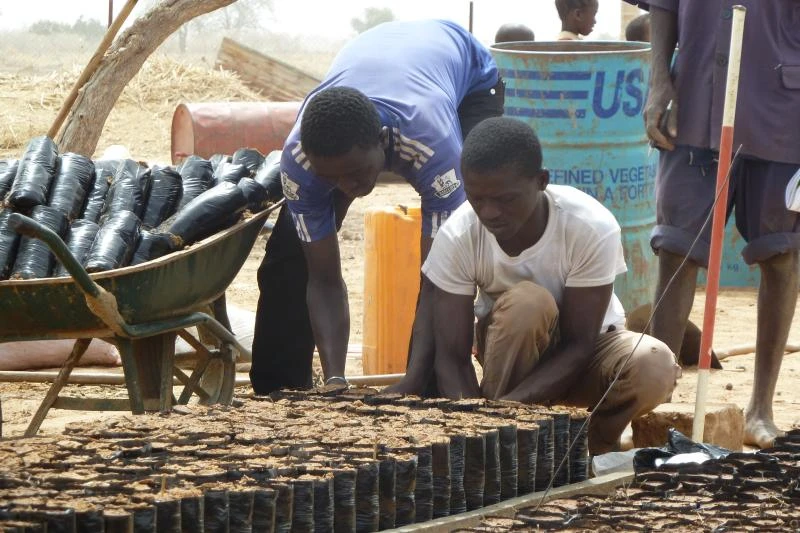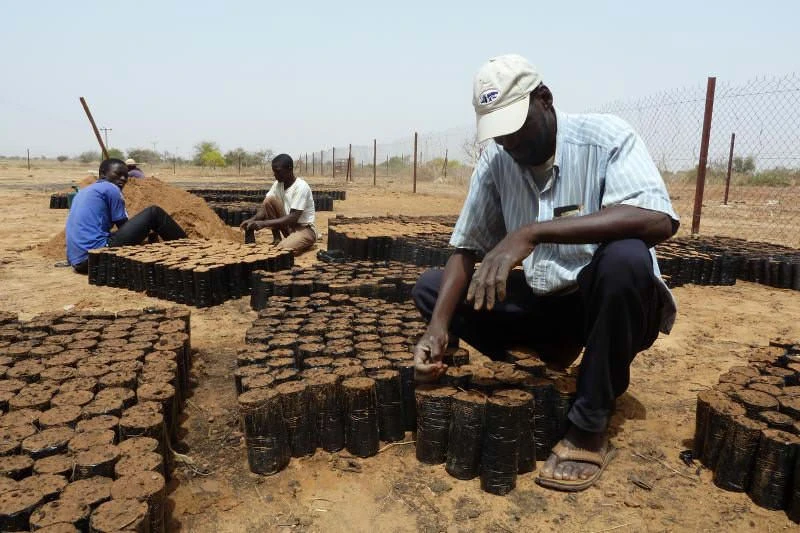
The boys and girls who make it happen
Here are all of the steps that will be carried out until the beginning of the planting season early July.
Trees come in all shapes and colors
A total of 45 000 trees will be residing in our nursery (excluding the Moringa), however the new drilling will allow a second production before the end of the year. For the annual production, we also add the #Moringa_oleifera, which grows very well in direct seeding (12.5 Hectares or 125,000 trees planned + the ones that will be planted with villages and small land owners). Many thorny trees will be planted this year since such trees are ideal when it comes to creating natural plant barriers (mainly against animal and winds). Some fruit varieties also add to the Tree-Nation tree mix since they ensure good yields in the long term.
The production will be distributed as followed:
- 25000 #Acacia_senegal
- 5000 #Bauhinia_rufescens
- 5000 Zizyphus (grafted)
- 1000 Mango trees
- 3000 Lemon trees
- 1000 #Carica_papaya
- 500 apple guava
- 500 Karités
- 2000 Baobabs (#Adansonia_digitata)
- 1000 #Khaya_senegalensis
- 1000 Cassia
Good preparation is half the rent
We have installed a permanent nursery next to the main entrance and close to the edge of the road, thus giving our project better visibility. The terrain has been cleared of debris and rubbish and we constructed a sun-protected siesta spot for the workers. Local artisans have woven the north-facing straw fence that will decrease the impact of the hot winds in April and May. Other resources were purchased on the local market: sand, fertilizers, manure, pesticides, pots and seed.
Filling the pots and getting them organized
To give the trees are good start to life, simply mix 2 wheelbarrows of sand with 1 wheelbarrow of manure and add 1 kilo of fertilizer and of course, water. We then fill the pots in such a way that there are no tapped air bubbles, but without it being too compact either. Pots are sprayed every day, and will be carefully aligned (100 x 10).
Between now and July
As soon as 1000 pots are ready we start inserting the seeds, starting with the ones that take most time to grow or that require #grafting. Nursery specialists then start giving water on a daily basis, while also removing unwanted weeds. In about three months the plants will be ready for the plantation. In the meantime they are gradually given less water so that they can adapt to their future homes. Nobody likes to come unprepared.
Grafting?
The Ziziphus and lemon trees are local species whose roots are well adapted to the soil. However, their fruits are small and contain many seeds. That’s where grafting comes into play, which basically consist or plugging a tree that produces big and juicy fruits on onto a local tree adapted to the soil (have a look here for more details on this method). The “plugins” come from trees from the plantations of our partner, the INRAN (Institut National de Recherche Agronomique du Niger)
Plantation
The rainy season stretches from May to September with the peak rainfall coming in July and August. To start the planting process the soil must be moist to dig the holes (done in May and June), and the trees should be planted when the clouds bring the heaviest rainfall and when the soil is wet and cooled. That’s all that’s needed to get the trees to grow.
What’s planned in the coming months?
The solar pump
We selected a revolutionary Danish system with a great performance when it comes to its photovoltaic panels and pump. Also, the system can be powered by a generator during cloudy weather (which is rather rare here, given that Niger is one of the countries which receives more than its fair share of Sunshine!). Learning form past experiences we have a contract that provides for penalties if the system is not installed before May 1st. We are therefore very confident to have everything ready on April the 29th!
The “California” irrigation system
Jardinex, a French agricultural development consulting firm, conducted a study for our project and presented 4 different scenarios for an irrigation system. Visiting different sites these next two weeks will allow for more insights and ultimately guding us to the best choice of system. Three different businesses will be then asked to make bids for the work that needs to be realized.