This report describes the latest activities from the months of March to June 2012. Important developments during this period relate firstly to the launch of the production of plants and also to extending the network of solar panels for increasing our limited capacity of water to meet the production needs and requirements of the #Moringa_oleifera plants.
Cultivation of forest plants and fruit
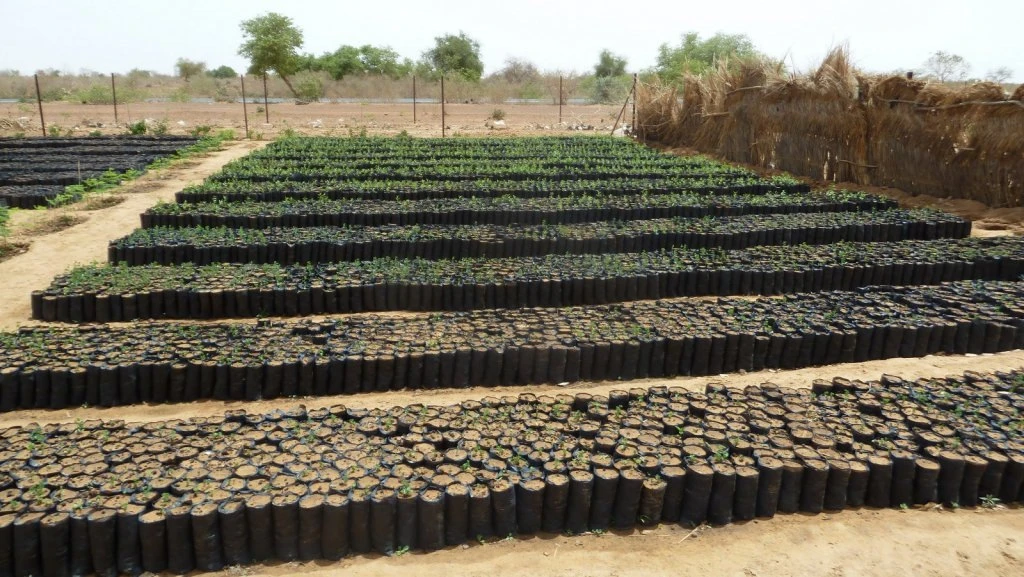
Production forecasts for this campaign were adopted in 2012 in an agreement between the team of Tree-Nation Niger and the technical council of INRAN (and Dr. Ichaou Abubakar). In total, 60 000 plants were expected for the 2012 plantings and an estimated 66,000 were potted.
Filling the pots started on April 7, 2012 and was carried out exclusively by women in and around the farm. In total, 67,355 pots have actually been filled with plants, while 1,529 of these pots were made from recycled plastic bags.
A few days later, sowing of 8000 Ziziphus and 5000 Bauhinia (new species) plants started. The seedlings of other plants followed the week after that. The poor quality of this year's seeds, although we worked with a qualified seed bank, led to two replanting operations, especially for the acacias. 3,540 filled pots, with 1,529 bags recovered, have not been planted by the end of June. The root pruning of the 13,000 seedlings of Ziziphus and Bauhinia was already done and the plants that have not advanced were replaced.
For the fruit trees, sowing in seed beds worked quite well. They will be transplanted into pots at the end of July.
Expanding the number of solar panels
We've finally made the decision to expand our number of solar panels to increase the pumping capacity. The dryness of the recent months, vegetable production and planting of Moringas which require a constant supply of water, have convinced us in this choice.
Similarly, the lack of water did not precisely measure the overall impact of our new drip irrigation system, although tests on some plots have been successful.
We now have six additional solar panels of 230 watts each (therefore a total of 1380 watts) that were added to the existing network of 10 panels. This brings the network's capacity to 3,680 watts in total. This new capability has enabled the pumping system to extend its daily operating time by at least 2 hours allowing for an increased production of water of at least 15 cubicmetres per day.


