

#CarbonCatchers #EcoEducation
Lately, the debate over the numerous applications of blockchain technology and cryptocurrencies has broadened significantly with heated discussions over their environmental impact and the role they may play in building a more sustainable world. But let’s start from the beginning.
Blockchain and cryptocurrencies
The core concept of blockchain is in fact quite easy. Simply put, blockchain is a type of database, a collection of information that is stored electronically on a computer system (Conway, 2020).
Not every database is a blockchain, however. A traditional database is typically structured in table format to allow for easier searching and filtering for specific information and it’s usually managed by one individual or business that has complete control over how it works and the data within it (ibidem).
A blockchain, on the other hand, collects information together in groups, also known as blocks. Blocks have a certain storage capacity and, when filled, are chained onto the previously filled block, forming a chain of data known as ‘blockchain’. The chain of data is encrypted, which means that it cannot be altered by anyone, creating a sort of irreversible timeline of data (Filcak, Považan, Viaud, 2020).
Another major difference with traditional databases is that, even though private blockchains do exist, the vast majority are decentralized. Like any database, blockchain needs to be stored on a collection of computers, but unlike a normal database, each computer or group of computers is operated by a multiplicity of individuals in different geographic locations, rather than by only one individual or business (Conway, 2020). The whole point of a blockchain is to let people who don’t know and trust each other share valuable data in a secure, tamperproof way (Orcutt, 2018).
Why is blockchain technology so revolutionary, you may ask? The goal of blockchain is to allow digital information to be recorded and distributed, but not edited. This means that blockchain technology is a lot more secure than a normal database because it prevents individuals from altering the data and blocks within the chain. By being decentralized and accessible to anyone, blockchains are also more transparent both because anyone can access the information - through so-called blockchain explorers - and because in order to change the information stored within the blockchain, the majority of the members of the network would have to agree (Ibidem).
What are the benefits?
The application of blockchain technology can benefit several different areas, not only necessarily related to the world of finance, including governance, commerce, healthcare and education. In public administration, for instance, it can benefit users by allowing them to create records, such as land registries or birth certificates, without the involvement of public officials, making the processes less lengthy and bureaucratic. In Estonia, for instance, this system has been tested to allow people to use their ID cards to access a large variety of digital services (Filcak, Považan, Viaud, 2020).
However, while other things like legal contracts or product inventories can be stored, at present blockchains are mostly used to store cryptocurrency transaction history.
Cryptocurrencies are a form of virtual currency that can be used as a medium of exchange. Unlike traditional currencies, cryptocurrencies are not controlled by a central bank and their value doesn't depend on a single authority or government. The decentralized nature of the system and the automation of processes (for example through smart contracts) that would traditionally be performed by a ‘middleman’ mean that transaction costs are very low.
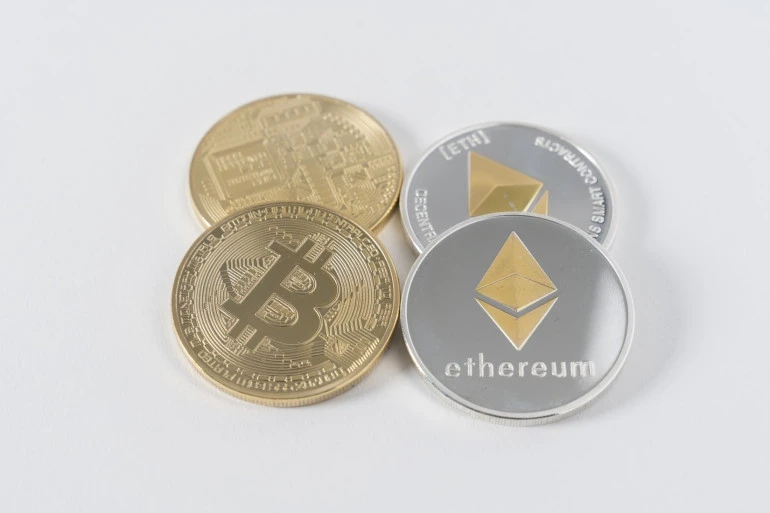
Another advantage of cryptocurrencies over traditional currencies is that transactions cannot be changed or altered and that they are available for anyone in the network to see, automatically increasing transparency and accountability (Goyal 2018). Just like with traditional money, there are different cryptocurrencies. The most popular one, Bitcoin, is not the only one and several others are emerging: Ethereum, Litecoin, Cardano, Polkadot to name only a few.
By building trust and curbing the opportunities for corruption, blockchain technology could steer the world towards sustainability. Blockchains for instance are being used to track products from the manufacturer to the shelf and help prevent waste, inefficiency, fraud, and unethical practices by making supply chains more transparent (FutureThinkers).
This will help consumers make ethical decisions when buying products. Another application is tracking and monitoring environmental treaties, forcing governments and corporations to stick to their commitments while also allowing people to check on the progress made (ibidem).
Environmental sustainability
While the applications are endless when it comes to blockchain technology and cryptocurrencies, the environmental impact that they have is a matter of debate.
Cryptocurrencies depend on so-called miners to verify transactions through calculations performed by computers, which end up using large amounts of energy. Since almost two-thirds of mining takes place in China, where coal is still the largest source of electricity, that equates to more emissions (Starn, Wade, Saul, 2021).

To give you an idea, the annual Bitcoin’s carbon footprint is estimated to be around 37 million tons of carbon dioxide, roughly the same amount produced by New Zealand. Recent studies found out that one Bitcoin transaction would generate the CO2 equivalent of 706,765 swipes of a Visa credit card (Laurent, 2021).
Using renewable sources of energy as opposed to traditional sources could be an easily accessible solution. As a matter of fact, while some Bitcoin miners have started to use surplus natural gas that would otherwise be “flared” to generate power for mining, others are moving to regions with abundant hydroelectric supplies like Iceland, Norway, Canada and parts of Russia (Starn Wade, Saul, 2021).
According to a study conducted in 2019, Bitcoin is already taking steps towards using more sustainable energy resources. It is estimated, as a matter of fact, that three-quarters of Bitcoin mining activity is powered by renewable energy sources (Suberg, 2019). According to the latest study, hydroelectric power is the most common source of energy for miners with almost 62% of miners using hydroelectricity to power their operations (Musharraf, 2020).
Another important aspect to keep in mind is that not all cryptocurrencies use miners. Some, for instance, rely on systems like “staking” - rewarding coin owners for holding on to their currency and approving or invalidating transactions (Starn, Wade, Saul, 2021).
There are also alternative cryptocurrencies that directly incentivize the use of clean electricity. Solarcoin, for instance, rewards users of photovoltaic energy (Martin, 2020).
Others, like Ethereum, are experimenting with different models of verification that would reduce their energy consumption. Also on the rise are cryptocurrencies developed to offset some of their environmental impacts, or return value back to the community (Finappster, 2019). A recent example is UPCO2, a digital carbon credit coin released by a crypto wallet company called Uphold at the end of 2020.
Each UPCO2 coin represents one year-ton of CO2 pollution averted by a certified project preventing rainforest loss or degradation. Every coin comes with a digital certificate issued by international standards agencies, which allows certified projects to turn their greenhouse gas reductions into tradable carbon credits. The projects supported by Uphold through carbon credit purchases are preventing deforestation in the Amazon, the Congo Basin, Indonesia and other threatened rainforests (Wolf, 2021).
Offsetting the CO2 emissions of cryptocurrencies is another way that could allow both companies and individuals interested in investing in cryptocurrencies to make their first steps into this world while reducing their environmental impact.
While a lot still needs to be done in order to build a system that is mindful of the Planet, blockchain technology and cryptocurrencies have the potential to become part of the solution. Understanding the benefits they bring and encouraging the development of greener alternatives can transform the world in ways that definitely are worth exploring.
Trends
- The global blockchain market size is expected to expand from USD 3.0 billion in 2020 to USD 39.7 billion by 2025.
- According to analysts, the number of women in the cryptocurrency industry increased by 43.24% in the first quarter of 2020.
Calculations
- A single Bitcoin transaction could power the average US household for a month, with the Bitcoin network able to process about seven transactions per second.
- In October 2010, $100 bought 1,000 bitcoins. If someone bought and held that asset until today, those 1,000 bitcoins would now be worth more than $48 million.
References
- Conway, L. 2020. BlockChain Explained. Investopedia, Accessed March 2021, https://www.investopedia.com/terms/b/blockchain.asp
- Laurent, L. 2021. Bitcoin is an incredibly dirty business. Bloomberg, Accessed March 2021, https://www.bloomberg.com/opinion/articles/2021-01-26/is-bitcoin-mining-worth-the-environmental-cost
- Filcak et all. 2020. Blockchain and the environment. European Environment Agency, Accessed March 2021, https://www.eea.europa.eu/themes/sustainability-transitions/drivers-of-change/blockchain-and-the-environment
- Finappster, 2019. Are cryptocurrencies sustainable? Accessed March 2021, https://www.finappster.co.nz/blog/sustainable-cryptocurrencies
- Goyal, S. 2018. The Difference Between Fiat Money and Cryptocurrencies.Yahoo Finance, Accessed March 2021, https://finance.yahoo.com/news/difference-between-fiat-money-cryptocurrencies-132027811.html
- Suberg, W. 2018. Bitcoin is using less energy despite hash rate, new data shows. CoinTelegraph, Accessed March 2021, https://cointelegraph.com/news/bitcoin-is-using-less-energy-despite-record-hash-rate-new-data-shows
- Starn et all, 2021. Bitcoin is Red Hot. Can it ever be Green?. Bloomberg, Accessed March 2021, https://www.bloomberg.com/news/articles/2021-02-10/bitcoin-is-red-hot-can-it-ever-be-green-quicktake
- Martin, B. 2020. How to make power-hungry cryptocurrencies more sustainable. OpenMind, Accessed March 2021, https://www.bbvaopenmind.com/en/economy/finance/how-to-make-power-hungry-cryptocurrencies-more-sustainable/
- FutureThinkers. 7 ways blockchain can save the environment and stop climate change, Accessed March 2021, https://futurethinkers.org/blockchain-environment-climate-change/
- De Maijer, C. 2020, Blockchain trends in 2021: Expect the unexpected. FineExtra, Accessed March 2021, https://www.finextra.com/blogposting/19679/blockchain-trends-in-2021-expect-the-unexpected
- Magas, J. 2020, The number of women in crypto and blockchain is skyrocketing in 2020. CoinTelegraph, Accessed in March 2021,
https://cointelegraph.com/news/the-number-of-women-in-crypto-and-blockchain-is-skyrocketing-in-2020 - Arshad, M. 2020, Are cryptocurrencies harming the environment?. Earth.org, Accessed in March 2021, https://earth.org/are-cryptocurrencies-harming-the-environment/
- Reinicke, C. 2021, Bitcoin hits another record. Here’s how much you’d have if you invested $100 in 2009. CNBC, Accessed in March 2021, https://www.cnbc.com/2021/02/12/how-much-youd-have-today-if-you-invested-100-in-bitcoin-in-2009.html
- Orcutt, M. 2018, How secure is blockchain really?. MIT Technology Review, Accessed in March 2021, https://www.technologyreview.com/2018/04/25/143246/how-secure-is-blockchain-really/
- Musharraf, M. 2021, 76% crypto miners use renewables as part of their energy mix. CoinTelegraph, Accessed in March 2021,
https://cointelegraph.com/news/report-76-crypto-miners-use-renewables-as-part-of-their-energy-mix - Wolf, J. 2021, A closer look at digital carbon credit coins. Sustainable Review, Accessed in March 2021, https://sustainablereview.com/digital-carbon-credit-coin/


