Are you going to reach your CO2 goal this year? Discover your new IMPACT section

Are you going to reach your CO2 goal this year? Discover your new IMPACT section

2

Dear Citizen,

We have been talking about Your Impact section for a long time and we are very pleased to finally release it!


Your new Impact section

This section allows you to follow your tree planting efforts and also to check on your CO2 compensation since your very first day as a Tree-Nation citizen! It takes all your trees into account, allocating the CO2 offset values of each species.

We'll be adding more interesting stats in this section over time, so feel free to make a suggestion in the comment section below.


Are you going to reach your CO2 offset goal this year?

As we are about to say goodbye to 2017, we would like to make sure you can close this chapter without leaving a trail of CO2 emissions behind.

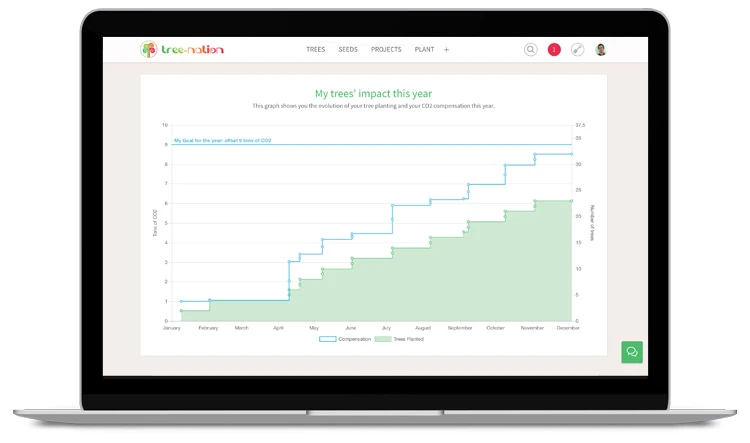
You can easily check this on the second graph of your Impact page as it displays your activity for the current year. You will notice the horizontal blue line with the caption "My goal for the year: offset 9 tons of CO2". This line is the goal to achieve for everyone who would like to offset ALL their CO2 emissions in a year. You can learn more about our calculation of 9 tons CO2 equivalent per capita emissions.

Take a look at your graph to see if you are above or below the goal line! You're still on time to offset 2017 with our improved Plant section!

If you prefer to plan for 2018, our Serial Planter programmes may come in handy since you can automate your CO2 compensation to make sure to reach your 9 tons goal, and more.

Happy Planting!

Leave a comment
Seed and grow5 December 2017
That is far more convenient than the worksheet I created back in spring 2012. The one and only critic is: you seem to account for the CO2 binding of a tree upon its planting rather than its lifetime. i.e. if I plant a tree now than will grow 25 years and will be cur in 40 years from now, then my CO2 compensation increases for the next 25 years, remains flat for another 15 years and releases the CO2, if the organic material is disintegrated (mostly: burned). So unless I know what the remains of the tree will be: wood, ashes, ... I don't know, for how I compensate CO2. As simple as that - maybe I should create a simple web-app to do exactly that.
Maxime Renaudin
Company
6 December 2017
"you seem to account for the CO2 binding of a tree upon its planting rather than its lifetime"
- Yes but only because this is the first version of our graph. We plan to show you both the full CO2 offset value of the tree lifetime AND the CO2 offset progression as it happens over time. You can see this in this picture here, how we plan to present it. https://info.tree-nation.com/wp-content/uploads/impact3.jpg
You'll notice there are 2 CO2 graph lines.
We plan to add this second graph but it means storing values in database and a little bit more time, for us at least :)

"and releases the CO2, if the organic material is disintegrated (mostly: burned)"
- Keep in mind that Carbon stored in wood is only released back to the atmosphere if the wood product is burnt or decays but not if it's used for construction for example (some CO2 may be released but most won't).
AND you can consider the CO2 is released only if no new tree takes its spot, which is almost always what happens, whether by natural forest expansion or by planting a new tree. (in one project, just planting 5 species helps increase the density of +60 native species from the region).
Also a lot of the CO2 is in fact stored into the soil so this part is usually never released, but this is something scientists have a hard time measuring.
In some projects like La Pedregoza the trees small wood will be collected and use to do Biochar which is a process releasing very little CO2 and then the biochar will be used to fertilize the grounds so not released into the atmosphere.
In general if a plantation project is well managed the net amount of released CO2 will be negligible.
Add the fact that we tend to take low CO2 estimations, you could consider the long-term CO2 release negligible.