
#CarbonCatchers series
Introduction
Awareness of climate change and the threats it poses has increased significantly over the last 12 months. This is a great thing as it means many individuals are making more environmentally conscious decisions in terms of what they eat, what they buy, how they travel and so on and so forth. Analysis conducted by Eurostat within the EU-28 has revealed that food products have the third highest carbon footprint in terms of carbon emissions per person (Eurostat, 2019). With this in mind, it is quite common to hear of people changing their diets to try to reduce these emissions. Another solution often quoted as a way to reduce carbon emissions is to buy ‘locally’ produced food. This article will discuss what the real impact of buying local food is and whether or not it is more environmentally sustainable.
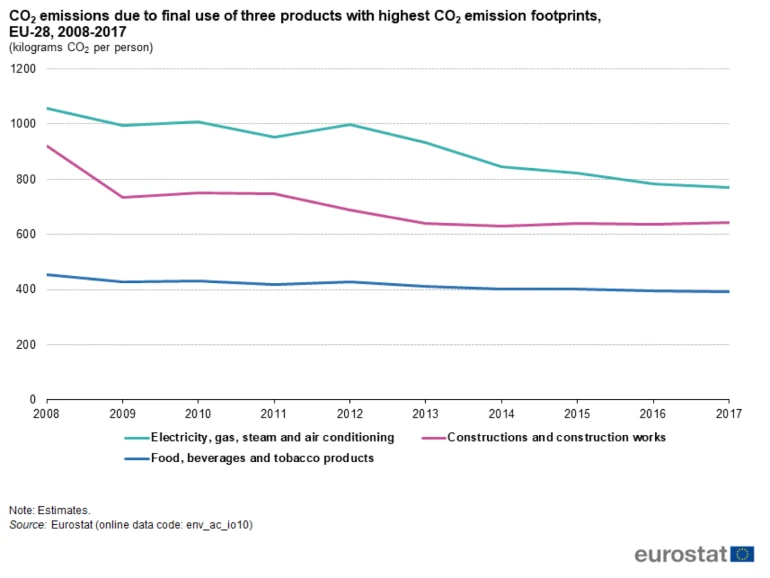
Figure 1: CO2 emissions due to final use of three products with highest CO2 emission footprints, EU-28, 2008-2017 (kilograms CO2 per person). Source: Eurostat https://appsso.eurostat.ec.europa.eu/nui/show.do?d...
Defining “local”
First of all, we must determine what buying locally actually means. Typically, local and non-local goods are defined by distance from place of production to place of consumption (Rahnama, 2017). The distance at which an item goes from being local to non-local is not specifically delineated but according to the Agriculture Committee of Congress of America, if the total distance a product has been transported is less than 400 miles (644km) from the original area or state of production it is considered local (Martinez et al., 2010). However, in other small countries this distance is reduced to between 30 and 50 miles (Jones et al., 2004).
Food miles
With the increasing impact of climate change, many consumers have become greatly concerned by the concept of ‘food-miles’. Since a study from the 1990s which coined the term, food-miles has been used as a proxy for the sustainability and environmental impact of food (Paxton, 1994). The focus on food miles, which is roughly a measure of the distance travelled from the place of production to consumption, has sparked many to concentrate efforts on buying locally sourced and produced foods. Many studies agree that the further food is transported, the greater are its associated carbon emissions. For example, a Canadian study concluded that 3.3 million tonnes of CO2 were associated with imported food annually (Kissinger, 2012). Figures such as these would of course encourage someone who is environmentally conscious to buy more locally produced food in an effort to reduce their own carbon footprint.
Not just the transport matters
However, such an approach at evaluating sustainability places a lot of emphasis on the transport phase and ignores all other aspects of food production. While it is true that on average, an American dinner plate has travelled 1640km to get there, a study published in 2008 found that the vast majority (83%) of food-related emissions are associated with the production phase rather than the transportation phase. The study suggests that dietary shifts away from more greenhouse gas intensive food sources are a more effective way of reducing a household’s carbon footprint than buying locally (Weber and Matthews, 2008). A similar study in the UK conducted by the Department for Environment, Food and Rural Affairs found that tomatoes grown in Spain for the UK market had a lower carbon impact that tomatoes grown in the UK itself as a result of different production methods (Smith et al., 2005).
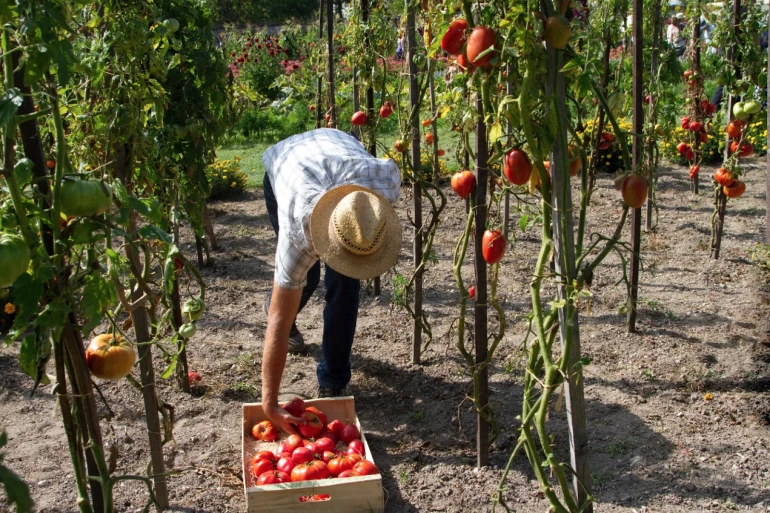
Figure 2: Harvesting summer tomatoes. Photo by: Kamala Saraswathi
Local or Organic
Local might not be best practice it turns out. There is an assumption that buying the most geographically local produce has the lowest carbon footprint and there is a tendency to label any mass-produced and transported food carbon intensive. A study from 2009, however, which compared bulk suppliers with local organic farms found that the overall carbon emissions from these bulk suppliers can be lower than buying ‘locally’ if buying locally requires a round-trip distance of more than 7.4km (Coley et al., 2009). This is because of the concept of the ‘last mile’. For one person to drive a distance of 7.4km to a farm to buy a small number of products is more carbon intensive per item than transporting en masse from a distant farm. Furthermore, the same research team produced a later study indicating that mode of transport was just as important as distance in determining carbon emissions associated with food (Coley et al., 2011). The paper concludes in saying that the concept of food-miles having a correlation with sustainability needs to seriously be re-addressed and in fact a more holistic and realistic way to evaluate the sustainability of the food we eat is through lifecycle analysis.
Fair miles
Another thing to consider in the argument of whether local is best is the concept of ‘fair miles’. Many farmers in the developing world are reliant on the export of goods to western markets for their livelihood. It is estimated that over one million people in rural Africa are supported both directly and indirectly through the export of fresh fruit and vegetables to the UK alone, generating an estimated £200 million income for these rural economies (MacGregor and Vorley, 2007). Furthermore, when the production of green beans in Kenya and the UK was compared based on lifecycle analysis excluding transport, the emissions were surprisingly similar (Smith et al., 2015).
Not all transports are equal
As previously mentioned, method of transport is also important in determining the carbon emissions associated with the transport of goods. For example, while 65% of UK food transport was associated with the shipping industry, this only accounts for 12% of food transport emissions (Smith et al., 2005). Although the shipping industry is enormous, it has a smaller carbon footprint when compared with other transport methods. In 2012, global CO2 emissions reached a staggering 35,640 million tonnes CO2. Of this, the international shipping industry emitted 796 million tonnes of CO2 comprising 2.2% of global emissions for that year (Smith et al., 2015). However, the shipping industry is also associated with high levels of NOx, SOx and PM10 (coarse particulate matter), with shipping contributing 16% of total NOx emissions in Europe (Russo et al., 2018).
Conclusions
There is much more to consider when buying food than simply how far the food has travelled to get there. While of course there are emissions associated with the transport of goods, these emissions have less of an impact than other activities associated with the production of food, lest we forget the widespread practice of deforestation to clear space for agricultural use. Furthermore, if we look beyond simple carbon emissions, much of the way agriculture is conducted today is highly unsustainable as well as polluting the local environment, for example the systemic use of chemical pesticides and fertilisers which have contributed to the phenomenon known as the ‘insect apocalypse’.
To improve your environmental footprint, you can support organisations which seek to reduce the impacts of #deforestation globally, suppliers which engage in fair trade, low water usage and agroforestry and reduce your consumption of foods which are land-use intensive and have high carbon emissions associated with their production such as beef. There are also constantly new innovations to keep an eye on in terms of food production such as #hydroponics, a method of growing plants without the use of soil therefore taking up a significantly smaller amount of space (Gentry, 2019). It is of course lovely to support small, local businesses and farms but they are not necessarily the most environmentally friendly just because of their proximity.
Keywords: #agroforestry #local organic #co2emissions #footprints #sustainable #foodmiles #EcoEducation
References:
Coley, D., Howard, M., Winter, M., 2009. Local food, food miles and carbon emissions: A comparison of farm shop and mass distribution approaches. Food Policy, 34(2), 150-155.
Coley, D., Howard, M., Winter, M., 2011. Food miles: time for a re-think? British Food Journal, 113(7), 919-934.
Eurostat, 2019. Greenhouse gas emission statistics – carbon footprints. <Accessed January 2020>
Gentry, M., 2019. Local heat, local food: Integrating vertical hydroponic farming with district heating in Sweden. Energy, 174, 191-197.
Jones, P., Comfort, D., Hilier, D., 2004. A case study of local food and its routes to market in the UK. British Food Journal, 106(4), 328-335.
Kissinger, M., 2012. International trade related food miles – The case of Canada. Food Policy, 37(2), 171-178.
Mac Gregor, J. and Vorley, B., 2006. “Fair miles”: the concept of “food miles” through a sustainable development lens. International Institute for Environment and Development (IIED).
Martinez, S., Hand, M., Da Pra, M., Pollack, S., Ralston, K., Smith, T., Vogel, S., Clark, S., Lohr, L., Low, S., Newman, C., 2010. Local food systems. Concepts, Impacts and Issues. United States Department of Agriculture Economic Research Service, 97, 1-80.
Paxton, A., 1994. The food miles report: the dangers of long distance food transport. S.A.F.E. Alliance, London.
Rahnama, H., 2017. Consumer motivations toward buying local rice: The case of northern Iranian consumers. Appetite, 114, 350-359.
Russo, M. A., Leitao, J., Gama, C., Ferreira, J., Monteiro, A., 2018. Shipping emissions over Europe: A state-of-the-art and comparative analysis. Atmospheric Environment, 177, 187-194.
Smith, T. W. P., Jalkanen, J. P., Anderson, B. A., Corbett, J. J., Faber, J., Hanayama, S., O’Keeffe, E., Parker, S., Johansson, L., Aldous, L., Raucci, C., Traut, M., Ettinger, S., Nelissen, D., Lee, D. S., Ng, S., Agrawal, A., Winebrake, J. J., Hoen, M., Chesworth, S., Pandey, A., 2015. Third IMO GHG Study 2014. International Maritime Organisation (IMO), London, UK.
Smith, A., Watkiss, P., Tweddle, G., McKinnon, A., Browne, M., Hunt, A., Treleven, C., Nash, C., Cross, S., 2005. The validity of food miles as an indicator of sustainable development: Final Report. DEFRA, London.
Weber, C. L. and Matthews, H. S., 2008. Food-miles and the relative climate impacts of food choices in the United States. Environmental Science and Technology, 42(10), 3508-3513.


