
by Dexter B. Dombro
We are very grateful for the funds donated by A. Raymond Tinnerman Europe towards our biochar program in the La Pedregoza Natural Reserve. This helped with the construction of a biochar retort and with the promotion of this technology in the region. Biochar is a valuable way of improving the nutrient retention of poor tropical soils and thanks to this oven we can produce biochar in an environmentally friendly manner. This article is a photo essay showing what we did and why it is important, if one wants to preserve soil microfauna while fertilizing trees and crops. Biochar is charcoal that has been produced using pyrolysis or a low oxygen burn, then is crushed and charged with compost or other organic fertilizers.
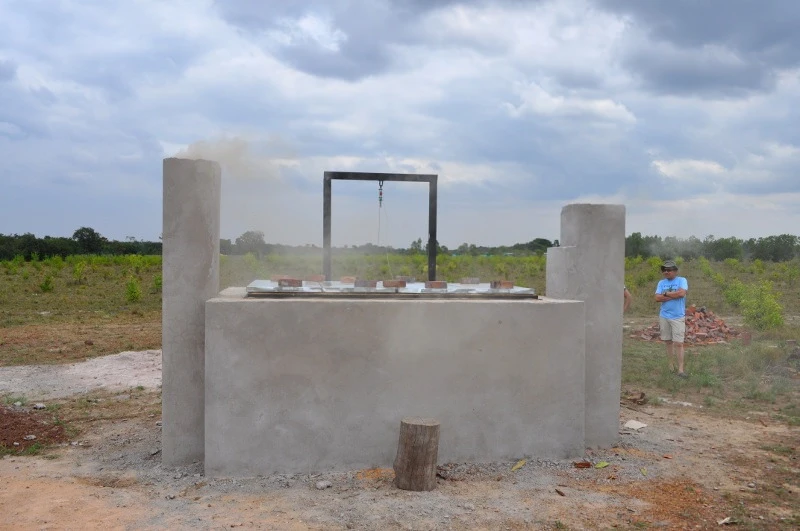
Getting the foundation right was an important first step, as there is a complex flow of gases and heat inside the biochar oven or retort.
The biochar oven not only consists of bricks and mortar, but also of metal work that has to be carefully measured and welded. The retort has to be airtight, and yet easy to open in order to fill it with biomass and to later remove the biochar after the burn has completed. The whole idea of this process is to eliminate damaging greenhouse gas emissions while making charcoal, as well as also improving the amount produced. Traditional charcoal making releases all the gases into the atmosphere and only produces 100 KG of charcoal per metric ton of biomass, whereas a biochar oven doesn´t release any greenhouse gases and produces between 350 KG to 400 KG of charcoal per metric ton of biomass.
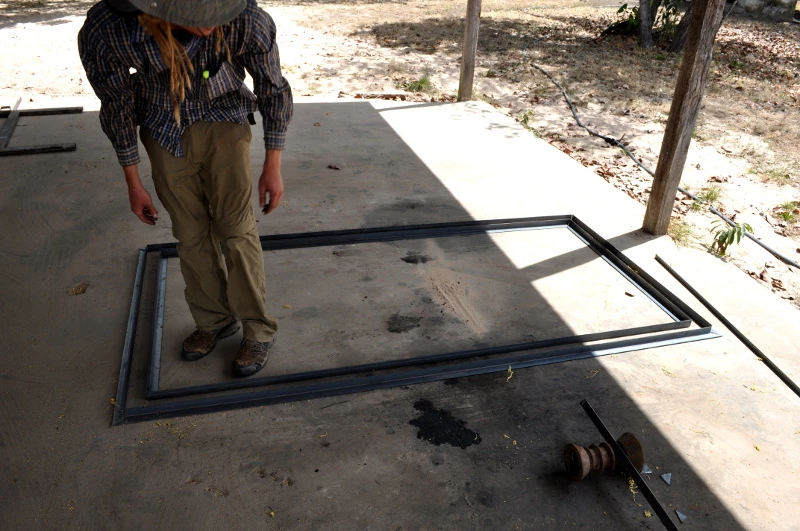
There is a lot of metal work involved in building a biochar oven or retort. One also wants to make sure it will last for many years without repairs.
We took the basic design from Chris Adams, a German designer, giving this type of biochar oven its name: the Adam´s Retort. Student interns at La Pedregoza from Eberswalde University for Sustainable Development in Brandenburg, Germany, did much of the work, with special thanks to Florian Kleinschroth for the construction phase of the project and to Renke de Vries and his brother Wilko for developing the operational protocol that will allow local people to achieve the maximum output, if they follow all of the steps we have detailed. The retort we built has a 1 metric ton capacity and uses wood from pruning and culls in our tree plantations as the chosen biomass, however it can operate with other types of biomass, such as rice husks or coconut shells.
Once this layer was finished, we embedded a 5 mm thick stainless steel sheet. The heat circulates below he sheet, allowing the charcoal to form in a low oxygen environment, hence the term pyrolysis oven.
The retort has two chimneys; one is used when the oven initially heats up. The other is used to allow the moisture in the biomass to escape in the form of steam. The heat used to drive the process is created in the fire box, which doesn’t use a lot of wood to get the process started. The entire burn becomes self-sustaining once the biomass reaches a certain temperature, at which point the gases are funnelled into the firebox and burnt off, making most of the charring process self-fuelling. The fastest results are achieved when the biomass or wood is pre-dried, as wet wood will slow down the charring process. At La Pedregoza we air-dry the biomass for three months before using it. The biomass should also be cut into small pieces before being placed in the charring chamber of the oven.
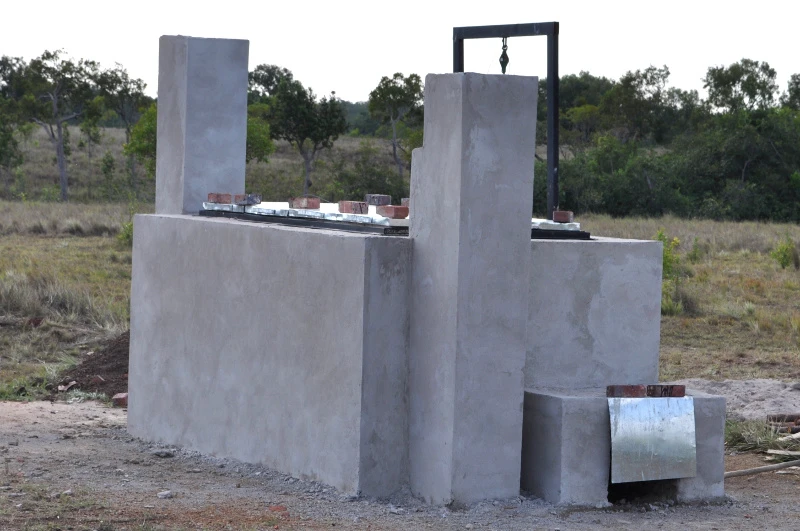
The oven is almost ready in this photo. We’re only missing the firebox door and chimney caps needed to shut the entire process down once the woody biomass is fully charcoaled, by starving it of oxygen.
The woody biomass is placed in a criss-cross pattern inside the oven, allowing the heat to penetrate everywhere. The biomass chamber is a sealed area in which the wood is converted to charcoal. We use sand or soil to seal off the lid once the oven is filled with biomass, as it can’t be burnt and is easy to find on most farms. Our retort has a double wall, with insulation between the layers, as well as an insulated lid, which allows the heat to build up quickly inside the oven. The idea is to keep the entire process simple, so that local subsistence farmers can use this type of oven without a lot of special requirements. The only way we could improve on this is if we had a metal biomass basket that was lifted in and out of the oven by a small crane, so that manual loading and unloading wouldn’t be necessary.
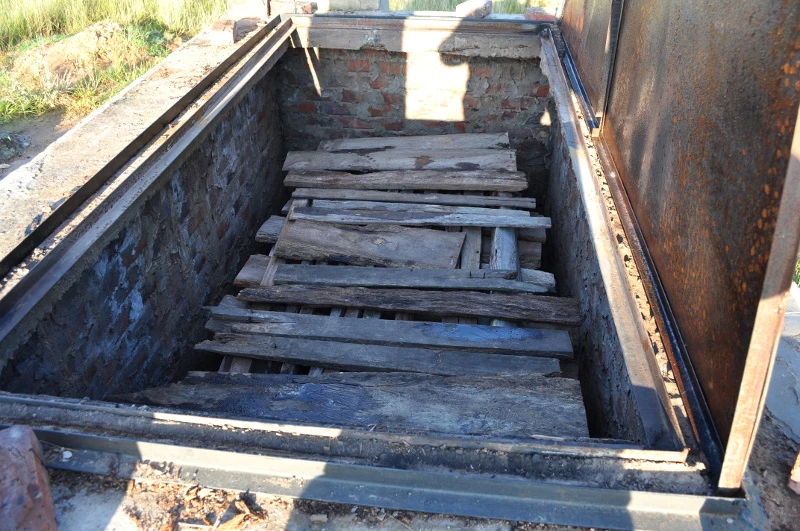
This type of biochar retort can hold up to 1 metric ton of biomass. Once the biomass has been charcoaled the weight will only be between 350 KG to 400 KG. The whole burning process takes about 12 hours
Once the burn is completed the biomass is converted to charcoal, but looks just like the wood that went into the oven. We remove the charcoal and soak it with a compost tea to extinguish any lingering embers. The pieces are put in large vinyl bags, after which we drive over the filled bags with a truck or tractor in order to crush the charcoal into little pieces, as they are better in the soil. Workers have to wear masks to protect their lungs during the unloading of the oven and the crushing of the charcoal. Next we mix the charcoal into our compost, and then we let it sit for at least 2 weeks. This converts it into biochar, ready to be added to the soil.
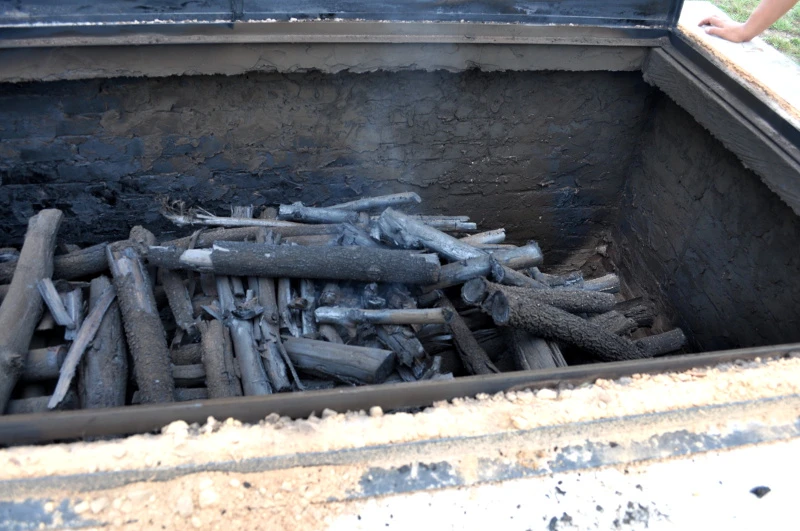
Biomass converted to charcoal in our Adam’s Retort.
So why are we doing this? Tropical soils have significant nutrient retention problems, with a high rate of lixiviation or filtration, causing organic fertilizers to leach out or to be washed down out of reach of the tree or plant. The biochar becomes a retaining agent, allowing organic material to accumulate (compost, leaves, twigs from deadfall etc.), slowly creating a layer of black soil. This phenomenon was first reported out of Brazil, where it was observed in ancient indigenous villages with soils that were way better than the areas around them. In Portuguese it is called Terra Preta or black soil, and is still working 500 years after the Europeans arrived.
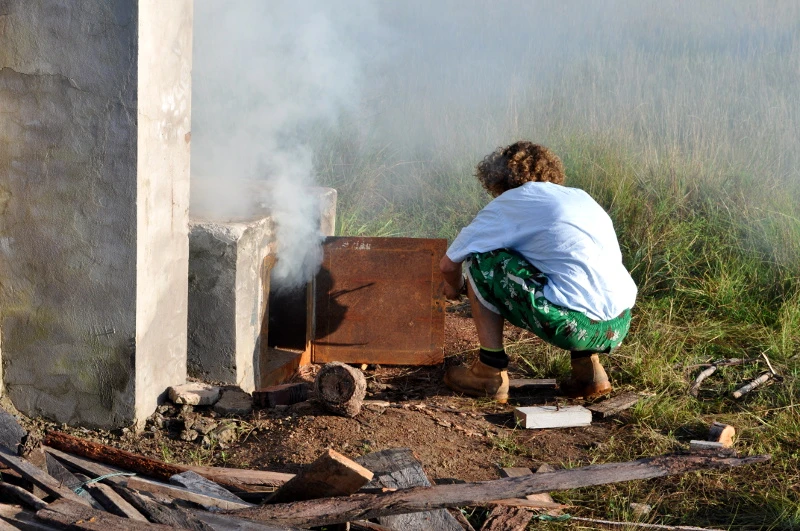
Getting the oven started is easy, though sometimes the wet season means that the wood in the firebox can be damp and it takes a couple of minutes to get things burning. The goal is to bring the oven to about 450°C to 500°C.
One of our objectives is to create an affordable and environmentally friendly method for producing biochar that local people can adopt, in order to improve their soils using readily available resources. Our La Pedregoza Environmental Corporation, a non-governmental, non-profit entity or NGO is working to hold a number of workshops and seminars in the region to promote organic practices and natural silviculture. That is why the next step in the process was to prepare a detailed protocol that can be followed by local people for best results, and also to insure the health and safety of biochar oven operators in the region.
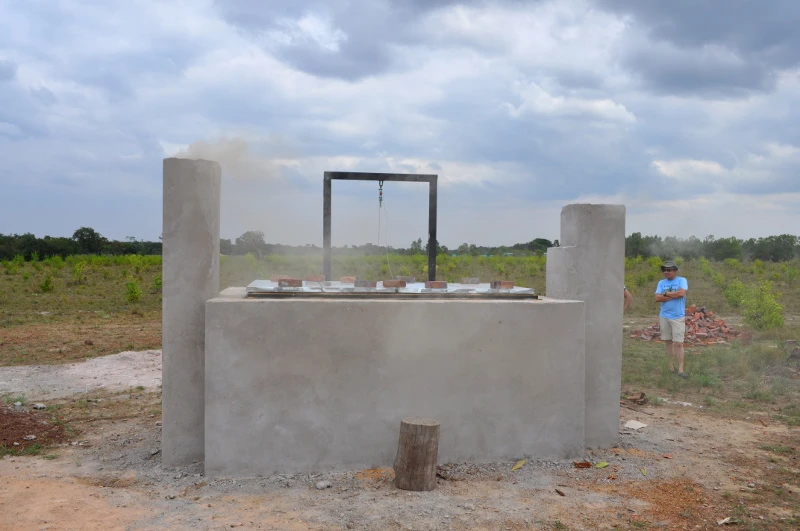
Once the smoke changes color the steam has evaporated and the charring process begins, at which point we close off the oven’s airflow.
One of the interesting facts about biochar is that once it has been placed in the soil it has a half-life of 1,000 years, which means that this is an extremely cost-effective method of amending poor soils so that they can be more productive. It also means that it helps to sustain the microfauna of the soil, which in our opinion is really important, since soil is the most biodiverse eco-system on the planet. Creating healthy soil also means that the forester or farmer has a much greater choice of possible species they can cultivate, while at the same time protecting and enhancing local biodiversity. Needless to say this is also an amazing way of sequestering carbon in the soil for centuries, as that carbon would otherwise cycle into our atmosphere in just a few short decades.
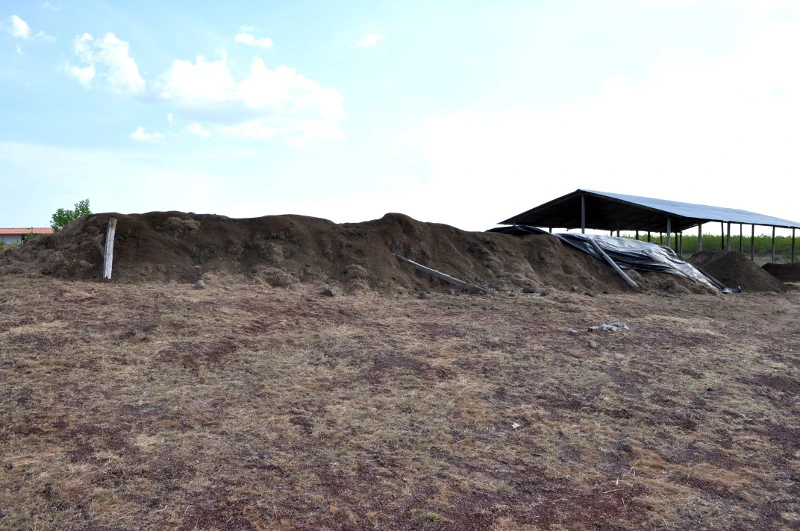
At La Pedregoza we make huge compost piles mixed with biochar in order to organically improve our otherwise poor tropical soils.
A Raymond Tinnerman Europe´s donation to La Pedregoza Environmental Corporation’s soil improvement program is a wonderful step towards our ability to help improve the livelihoods of campesinos or small farmers in the Orinoco River basin of Colombia. It is also an important contribution to our tree planting activities, which we have been carrying out together with Tree-Nation for several years now. We are calling the organic practices we are developing in the region natural silviculture. We are sure that the employees and management of A Raymond Tinnerman Europe can be very proud to have contributed to this effort with their gift. Thank you so much, we can and we will build a better world together!
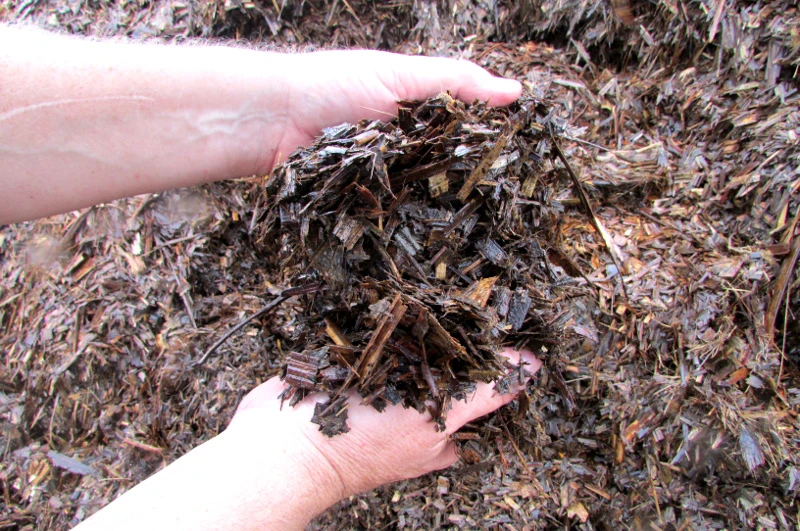
Compost made with chopped moriche palm leaves and biochar promises to make for excellent tree planting soils at La Pedregoza.
Dexter B. Dombro is one of the founders of the Corporación Ambiental La Pedregoza and of the Reserva Natural La Pedregoza in Vichada, Colombia. La Pedregoza is one of the featured plantations within Tree-Nation. Among other environmental activities Dexter is a member of the IUCN’s World Commission on Protected Areas and is dedicated to biodiversity conservation in the Orinoco River basin. The tree plantation at La Pedregoza was founded in 2007.


