How much carbon does a tropical tree sequester?

Dexter Dombro21 November 2011
By Dexter B.Dombro,
Some people have asked me what evidence there is to support the claim by CO2 Tropical Trees that the average tropical tree will sequester 22.6 kg or 50 lbs of carbon per year. First off, let me stress that this is affected by location, soil type, rainfall and species.
Having said that, most tropical trees located within 15 degrees northern and southern latitude of the equator do indeed sequester significant amounts of carbon dioxide (CO2) from the atmosphere, something that is supported by numerous studies and ongoing research. In this article I will offer some calculations in support of the efficiency of tropical plantation trees as a method of #CarbonSequestration. I will base my calculations on industry standard hectares (an area measuring 100 meters by 100 meters, or 2.47 acres) with 1,250 trees planted per hectare, later culled back to 600 trees per hectare.
In an article entitled “Carbon sequestration in tropical agroforestry systems” (1) by Alain Albrecht and Serigne T. Kandji, both of the Institut de Recherche pour le Développement, they found that the carbon sequestration potential of tropical agroforestry systems produced a median sequestration value of 95 metric tons (104 US tons) per hectare per year. Taking into account the variables of location, soil type, rainfall and species it can be as high as 228 metric tons (251 US tons) per hectare.
Assuming a median of 95,000 kg divided by 1,250 trees per hectare one would get 76 kg (167 lbs) per tree. In a managed plantation trees are often culled back to about 600 trees per hectare, which would result in 158 kg (348 lbs) per tree per year. These numbers support the cubic meter increase of woody biomass observed in growing locations with excellent conditions, which I will address later. Please note that managed plantations generally produce 20 to 30 times more wood than do natural forests, resulting in higher carbon sequestration rates per hectare.
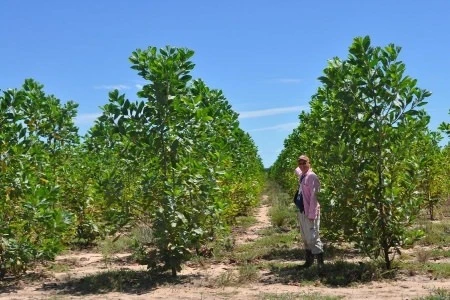
Studies cited in Science Daily (2) show that natural African tropical forests absorb about 600 kg (1,323 lbs) of carbon per hectare per year. If you take 600 kg by 25 times more wood per hectare in a plantation setting, you get 15,000 kg (33,000 lbs) per hectare per year divided by 600 plantation trees per hectare, which results in 25 kg (55 lbs) of carbon sequestered per tree per year. I should also mention that one of the species CO2 Tropical Trees plants is Acacia mangium, a recognized nitrogen fixing tree (NFT). Studies like “Greater Soil Carbon Sequestration under Nitrogen-fixing Trees Compared with Eucalyptus Species” (3) published by Ecosystems, a Springer publication, show that NFT’s sequester more carbon in the soil than do other types of tropical trees.
One problem in the literature is the vastly varying timelines on which research has been based. the Amazonia Reforestation program rely on a 10 year cycle from seed to mature tree for all of their calculations. This fact further enhances their credibility on the issue, because in the study “Carbon sequestration through afforestation: Role of tropical industrial plantations” (4), their methodology of using a 10 year cycle to maximize woody biomass growth and carbon sequestration is supported.
The article also confirms that once tropical trees reach maturity their effectiveness for carbon sequestration purposes declines. That means that using a 10 year cycle maximizes the carbon sequestration efficiency of their tropical tree plantations, with every cycle ending in harvest and followed by re-planting.
Let me cite some additional studies and methodologies. A Dutch study entitled “Estimation of Tropical Forest Biomass for assessment of Carbon Sequestration using regression models in remote sensing in Berau, East Kalimantan, Indonesia” (5) by Irvin K. Samalca, Alfred de Gier and Yousif Ali Hussin, of the Department of Natural Resources at The International Institute for Geoinformation Science and Earth Observation, confirms and shows that 50% plus of a tropical tree’s woody biomass is carbon. That means that fast growing tropical trees like those planted by CO2 Tropical Trees and Amazonia Reforestation, which reach maturity in just 10 years time, are excellent carbon storage vessels.
Let’s calculate this from a different perspective. We know from several studies that the woody biomass of a tropical tree plantation can increase by at least 35 cubic meters plus (14,382 board feet) per hectare per year. Depending on the hardwood species, one cubic meter (424 board feet) of tropical hard wood can weigh from 600 kg to 1,200 kg (1,322 lbs to 2,645 lbs). Assuming 1 hectare of trees with a gain of 35 cubic meters of
wood times a conservative average of 750 kg (1,653 lbs) per cubic meter, and you get 26,250 kg (57,871 lbs) per hectare per year. If at least half of that woody biomass is carbon, then one gets 13,125 kg (28,935 lbs) of carbon. Divide 13,125 kg of carbon by an average of 600 mature plantation trees (after culls) and one gets 22.6 kg (50 lbs) per tree, the number used by CO2 Tropical Trees. There is a table in my free download Acacia mangium e-book (6) as well as a useful table regarding the weight of cubic meters of wood at the Computer Support Group’s website (7).
CO2 Tropical Trees is actually relying on the most conservative estimates of carbon sequestration for its carbon neutral program. They are not alone in relying on those numbers. For example, Carbonify.com (8) has a carbon calculator that is based on 22.6 kg or 50 lbs of carbon per tropical tree per year.
Another typical example is the article published by James Post (9), citing a 2005 study in Wikipedia that uses 22.6 kg or 50 lbs of carbon sequestration per tropical tree per year for the purpose of calculating carbon offsets. In conclusion all I can say is that every time someone funds the planting of a tropical tree with Amazonia Reforestation, the very least they can expect from that tree is 22.6 kg or 50 lbs of carbon sequestered per year from our atmosphere.
Given these facts and numbers people and institutions really don’t have any more excuses for not funding tree planting as an obvious partial solution to climate change.
Dowload this article in pdf
---------
(1) http://www.sciencedirect.com/science/article/pii/S0167880903001385
(2) http://www.sciencedaily.com/releases/2009/02/090218135031.htm
(3) http://www.springerlink.com/content/7amlb75y8x0ku66n
(4) http://www.jstor.org/pss/4314486
(5) http://www.a-a-r-s.org/acrs/proceeding/ACRS2007/Papers/PS2.G2.3.pdf
(6) http://www.myreforestation.com/downloads/Acacia mangium e-book.pdf
(7) http://www.csgnetwork.com/specificgravwdtable.html
(8) http://www.carbonify.com/carbon-calculator.htm
(9) http://www.caribpro.com/Caribbean_Property_Magazine/index.php?pageid=175
Leave a comment
No results to show


Terms of Use·Terms of Service·Privacy policy·Cookies policy··Copyright © 2006 - 2026 Tree-Nation NEOVEE SOLUTIONS, SL