
Purchasing the seeds and polythene tubes is normally made from known dealers like Tanzania tree seed agency (TTSA) and Amboni plastics respectively. TTSA offers important consultation in case the seed in demand is newly introduced to the region. Further information about the seeds to be bought is provided by Tanzania forest research institute (TAFORI) which has also a branch in the Western Usambara.Additional consultation may also be deduced from local Agricultural universities such as Sokoine University of Agriculture (SUA) and University of Dar es Salaam through departments of Forestry studies and applied agricultural science. Researches and prio projects reports are as well in count to back up what is to be implemented. If farmers in the villages are integrated in the project, certain officialdom has to be followed. The district Agricultural department falls in and extension officers have to approve the integrations.
Sometimes instead of buying expensive seeds for some species, a particular Nature reserve authorizes collection of younger saplings growing in the forest. They are taken care of before being transplanted to the target sites. This is easy for species like Croton megolocarpus, Podocarpus usambarensis, Markhamea lutea, Ficus sir and Ficus thorningii. Collecting these saplings instead of sowing seeds has two major advantages, first cutting down the germination time, secondly offering super field performance due similar environment.
When all necessary needs and facilities get set the next step is tree nursery (s) establishment.A tree nursery establishment has the following basic steps (Only for seed sowing nurseries).
a) Seeds inspection. All unhealthy seeds are removed and destroyed.
b) Site selection and germination beds preparation (moist, free from soil predators and enough light)
c) Seeds sowing and watering. Covering the seed bases by dry leaves and cages to restrict sunlight intensity which may affect germinating seeds or the heat intolerant growing plants.
d) Nursery management (Growth management; controlling water and roots growth, use of fertilizers and proper positioning for air and light)
e) Transplantation.
Every activity in the tree nursery has to be handled carefully since it is where the general plant quality starts. Before sowing the seeds, ash may be spread throughout the germination beds to prevent them from termites and harmful ants (only in termite or ant friendly soils).
After the planting sites are surveyed, confirmed and mapped hired planting supervisors visit the communities adjacent for awareness creation and project introduction. This goes with conducting meetings in villages. Numbers of the people to be involved and other necessary information are also communicated. Needed casual workers are let to prepare their tools and get ready for work at least a week before. The very first exercise is strips making (slashing a two meters wide Streep from one point to the end) and holes digging especially if the exercise has to be in Natural forests. Holes are dug either a few days before rain, at least four to five days or in the early days when it starts. Round holes have to measure a foot deep and diameter to be able to keep enough moisture for the new plant to survive during dry seasons. Commonest spacing between holes are either 3M X 3M requiring 960 trees per hector or
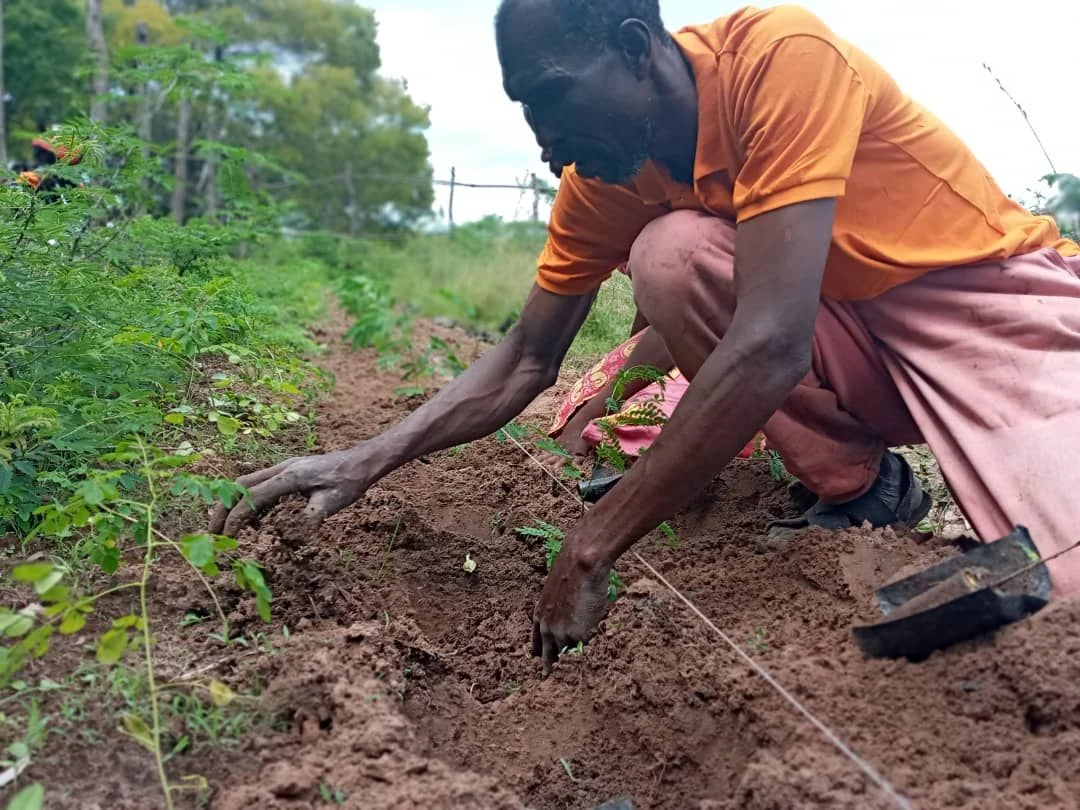
2.5m X 2.5M which makes a total of 1111 trees per hector. When the site is ready for planting saplings are sorted, counted and transported to either the exactly site or an area closer depending on proximity. While saplings are unloaded from the vehicles damage assessment and recounting are also made. Planters must be supervised not to rash the exercise since any damage to roots, stems or leaves may affect the plant normal growth and eventually survival rate. While planting the wrapping polythene piece (usually a plastic material) should be cut off the compacted soil then recycled or destroyed in the end of planting exercise. The lower part should be inserted in the hole without damaging the nursery soil or roots.
Covering soil should be pressed around the lower part of the stem to reduce soil air which has roots decaying implication. Two to three inches of the upper part of the hole is left uncovered to easily trap some running rain water which sinks for later plant uses.


