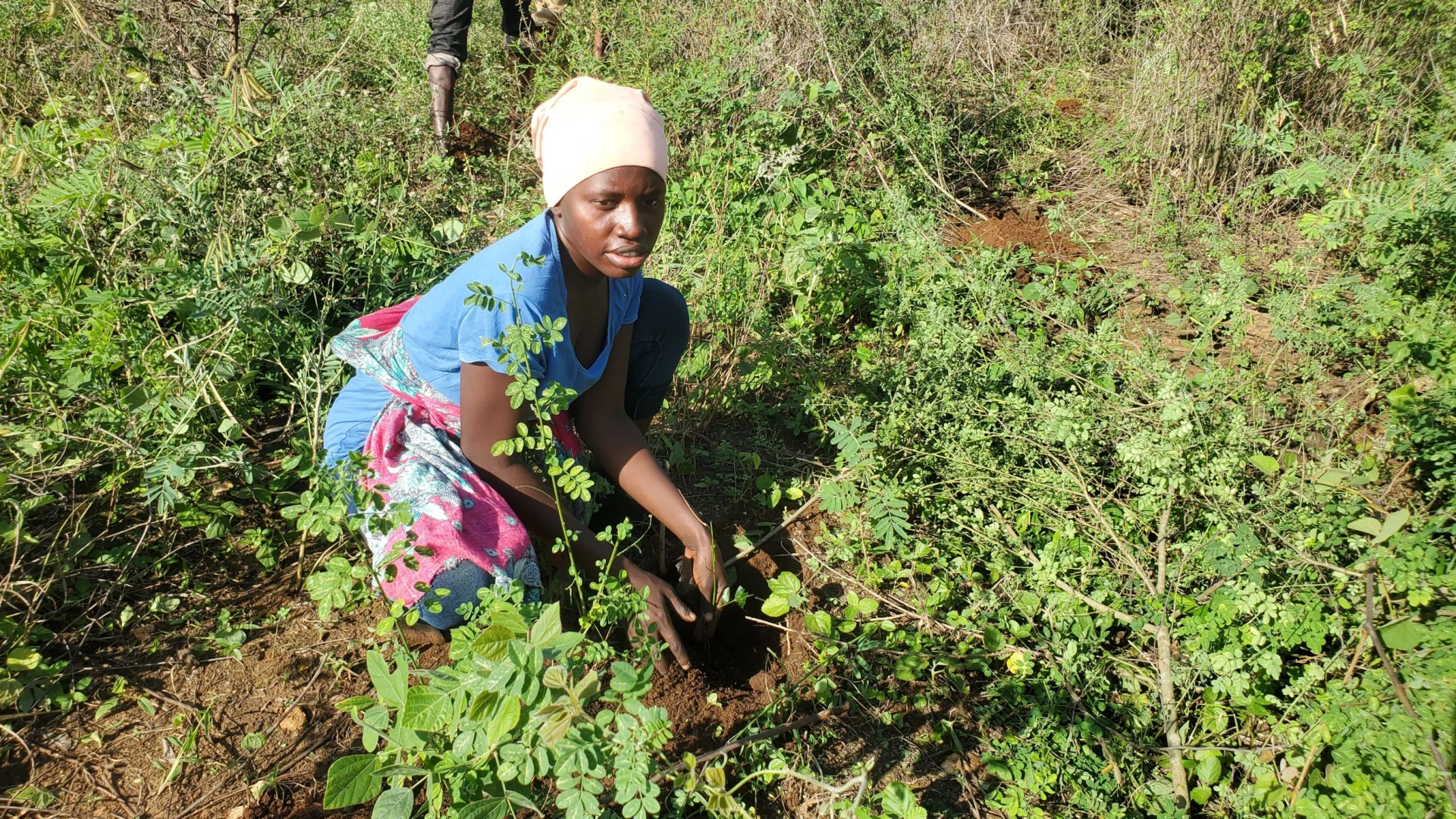

The planting process has the following four steps before a tree is left to grow on its own in the wild.
Funding and purchases
Based on local operation experience when project proposal and budget are agreed and approved by parts the next step is laying down guiding conditions which stipulate all important terms. Depending on what the agreement says, the beneficiary expects the first sum as a following step. The moment it gets delivered follows a meeting that involves the organization director (s) and the proposed project management team under a planting manager (PM). The PM collects all sub departmental written project needs including nursery infrastructures/facilities/equipment, seeds/seedlings, soils, polythene tubes, outsourced consultation and transportation. Since 50% of the tree planting fund is always directed to support unable groups such as school children, intended schools are informed to get the lists done at this stage.
These fragments of the budget are usually formed after deep analysis and market survey by trusted representatives. Backed up with pro forma invoices, the finance approves needed amounts to the dealers and suppliers.
Primary preparations
The purchasing of seeds, soil, manure, sand and polythene tubes is normally made with consultation from known dealers like the Tanzania tree seed agency (TTSA) and Amboni plastics respectively. TTSA offers important extra consultation in case the seed in demand is newly introduced to the region. Further information about the seeds to be bought is provided by the Tanzania forest research institute (TAFORI) which also has a branch in the Western Usambara. Additional consultation may also be deduced from local universities such as Sokoine University of Agriculture (SUA) and University of Dar es Salaam through the departments of Forestry studies and Applied agricultural science. Research and prio project reports are as well in count to back up what is to be implemented. When farmers in villages are integrated in the project, certain administration has to be followed. The district Agricultural Department falls in and extension officers have to approve and work hand in hand in the process.
Sometimes, seeds and saplings are collected from nearby forests for some species, forest reserves authorize the collection of younger saplings and seeds growing in the shade in the forest. This is normally done within Nilo nature reserve, Amani nature reserve, Magamba Nature reserve and Shengena in the Kilimanjaro region. They are taken care of before being transplanted to the target sites. Some species easily collected through this process include Croton megolocarpus, Podocarpus usambarensis, Markhamea lutea, Ficus sir and Ficus thorningii. Sometimes, collecting already growing saplings instead of sowing seeds has two major advantages. Firstly, cutting down the germination time, secondly offering super field performance due similar environment.
Nursery set up
When all necessary needs and facilities get set the next step is tree nursery (s) establishment. A tree nursery establishment has the following basic steps (Only for seed sowing nurseries).
a) Seeds inspection. All unhealthy seeds are removed and destroyed.
b) Site selection and germination bed preparation (moist, free from soil predators and enough light)
c) Seeds sowing and watering. Covering the seed bases by dry leaves and cages to restrict sunlight intensity which may affect germinating seeds or the heat intolerant growing plants.
d) Nursery management (Growth management; controlling water and roots growth, use of fertilizers and proper positioning for air and light)
e) Transplantation.
Every activity in the tree nursery has to be handled carefully since it is where the general plant quality starts. Before sowing the seeds, ash may be spread throughout the germination beds to prevent termites and harmful ants (only in termite or ant friendly soils) to settle in the soil.
Planting preparations
When the planting sites are surveyed, confirmed and mapped hired planting supervisors visit the communities adjacent for awareness creation and project introduction. This goes with conducting meetings in villages. Numbers of the people to be involved and other necessary information are also communicated. Needed casual workers are let to prepare their tools and get ready for work at least a week before. The very first exercise is strips making (slashing a two meters wide strip from one point to the end) and the digging of holes especially if the exercise has to be in natural forests. Holes are dug either a few days before rain, at least four to five days or in the early days when it starts. Round holes have to measure a foot deep and diameter to be able to keep enough moisture for the new plant to survive during dry seasons. Commonest spacing between holes are either 3M X 3M requiring 960 trees per hectare or
2.5m X 2.5M which makes a total of 1111 trees per hectare. When the site is ready for planting, saplings are sorted, counted and transported to either the exact site or an area close to the site depending on the proximity. While saplings are unloaded from the vehicles, damage assessment and recounting is also done. Planters are supervised not to rush the exercise since any damage to roots, stems or leaves may affect the plant's normal growth and eventually its survival rate. While planting the wrapping polythene piece (usually a plastic material) should be cut off the compacted soil then recycled or destroyed in the end of planting exercise. The lower part should be inserted in the hole without damaging the nursery soil or roots. Covering soil should be pressed around the lower part of the stem to reduce soil air which makes roots decay. Two to three inches of the upper part of the hole is left uncovered to easily trap some running rain water which sinks for later use.
Tending and monitoring.
These are essential tasks which can reveal the output level and efficiency of the original work. They are the last activities.
TENDING
In natural forests, indigenous species grow slower compared to alien pioneer weeds and tree species. This necessitates a quick open up for enough light and air to reach the newly planted trees. Tending is scheduled three times every twelve months. Athough the first round should be between 60 to 90 days after planting. Other monitoring works such as picturing and GPS tracking can still be carried out as required. It’s during the tending when survival and growth rate can be determined after which a replacement schedule can be placed. Normally, replacing saplings are termed at 10% to 15% of the total trees planted.
MONITORING
Depending on the parts agreementm, tracing and recording of the trees growing are assisted by technology (using Apps and software) such as Tree tracker, Plain meter, Green stand and ODK or physical visit reports just accompanied by photos and video footage. Hardship in monitoring is usually experienced if one or multiple of the following are encountered;Vastness of the planting site, the use of different spacing parameters on one site, poor site preparations, remoteness of the sites vs internet demanding software, accessibility and bad weathers.
These challenges become acute to parts intending to plant huge load in a short time without well trained, experienced and prepared crew. In mountainous and rocky areas like Usambara, Udizungwa, Pare and most parts of the Southern highlands of Tanzania, planters have to creep through steep slippery thorny bushes to find growing trees to report. This is tremendously discouraging, especially for the younger unexperienced field workers. A solution for this can be splitting any bigger areas into portions of 2 to 3 hectares to which certain workers can be assigned.
With an idea to portion vast sites into workable portions, the exercise will be smooth and transparent. Suppose 320,000 trees planted in 288ha are to be tracked, the first thing can be dividing the site into 2ha portions. When divided a total of 144 pieces of 2ha each will have to be worked on. To trace 2220 trees in two hectares, one makes an average of 5,550 normal walking steps which is close to 5.6 km. If a step takes 2 seconds and a tree takes 5 seconds to be pictured, a tracer will need a total of 6 hours to complete the daily work at no pressure. In this region, a forest tour guide walks an average distance of 20 km in 8 hours. In that sense it is quite suggestive that a well screened tree tracer equipped with ‘Green stand app’ can visit up to 2220 trees in a day. Therefore 320,000 trees in 288 ha will require 12 tree tracers to visit them all in a maximum of one week and five days.
To control fatigue which may be caused by frequent travels from town to the sites in the twelve days of monitoring, tree tracers can camp in nearby villages. Camping closer to the working area will also raise a sense of responsibility and commitment.


