Plant to Stop Poverty

Plant to Stop Poverty

TZ Tanzania

78.8  Quality Score 

Our project helps rural communities adopt agroforestry to combat poverty and the effects of climate change. This approach secures food and income while restoring and protecting forests through tree planting. With experience planting over 1,230,000 trees in different districts, we bring proven expertise to these initiatives.

3,177,110Trees funded of 3,992,865
318,154 TCO2 captured
64,048Followers
Plant from 0.35 €
615 updates
April 2022

Establishment of successful organic agroforests requires a careful selection and planning of companion plants. Each plant value and potential towards others should deeply get assessed, understood and rightly exploited. Tephrosia vongelii “fish bean” is a herb native to tropical Africa

 See more
28 Apr 2022

Agroforests the community design apply simple technologies to ensure reasonable trees and crops diversities to fight both poverty and deforestation. Each farmer uses cheap and easily accessible farm tools to achieve the most out of what we do to support.

27 Apr 2022

Artocarpus heterophyllus (Jack fruit plant) a tropical fruit tree belonging to family moraceae rich in vitamin A and C and anti-oxidants. Carotenoids present in the fruit are associated with higher performance in prevention of several cancer types. The tree is strategically included

 See more
23 Apr 2022

Citrus aurantifolia (Lime tree) bearing nutritious fruits for the farmers we are supporting. This is an impact PSP is having to our community, we expect much more in terms of both environmental conservation and social-economic empowerment.

21 Apr 2022

Being a process, trees to grow need to undergo a couple of stages. They may differ depending on tree types and purpose they save though most of the nursery bed properties are identical in early stages. In medieval periods for fruit trees branching management and grafting or budding

 See more
19 Apr 2022

Syzygium cuminii (Black plum tree) is well stocked in our tree nurseries ready for distribution in a few days to come. The tree reaches up to 30 meters high and can live up to 100 years in the field. Raw fruits are 80% water 19% carbohydrates and 1 % protein. The fruit contains a

 See more
16 Apr 2022
Khalifa Mganga · 17 April 2022

عزيزي السيد شكرا لك على التحيات والدعم

Seyed Ghorabi · 17 April 2022

خیلی زیبا هستند این درختان و هر چی بیشتر بکاریم هوای سالم‌تری خواهیم داشت

Every activity in the tree nursery has to be handled carefully since it is where the general plant quality starts. Before sowing the seeds ash may be spread throughout the germination beds to prevent them from termites and harmful ants (only in termite or ant friendly soils).

15 Apr 2022

The first beneficiaries are the countryside isolated villagers who directly participate from nurseries activities to tree planting and tending. The project activities directly contribute to uplifting of the rural family health and economies.

12 Apr 2022

As we encourage smart agriculture for climate change resilience a couple of simple Forest garden technologies to maximize quality and productivity are applied. In the video is mulching a technique applied to preserve moisture, speeding up enzymatic processes to improve soil quality,

 See more
10 Apr 2022
Khalifa Mganga · 23 April 2022

That is so great to hear Gloria!.. thank you so much for following and feedback.

Gloria · 23 April 2022

I learned about the mulching technique recently and it seems to me to be one ...

The most joyful moment is when a farmer starts enjoying trees first produce. Expectation for much more from the trees in the near future makes their endless smile. On photo is one of the beneficiary farmers enjoying papaya produce which will support both family food and income.

08 Apr 2022

Mangifera indica (Mango plants) growing nicely in Mnyuzi tree nursery. In next few weeks they will get grafted then offered to farmers to plant in their farmlands during this rain season.

07 Apr 2022

We use every untapped opportunity a tree can provide to empower the central part of forests’ conservation, the local people. Apart from offering delicious and nutritive fast food to the people Mangifera indica (Mango tree held on photo) are proved to be the best and quick to revive

 See more
06 Apr 2022

Destructive monoculture inherited over time has badly impacted forest parts by turning them to semi desert in most parts of Tanzania.
This is due to missing alternatives for people to earn living in rural areas.
Through PSP engagement, we hope to replant every lost tree to restore

 See more
04 Apr 2022
Khalifa Mganga · 6 April 2022

Dear Sue, thanks to you for such a valuable contribution and support to our c...

SueM · 6 April 2022

I am delighted to say I was able to buy some trees for your project today 😊🌳

Khalifa Mganga · 5 April 2022

Hello Sue, 
Countless apologies for what you are facing, the challenge is...

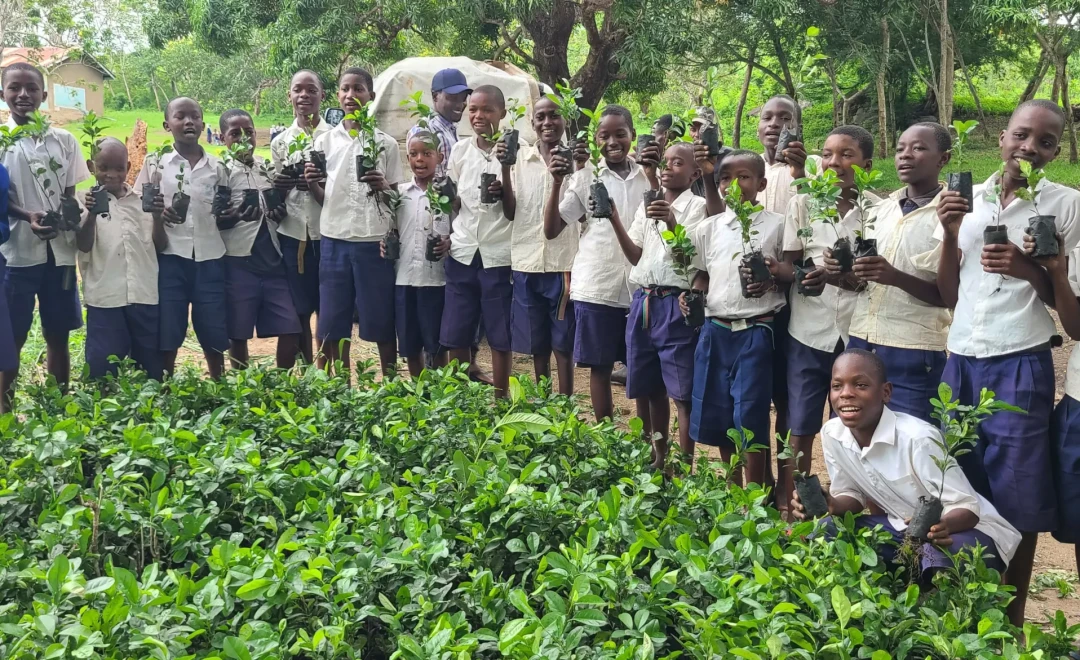
We have started distributing agroforestry fruit trees to farmers an exercise that goes with rehabilitation of natural forests’ cleared parts.
Villagers are super excited to receive fruit trees for their farms.
Right now, anything to offer them for either Easter or Ramadhani festivals

 See more
03 Apr 2022

Additional agroforestry techniques we include during PSP implementation are neem making (organic pesticide), compost making and companion cropping to protect the grafted trees and crops from pests and diseases.
Today our nursery counter hits to thousands of grafted mango saplings

 See more
01 Apr 2022
Khalifa Mganga · 3 April 2022

Hello Sue, 
Thank you so much for the support and  feedback. 
Could y...

SueM · 1 April 2022

I tried to buy some trees today, but for some reason the site froze!Hopefully...