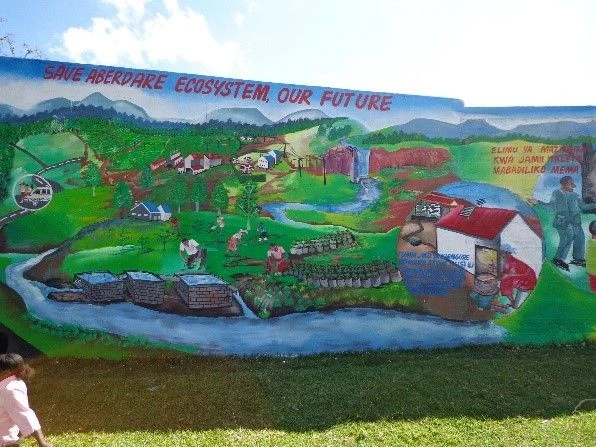

Environmental Problem Analysis relative to Aberdare Ecosystem
a) Degradation of the Aberdare ecosystem is caused by a complex and dynamic mix of driving forces and resultant pressures. These include Increasing population, poverty levels, lack of knowledge and HIV/AIDS.
b)Rapid Population growth in the catchment community has led to increased demand for energy requirements, building materials and financial needs. This is exerting pressure on the Aberdare forest as people continue to encroach on the forest in search of more farming space, pasture, and forest resources unsustainably.
c) Destruction of the forest by forest fires, charcoal burning and encroachment by farmers leading to massive soil erosion. There is inappropriate agricultural practices leading to water pollution along the river courses
e) Lack of environmental awareness and incentives among the catchment community has negatively affected conservation efforts in the Aberdare ecosystem. In the past the forest adjacent communities were excluded from active participation in management and conservation of forests.
f)The effects of climate change have impacted negatively on the main source of income for the region which is tea and coffee .Crop failure in the highlands has pushed the catchment community to encroach on wetlands and riparian areas in search of water for irrigation and fertile soils leading to soil erosion and degradation. This has affected environmental regeneration.
g)Use of agro chemicals have led to river pollution affecting people, livestock and aquatic life downstream.
h)Uninformed site matching of blue gum/eucalyptus trees along wetlands and catchment areas has led to drying up of rivers, streams, springs and wetlands bringing untold suffering to the catchment community.
i) There are severe water shortages for both livestock and humans due to declining river flows, drying up of streams and wells. This has weakened livelihood systems in the area and brought water relate d conflicts.
j) HIV/Aids prevalence among the catchment community: The burden of HIV/AIDS continues to pose a major challenge to
-The reduced flow of water from the catchment has led to reduced flow to the important Tana hydro-electric power station and subsequent supply which ultimately slow down Kenyan economic growth.
1.5.2 Previous Community Attempts in addressing Environmental Problems
The
KSEI has brought women groups together in an intervention where they have adopted Clean cooking technologies, to help solve energy problems facing the community. Over 10,000 households have benefited from this programme that requires being up-scaled and advanced to benefit more households to create an impact and reduce wood fuel consumption in the
KSEI has planted over 500,000 indigenous trees in schools,forests and farmlands in the project area through established environmental clubs in schools through the support of Panasonic Leaf ,European union and ENO programme which KSEI is a Partner. KSEI has engaged the local community in identifying the environmental problems affecting them .
1.5.3 Effects of the Environmental Problems on Adjacent and Distant Ecosystems
§ Reduced forest cover due to unsustainable exploitation of natural resources.
There is evident decline of the tree cover in the
§ Encroachment on wetlands and riparian area
The effects of climate change have impacted negatively on tea and coffee which are the main source of livelihood for the community leading to low income. High population and urban settlement means increased demand for food. This has led farmers into horticultural-farming along rivers and wetlands leading to soil erosion and pollution due to use of agro-chemicals. There is a lot of river abstraction outside the approved regulatory framework leading to decreased water flow downstream impacting negatively on the downstream communities and aquatic life hence affecting ecological balance in the ecosystem. There is also uninformed site matching of blue gum trees along wetlands and riparian areas causing drying up of rivers, streams and springs. The invasion of riparian areas and wetlands leads to pollution and siltation of rivers due to soil erosion. This has affected aquatic and bird life in the wetlands leading to migration of birds to other adjacent ecosystems and decimation of other organisms vital in maintaining ecological balance in the affected ecosystems.
§ Limited knowledge and awareness in sustainable management of natural resources
There is capacity deficiency among the catchment community. Lack of awareness and sensitization has led to ignorance which in turn leads to unsustainable use of natural resources. Poor knowledge on site matching of tree species has resulted in Blue gum trees being planted in water catchment areas leading to drying up of water sources. A lot of streams and springs in the Aberdare ecosystem have dried up leading to human wildlife conflicts due to limited water sources. Water borne diseases such as typhoid are also common due to catchment pollution from water stagnation as springs and streams continue to dry up. The community groups, institutions and leadership require strengthening to equip them with the necessary knowledge and attitudes required to effectively manage and sustain the Aberdare ecosystem. Pollution of the environment especially related to water has led to adverse effects on animal and human health as well as the quality of the environment.
§ Climate Change Effects
Global warming resulting from carbon emissions has significantly affected the climate which in turn has reduced rainfall resulting in poor agricultural outputs and weakened livelihood systems. The limited livelihood led to encroachment of forests and wetlands hence unsustainable exploitation of forest resources. Loss of tree cover significantly reduces the vegetation cover which act as natural sinks for carbon dioxide. Deforestation has enhanced climate change and its impacts. In addition, it has resulted in increased occurrence of floods, soil erosion and drought. Some of the consequences of deforestation being experienced in the country include reduction in water and hydro-electric power supply leading increased production costs of goods and services which will ultimately slow down Kenyan economic growth. Other challenges relating to poor environmental conservation and management include global warming and climate change affecting crop yields and degrading agricultural lands; poor land use leading to land degradation and desertification, loss of water, soil infertility, poor crop yields, loss of biodiversity, reduced opportunities for livelihoods’ potential to contribute to national development.
§ Poverty
The Upper Tana Catchment is an agricultural productive area but the agricultural income is low. Factors contributing to poverty are small farm holding, population pressure, market failure of the traditional cash crops and exploitation of natural resources. Nearly 60% of the population is poor due to unfair distribution of resources where the elderly own much of the wealth leaving the younger and most productive segment of the population poor thus driving them to exploiting forest resources for income unsustainably. There is also aging farm labour as the young generation migrate to urban areas in search of jobs and education. Poor crop yields coupled with poor management of farmer cooperatives led to farmers clearing coffee bushes to give room for subsistence crops like maize and beans. This in turn leaves the soils bare hence erosion and siltation. Small land holding coupled with over exploitation and soil degradation has resulted in decreased farm yields, reduced family income and food insecurity and nutrition.
§ Population pressure
The increased population density in the
Relevance of thie project to National Development Objectives
Relevance to, and Consistency with, the Environmental Objectives
The proposed project will support
Specifically, the project proposes to enhance impact in the following areas:
a) Increasing the incomes of members of poor communities .
b) Promoting gender equality and in the empowerment of women through specific initiatives promoting women’s rights and economic empowerment.
c) Incorporating a community-based NRM strategy.
d) Adopting an integrated approach to environmental conservation and poverty reduction.
The National Climate Change Strategy, 2010 also highlights tree planting as a complimentary effort to forest restoration and conservation. The proposed project will help enhance this potential to encourage a culture of community responsibility towards the environment conservation.

