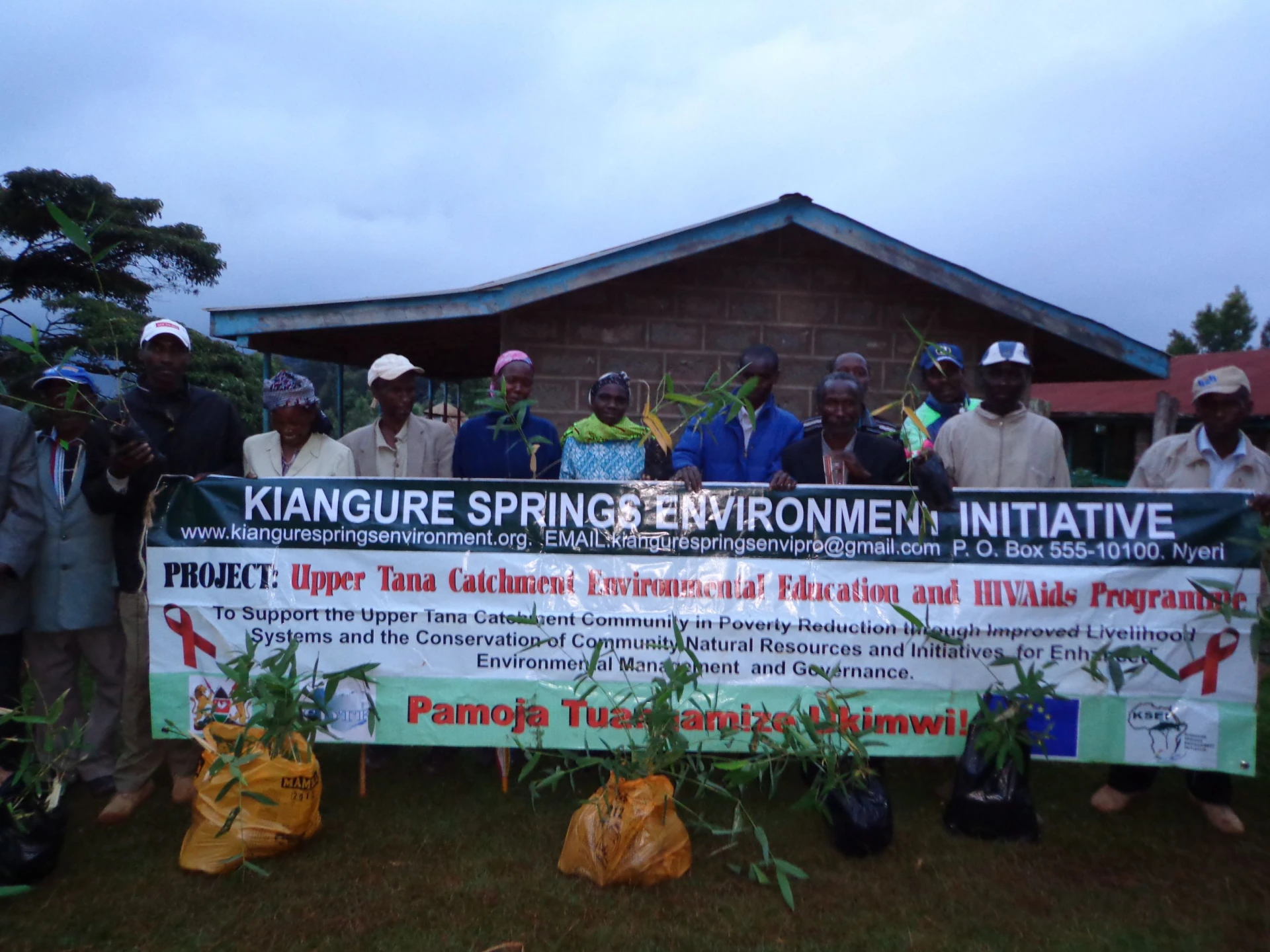

CONTRIBUTION OF TREE PLANTING TOWARDS INCREASING COMMUNITY AND ECOLOGICAL RESILIENCE IN THE ABERDARE ECOSYSTEM
The case of Kiangure Springs Environment Initiative
BACKGROUND
Kiangure Springs Environment Initiative through its forest management programme is working enhance community and ecological resilience in the Aberdare forest ecosystem in Central Kenya.
The overall objective of this programme is to support the local community in poverty reduction through improved livelihood systems and the conservation of community natural resources and initiatives for enhanced environmental management and governance.
The rationale for the project is based on the linkage between rural poverty and ecosystem health in a densely populated and environmentally fragile ecosystem of critical national and global significance. The high prevalence of rural poverty contributes to environmental degradation which in turn reduces sustainable livelihood opportunities, and creates negative environmental challenges including forest degradation, human-wildlife conflict, and reduced availability and quality of water to downstream users. Fortunately however, there are a number of opportunities for improving rural livelihoods in ways that are also beneficial for the environment.
Degradation of the natural resource base leads to low productivity and therefore low incomes. It is evident that in the project area, large segments of the poor are located where the natural resources are most degraded. In addition, the unpredictable rainfall and frequent droughts tend to undermine an already fragile resource base and have contributed to declining agricultural yields including low tea yields. Droughts in 2009 and 2011 generated food emergencies, while flooding in 2010 affected parts of the country. Together with the impact of HIV/AIDS,Climate change and Covid 19 , these factors have eroded gains in education, health, food security, employment and income and fueled conflict.
Essentially the project is working with the custodians of natural resources in the Upper Tana catchment providing them with a number of direct and indirect benefits to increase their resilience and that of the ecosystem.
The project area is the Upper Tana catchment region of Nyeri County. Project interventions will be progressively scaled up to the entire Upper Tana region of the eastern side of the Aberdare forest touching five of Kenya’s 47 counties. As one of Kenya’s five main water towers,Aberdare forest plays a critical role in supporting the national economy by providing water for Nairobi city and about half the population, and supports 55% the of the country’s hydroelectric power generation and support agriculture.
The specific objectives and achievements of the project are:
- Improve the livelihood of the Upper Tana Catchment Community through improved energy efficiency and energy switch earning carbon finance and reducing poverty through Income generation activities.
Capacities and strategies of engagement in sustainable energy conservation technologies and practices are being enhanced through training while pressure on natural resources is being reduced through increased adoption of Kiangure Improved Stove (KIS) by the catchment community. Over 50 artisans have been trained in Stove installation and fabrication and a stove fabrication and maintenance centre established.Through the donor funds the CBO have enhanced conservation of the catchment by assisting the community to adopt over 8000 stoves translating to 16,000 tonnes of carbon being sequestered with a growing potential of carbon finance and reduced indoor pollution
Households are saving money from reduced fuel use. The introduction of fish farming using the raised fishpond technology have greatly impacted on the ecosystem with most farmers moving away from the riparian land and natural forests . The incidences of water abstraction have reduced enhancing the communities downstream to have access to water, this activity have also served as a major economic activity ensuring food security. The project will steer a vibrant fish farming project to benefit from the fish processing plant constructed under the Economic Stimulus Programme (ESP) in Tetu Sub County to promote livelihood diversification. The project will also enable institutions and households adopt biogas and solar technology for sustainable waste management and renewable energy option. Biogas units have been installed in 300 households so far and construction ongoing .
This is to help urban and rural communities find long lasting socially and economically enriching solutions to reduce their energy consumption and thus ensure continued regional biodiversity and energy security for future generations. This project will concretely contribute to improving livelihoods through job creation, reduce food insecurity and contribute to combating climate change.
- Forest conservation through participatory community level awareness and capacity building for sustainable use and management of natural resource in the Aberdare ecosystem .
A community- based approach to strengthen the resilience of poor communities’ farming system in the face of climate variability and change have been initiated with Donor funding to reduce vulnerability to current climatic risks. The project has introduced adaptive activities like improved forest resource management through farm schools More appropriate agricultural practices such as agro forestry and river bank protection; rehabilitation of degraded forest ;environmental education and awareness. The project has so far planted over 500,000 trees in forests and farmlands benefitting over 2000 households and creating carbon sinks. Over 5 million trees will be planted in the ecosystem through partnerships with Donors ,the Government and local community. Participatory community level awareness has been created through environmental education in schools and farming community. So far 70 environmental clubs patrons have been trained and clubs created in 70 schools while mural art is creating awareness on the need to conserve the Aberdare forest.
The CBO has in the past been involved in community level awareness on conservation issues through painting of 30 conservation murals through partnership with partners addressing environmental issues,good governance and HIV/Aids. The grant supported activities are relieving pressure on forests and water resource by focusing on poverty reduction strategies and introducing alternative livelihood options and improved management practices in agricultural lands adjacent to the Aberdare forest while stemming the prevalence of HIV/aids through community outreaches and VCT
CONCLUSION
The livelihoods of majority of the Upper Tana Catchment community depends on rain fed small- scale farming practice highly vulnerable to the effects of climate change. Over 85 percent of the community is dependent on agriculture .Climate change is expected to increase the frequency of severe natural disasters such as drought, reduced rainfall and floods resulting in more crop failure and food shortage. Currently Kenya has a population of over 55 million with expected increase by 2050 which will exacerbate competition for land and resources. Over 70 % of the Upper Tana catchment communities rely on wood for cooking .Nyeri alone has a population of 800,000 persons with 248,050 households and a population density of 498p/km2. About 72.2% households are relying on wood for fuel while 85.2% still uses the traditional three stones for cooking. There is urgent need to integrate population issues in the fight against climate change in the Upper Tana Catchment region as this may help in building community and ecological resilience. Serious intervention in water harvesting and crop and livelihood diversification is required to increase community and ecological resilience to climate change. Vigorous distribution of improved cooking stoves is required plus Synergy inresearch efforts to clearly quantify the links between improved cook stoves/cleaner fuels and their effects on health and safety, environment, livelihoods and women’s empowerment while increasing the number of investors and resources to support the scale- up and adoption of clean cook stoves and fuels in priority markets.Massive tree planting willl be key to create the requires ecosystem balance and a sustainable furure.


