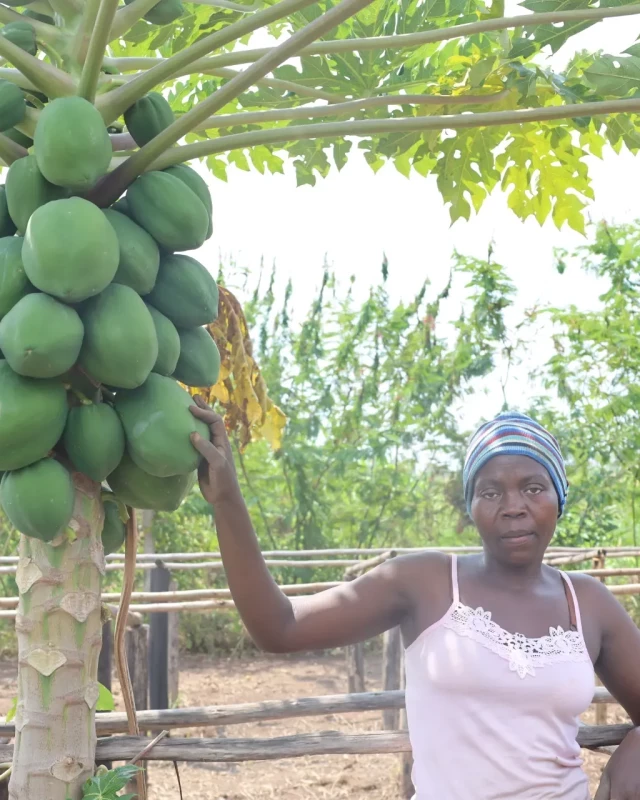
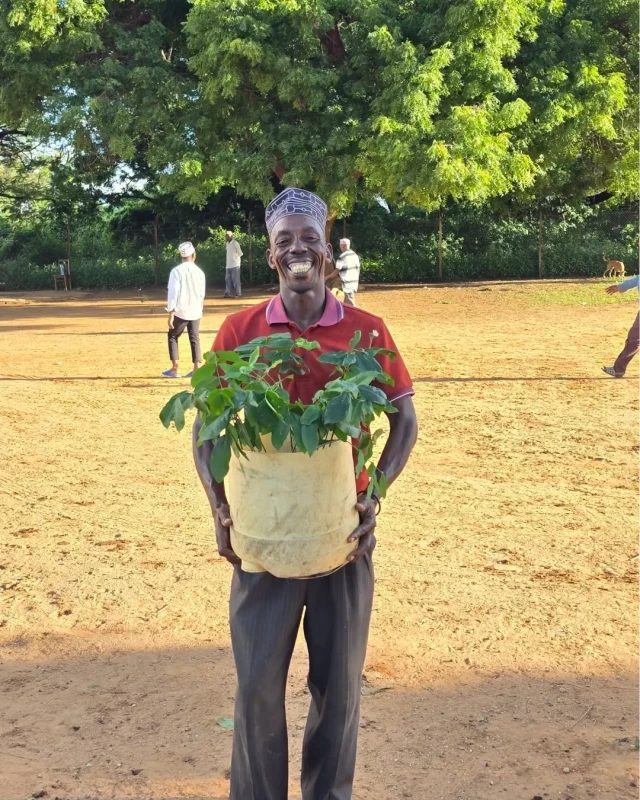
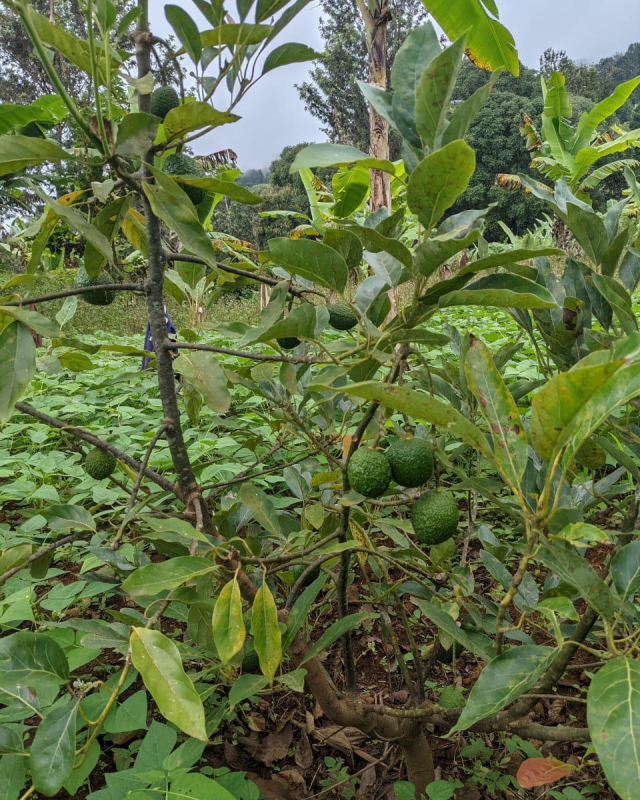
Forest Gardens is our tier for smallholder agroforestry: a certification whose primary impact is socioeconomic. Trees are planted into a family's household economy on tropical smallholdings, providing food, fodder, timber, and shade around homes and fields. Carbon accounting is capped at 250kg per tree, reflecting that these are working trees used by the household rather than left to accumulate biomass indefinitely. Plots are small and scattered, so verification uses geolocated photographic evidence rather than satellite resolution.
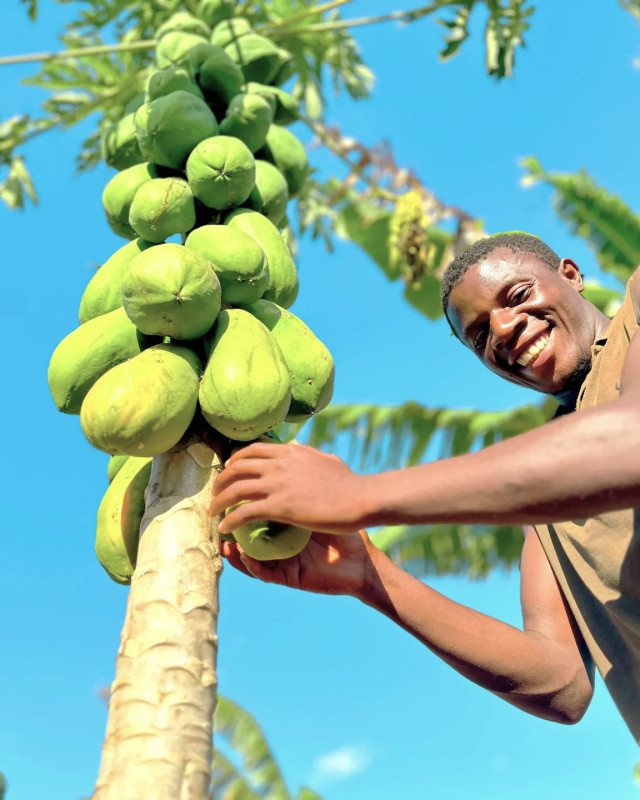
- Land
- Smallholder farmer land
- Carbon rights
- Reserved for farmers
- Verification
- Geolocated photo tracking
- Typical use
- Household agroforestry & livelihood programs
- Price
- From €0.35/tree
- Carbon captured
- Capped at 250kg ex-ante per tree
- Monitoring period
- 5 years per site from planting
- Partners
- Smallholder farmers
Impact potential
Climate change mitigation potential
The alternative to on-farm fodder and timber trees is deforestation elsewhere.
Smallholder farmers need feed for livestock and wood for construction. Without on-farm alternatives, they take these from remaining natural forest. Forest Gardens shifts that pressure onto planted, productive trees inside the farm itself, keeping wood and fodder inside the household economy and leaving the natural forest intact. Because these trees are cut and regrown through farmer use, the carbon benefit is real but bounded, which is why per-tree accounting is conservatively capped at 250kg. The scale is significant: hundreds of millions of smallholder farming households worldwide can integrate more trees into their productive systems, and the aggregate mitigation is substantial even at the capped per-tree accounting.
Climate change adaptation potential
Every tree is another layer of climate resilience for the household.
Smallholder farmers are among the world's most climate-exposed populations, and Forest Gardens plants directly into that exposure. Diverse on-farm trees stabilize the household against climate stress: shade species cool crops and livestock during heatwaves, deep-rooted species hold soil against extreme rainfall and retain moisture through drought, and food trees provide backup nutrition when annual crops fail. Because the tree portfolio is diverse across species and functions, a single climate shock does not remove the entire on-farm system. Each tree strengthens the family's ability to absorb a bad season.
Socioeconomic impact
The trees themselves are the family's food, feed, timber, and income.
Forest Gardens is designed around the household economy. Each tree serves as a productive asset: food for the family, fodder for livestock, timber for construction, and marketable products for cash income. Because the tree portfolio spans multiple functions and cycles, families diversify away from dependency on a single crop, reducing vulnerability to price shocks and seasonal gaps. Mature trees also become durable household assets, appreciating in value and passing across generations.
Biodiversity impact
More biodiversity on the farm, less pressure on the forest beyond it.
Monoculture cropland supports very little wildlife. Adding a diverse mix of trees to a smallholder farm changes that: pollinators, insects, birds, and small mammals find habitat and food sources they cannot find on open cropland. Forest Gardens does not aim to restore pristine forest on farmland. It aims to make working farms more biologically diverse, and even productive fruit or timber species serve as habitat, feeding stations, and migration stopovers for wildlife. Beyond the farm, Forest Gardens also reduces pressure on the surrounding natural forest: when families source fodder, timber, and firewood from their own trees, they do not need to take them from remaining forest, and the biodiversity of that intact forest is preserved with it.
Our Forest Gardens process
Validate planting partner
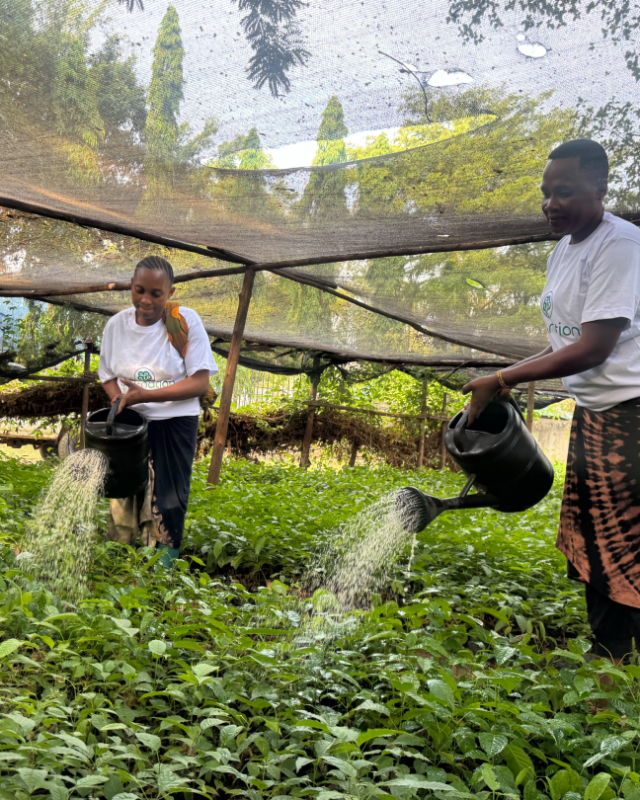
Tree-Nation finds and validates competent local partners who implement Forest Gardens projects.
Select farmers
Together with our partners, we validate farmers taking part in our program, along with the planting plan for their farm.
Co-design PDD
We create a PDD detailing the full project design from species selection to monitoring.
Planting report
We receive a planting report with geolocated photos as proof planting is completed.
Monitoring
The site is moved into monitoring with annual monitoring reports, backed by geolocated photos and survival rates.
Validate planting partner
Tree-Nation finds and validates competent local partners who implement Forest Gardens projects.
Select farmers
Together with our partners, we validate farmers taking part in our program, along with the planting plan for their farm.
Co-design PDD
We create a PDD detailing the full project design from species selection to monitoring.
Planting report
We receive a planting report with geolocated photos as proof planting is completed.
Monitoring
The site is moved into monitoring with annual monitoring reports, backed by geolocated photos and survival rates.
How carbon is measured
The same per-tree methodology. Because we calculate tree by tree rather than by hectare, a farmer planting forty trees is measured with the same rigor as a thousand-hectare project — this is what makes smallholder work fundable at all.
- Any project size, down to a single household plot
- 10-year growth cap and 500 kg per-tree hard cap
- Failure insurance applied before any claim is made
How it is verified
Every planting site is photographed with GPS coordinates and timestamps, and records list species, quantities, and dates. Plot boundaries are published, and repeat visits document survival over the monitoring period.
- Geolocated, timestamped photos
- Species and quantity records
- Repeat monitoring visits
Reporting & disclosure
Forest Gardens contributions are designed to fit biodiversity, community, and forestry frameworks that your sustainability team uses. The primary impact is socioeconomic, with carbon accounting conservatively capped at 250kg per tree.
Forest Gardens is not designed for climate offset reporting. It operates in countries where new carbon market laws now require projects used for climate reporting to go through country-specific certification and state approval processes.
Compliance would require replacing Tree-Nation's certification and methodology with external ones, at costs that would multiply the price per tree several times over. And because each country has different rules, structuring the project to fit one country's framework would force us to leave others out. We would have to price Forest Gardens several times higher and abandon geographies where smallholder communities benefit most from it today.
We kept Forest Gardens operational under Tree-Nation's certification, across all its geographies. Sponsors who need climate offset reporting should fund a Foundation or Mission project.
Whether you're required to file at all depends on your size. Post-Omnibus CSRD applies to companies with 1,000+ employees and €450M+ turnover, with the first reports for FY 2027 due in 2028. If you file, here's how Forest Gardens contributions fit each framework. If you don't file, the underlying methodology and data still back your voluntary communication credibly.
| Framework | Applies to | How Forest Gardens contributions fit |
|---|---|---|
| CDP Climate Change (Full Corporate) | Voluntary. The version used by companies with 1,000+ employees or $250M+ revenue when they respond to CDP | Not recommended for Forest Gardens. Forest Gardens does not issue carbon credits, so its CO2 impact cannot be reported as a retired credit under CDP 7.79. Sponsors wanting to disclose Tree-Nation contributions under CDP Climate Change should fund a Foundation or Mission project. |
| CDP Climate Change (SME) | Voluntary. The version available to smaller companies | Not applicable. The SME module covers internal emissions inventory, targets, and reduction initiatives only. Sponsors who want to disclose Forest Gardens contributions can opt into the Full Corporate questionnaire instead. |
| CDP Forests (Full Corporate) | Voluntary. The version used by companies with 1,000+ employees or $250M+ revenue when they respond to CDP | Answer affirmatively on Question 8.17 (supporting or implementing projects focused on ecosystem restoration and long-term protection). In Question 8.17.1, fill the fields in order. Project reference: a name for this project in the sponsor's system. Project type: Agroforestry. Expected benefits: Increase in carbon sequestration, Net gain in biodiversity and ecosystem integrity, Creation of green jobs and sustainable livelihoods, Improvement of standard of living especially for vulnerable groups, and Improvement to soil health. Is this project originating any carbon credits: Yes. Description of project: a brief summary of the project and the sponsor's contribution. Where is the project taking place in relation to your value chain: Project based elsewhere unless the sponsor has operations near the project. Start year: the planting year of the sponsor's contribution. Target year: typically 10 years from planting. Project area to date and Project area in the target year (hectares): from the estimate available on the sponsor's Tree-Nation forest. Country/Area comes from the specific project record. Latitude and Longitude: any point within the project's area in decimal degrees (WGS84) per CDP guidance, using a recent farmer geolocation coordinate. Monitoring frequency: Annually. Total investment over the project period: the amount of the sponsor's contribution. For which of your expected benefits are you monitoring progress: Increase in carbon sequestration and Creation of green jobs and sustainable livelihoods. Please explain: describe how Tree-Nation projects work, that sponsor funding is allocated across multiple planting sites over time (all publicly available), and any additional context on the project or contribution. |
| CDP Forests (SME) | Voluntary. The version available to smaller companies | Not applicable. The SME Forests module asks the sponsor to disclose the deforestation-free (DF) or deforestation- and conversion-free (DCF) status of their own commodities (timber, palm oil, cattle, soy, rubber, cocoa, coffee), not restoration financing. |
| CSRD ESRS E1: Climate | Mandatory for 1,000+ employees and €450M+ turnover. First reports for FY 2027 due in 2028 | Not recommended for Forest Gardens. Forest Gardens does not issue carbon credits, so its CO2 impact cannot be substantiated as a quantified climate contribution under ESRS E1. Sponsors wanting to disclose Tree-Nation contributions under ESRS E1 should fund a Foundation or Mission project. |
| CSRD ESRS E4: Biodiversity | Mandatory for 1,000+ employees and €450M+ turnover. First reports for FY 2027 due in 2028 | Under Paragraph 28, disclose Forest Gardens as a biodiversity restoration action (Tree-Nation does not currently issue biodiversity offsets or credits). Describe the action (smallholder agroforestry integrating trees into farm households for food, fodder, timber, and cash income), local knowledge incorporation via farmer-led species selection reflecting household needs and local ecology, and nature-based solutions applied (Paragraph 28c). Sponsors may optionally add KPIs (trees planted per farm, species diversity, on-farm biodiversity uplift, and reduced pressure on surrounding natural forest), financing effects (direct sponsor contribution flowing through local intermediary partners to smallholder households, indirect farmer benefits through diversified income, food security, and improved soil health), and Forest Gardens methodology as the framework applied. |
| CSRD ESRS S3: Affected Communities | Mandatory for 1,000+ employees and €450M+ turnover. First reports for FY 2027 due in 2028 | Under Paragraphs 30-38, disclose: affected communities as smallholder farmer households hosting the trees on their farms, and the rural communities they live in; positive impacts including diversified household income from tree products (food, fodder, timber, cash crops), food security through fruit trees and expanded production, reduced dependence on natural forest for household needs, improved soil health on farms, and durable household assets that pass across generations; financing effects as the sponsor's contribution flowing through local intermediary partners to smallholder households; tracking through farmer engagement and participation records that Tree-Nation maintains together with local intermediary partners. |
| VSME | Voluntary for SMEs | Describe your Forest Gardens contribution in the Practices and Initiatives narrative (B2 in the Basic Module, or expanded in C2 in the Comprehensive Module). VSME is a simplified voluntary standard and does not include a quantified climate contribution slot. |